

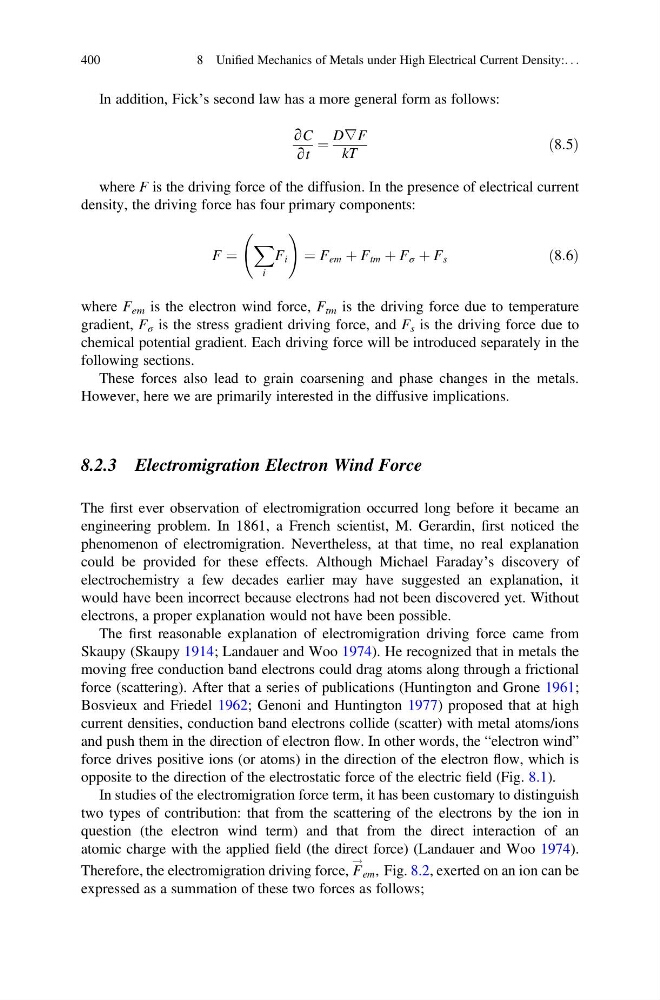
In addition, Fick’s second law has a more general form as follows:
∂C
∂t
¼
D∇F
kT
ð8:5Þ
where F is the driving force of the diffusion. In the presence of electrical current
density, the driving force has four primary components:
F ¼
X
i
F i
!
¼ F em þ F tm þ F σ þ F s
ð8:6Þ
where F em is the electron wind force, F tm is the driving force due to temperature
gradient, F σ is the stress gradient driving force, and F s is the driving force due to
chemical potential gradient. Each driving force will be introduced separately in the
following sections.
These forces also lead to grain coarsening and phase changes in the metals.
However, here we are primarily interested in the diffusive implications.
8.2.3 Electromigration Electron Wind Force
The first ever observation of electromigration occurred long before it became an
engineering problem. In 1861, a French scientist, M. Gerardin, first noticed the
phenomenon of electromigration. Nevertheless, at that time, no real explanation
could be provided for these effects. Although Michael Faraday’s discovery of
electrochemistry a few decades earlier may have suggested an explanation, it
would have been incorrect because electrons had not been discovered yet. Without
electrons, a proper explanation would not have been possible.
The first reasonable explanation of electromigration driving force came from
Skaupy (Skaupy 1914; Landauer and Woo 1974). He recognized that in metals the
moving free conduction band electrons could drag atoms along through a frictional
force (scattering). After that a series of publications (Huntington and Grone 1961;
Bosvieux and Friedel 1962; Genoni and Huntington 1977) proposed that at high
current densities, conduction band electrons collide (scatter) with metal atoms/ions
and push them in the direction of electron flow. In other words, the “electron wind”
force drives positive ions (or atoms) in the direction of the electron flow, which is
opposite to the direction of the electrostatic force of the electric field (Fig. 8.1).
In studies of the electromigration force term, it has been customary to distinguish
two types of contribution: that from the scattering of the electrons by the ion in
question (the electron wind term) and that from the direct interaction of an
atomic charge with the applied field (the direct force) (Landauer and Woo 1974).
Therefore, the electromigration driving force, F
!
em , Fig. 8.2, exerted on an ion can be
expressed as a summation of these two forces as follows;
400
8 Unified Mechanics of Metals under High Electrical Current Density:. . .
∂C
∂t
¼
D∇F
kT
ð8:5Þ
where F is the driving force of the diffusion. In the presence of electrical current
density, the driving force has four primary components:
F ¼
X
i
F i
!
¼ F em þ F tm þ F σ þ F s
ð8:6Þ
where F em is the electron wind force, F tm is the driving force due to temperature
gradient, F σ is the stress gradient driving force, and F s is the driving force due to
chemical potential gradient. Each driving force will be introduced separately in the
following sections.
These forces also lead to grain coarsening and phase changes in the metals.
However, here we are primarily interested in the diffusive implications.
8.2.3 Electromigration Electron Wind Force
The first ever observation of electromigration occurred long before it became an
engineering problem. In 1861, a French scientist, M. Gerardin, first noticed the
phenomenon of electromigration. Nevertheless, at that time, no real explanation
could be provided for these effects. Although Michael Faraday’s discovery of
electrochemistry a few decades earlier may have suggested an explanation, it
would have been incorrect because electrons had not been discovered yet. Without
electrons, a proper explanation would not have been possible.
The first reasonable explanation of electromigration driving force came from
Skaupy (Skaupy 1914; Landauer and Woo 1974). He recognized that in metals the
moving free conduction band electrons could drag atoms along through a frictional
force (scattering). After that a series of publications (Huntington and Grone 1961;
Bosvieux and Friedel 1962; Genoni and Huntington 1977) proposed that at high
current densities, conduction band electrons collide (scatter) with metal atoms/ions
and push them in the direction of electron flow. In other words, the “electron wind”
force drives positive ions (or atoms) in the direction of the electron flow, which is
opposite to the direction of the electrostatic force of the electric field (Fig. 8.1).
In studies of the electromigration force term, it has been customary to distinguish
two types of contribution: that from the scattering of the electrons by the ion in
question (the electron wind term) and that from the direct interaction of an
atomic charge with the applied field (the direct force) (Landauer and Woo 1974).
Therefore, the electromigration driving force, F
!
em , Fig. 8.2, exerted on an ion can be
expressed as a summation of these two forces as follows;
400
8 Unified Mechanics of Metals under High Electrical Current Density:. . .