

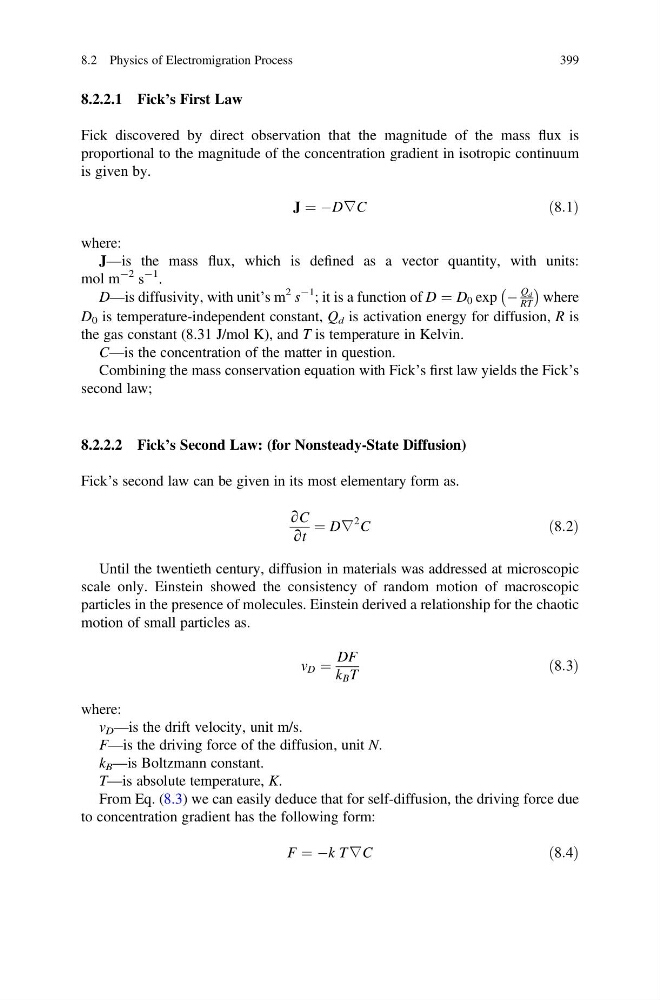
8.2.2.1 Fick’s First Law
Fick discovered by direct observation that the magnitude of the mass flux is
proportional to the magnitude of the concentration gradient in isotropic continuum
is given by.
J ¼ ÀD∇C
ð8:1Þ
where:
J—is the mass flux, which is defined as a vector quantity, with units:
mol m
À2 s
À1 .
D—is diffusivity, with unit’s m
2 s
À1 ; it is a function of D ¼ D 0 exp À
Q d
RT
À
Á
where
D 0 is temperature-independent constant, Q d is activation energy for diffusion, R is
the gas constant (8.31 J/mol K), and T is temperature in Kelvin.
C—is the concentration of the matter in question.
Combining the mass conservation equation with Fick’s first law yields the Fick’s
second law;
8.2.2.2 Fick’s Second Law: (for Nonsteady-State Diffusion)
Fick’s second law can be given in its most elementary form as.
∂C
∂t
¼ D∇
2 C
ð8:2Þ
Until the twentieth century, diffusion in materials was addressed at microscopic
scale only. Einstein showed the consistency of random motion of macroscopic
particles in the presence of molecules. Einstein derived a relationship for the chaotic
motion of small particles as.
v D ¼
DF
k B T
ð8:3Þ
where:
v D —is the drift velocity, unit m/s.
F—is the driving force of the diffusion, unit N.
k B —is Boltzmann constant.
T—is absolute temperature, K.
From Eq. (8.3) we can easily deduce that for self-diffusion, the driving force due
to concentration gradient has the following form:
F ¼ Àk T∇C
ð8:4Þ
8.2 Physics of Electromigration Process
399
Fick discovered by direct observation that the magnitude of the mass flux is
proportional to the magnitude of the concentration gradient in isotropic continuum
is given by.
J ¼ ÀD∇C
ð8:1Þ
where:
J—is the mass flux, which is defined as a vector quantity, with units:
mol m
À2 s
À1 .
D—is diffusivity, with unit’s m
2 s
À1 ; it is a function of D ¼ D 0 exp À
Q d
RT
À
Á
where
D 0 is temperature-independent constant, Q d is activation energy for diffusion, R is
the gas constant (8.31 J/mol K), and T is temperature in Kelvin.
C—is the concentration of the matter in question.
Combining the mass conservation equation with Fick’s first law yields the Fick’s
second law;
8.2.2.2 Fick’s Second Law: (for Nonsteady-State Diffusion)
Fick’s second law can be given in its most elementary form as.
∂C
∂t
¼ D∇
2 C
ð8:2Þ
Until the twentieth century, diffusion in materials was addressed at microscopic
scale only. Einstein showed the consistency of random motion of macroscopic
particles in the presence of molecules. Einstein derived a relationship for the chaotic
motion of small particles as.
v D ¼
DF
k B T
ð8:3Þ
where:
v D —is the drift velocity, unit m/s.
F—is the driving force of the diffusion, unit N.
k B —is Boltzmann constant.
T—is absolute temperature, K.
From Eq. (8.3) we can easily deduce that for self-diffusion, the driving force due
to concentration gradient has the following form:
F ¼ Àk T∇C
ð8:4Þ
8.2 Physics of Electromigration Process
399