

7.6.1 Material Properties
In order to simulate material response under isothermal and non-isothermal conditions, it is essential to determine appropriate material parameters. Isothermal tests on
PMMA are required to obtain material parameters for the dual-mechanism
viscoplastic model presented in earlier sections. PMMA response is highly sensitive
to loading rate and temperature. Therefore experiments must be conducted at
different loading rates and different temperatures. In addition, thermal properties
of PMMA are also necessary for a fully coupled temperature-displacement finite
element analysis. A significant part of mechanical material properties of PMMA
E, ν, I m , ν
o
I , Q I , n I , B g , X B , V, α p , γ
À
Á
can be obtained by conducting isothermal tests
at different temperatures and different strain (displacement) rates. Since some
material parameters such as h I , b, g, ν
o
M , Q M , h M , n M , μ M , ϕ
à , S
Ã
M cannot be directly
observed in experiments or their influence on material response cannot be isolated
from others, these parameters can be obtained by statistical methods, only.
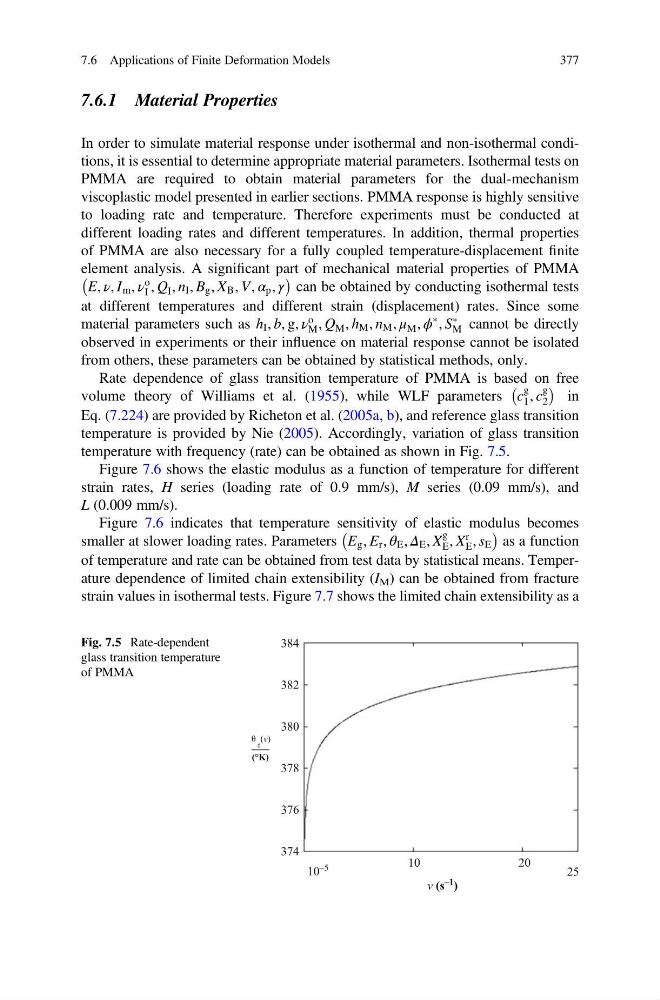
Rate dependence of glass transition temperature of PMMA is based on free
volume theory of Williams et al. (1955), while WLF parameters c
g
1 , c
g
2
À
Á
in
Eq. (7.224) are provided by Richeton et al. (2005a, b), and reference glass transition
temperature is provided by Nie (2005). Accordingly, variation of glass transition
temperature with frequency (rate) can be obtained as shown in Fig. 7.5.
Figure 7.6 shows the elastic modulus as a function of temperature for different
strain rates, H series (loading rate of 0.9 mm/s), M series (0.09 mm/s), and
L (0.009 mm/s).
Figure 7.6 indicates that temperature sensitivity of elastic modulus becomes
smaller at slower loading rates. Parameters E g , E r , θ E , Δ E , X
g
E , X
r
E , s E
À
Á
as a function
of temperature and rate can be obtained from test data by statistical means. Temperature dependence of limited chain extensibility (I M ) can be obtained from fracture
strain values in isothermal tests. Figure 7.7 shows the limited chain extensibility as a
384
382
380
378
376
374
10
20
25
10 –5
ν (s
–1
)
θ .g (v)
(°K)
Fig. 7.5 Rate-dependent
glass transition temperature
of PMMA
7.6 Applications of Finite Deformation Models
377
In order to simulate material response under isothermal and non-isothermal conditions, it is essential to determine appropriate material parameters. Isothermal tests on
PMMA are required to obtain material parameters for the dual-mechanism
viscoplastic model presented in earlier sections. PMMA response is highly sensitive
to loading rate and temperature. Therefore experiments must be conducted at
different loading rates and different temperatures. In addition, thermal properties
of PMMA are also necessary for a fully coupled temperature-displacement finite
element analysis. A significant part of mechanical material properties of PMMA
E, ν, I m , ν
o
I , Q I , n I , B g , X B , V, α p , γ
À
Á
can be obtained by conducting isothermal tests
at different temperatures and different strain (displacement) rates. Since some
material parameters such as h I , b, g, ν
o
M , Q M , h M , n M , μ M , ϕ
à , S
Ã
M cannot be directly
observed in experiments or their influence on material response cannot be isolated
from others, these parameters can be obtained by statistical methods, only.
Rate dependence of glass transition temperature of PMMA is based on free
volume theory of Williams et al. (1955), while WLF parameters c
g
1 , c
g
2
À
Á
in
Eq. (7.224) are provided by Richeton et al. (2005a, b), and reference glass transition
temperature is provided by Nie (2005). Accordingly, variation of glass transition
temperature with frequency (rate) can be obtained as shown in Fig. 7.5.
Figure 7.6 shows the elastic modulus as a function of temperature for different
strain rates, H series (loading rate of 0.9 mm/s), M series (0.09 mm/s), and
L (0.009 mm/s).
Figure 7.6 indicates that temperature sensitivity of elastic modulus becomes
smaller at slower loading rates. Parameters E g , E r , θ E , Δ E , X
g
E , X
r
E , s E
À
Á
as a function
of temperature and rate can be obtained from test data by statistical means. Temperature dependence of limited chain extensibility (I M ) can be obtained from fracture
strain values in isothermal tests. Figure 7.7 shows the limited chain extensibility as a
384
382
380
378
376
374
10
20
25
10 –5
ν (s
–1
)
θ .g (v)
(°K)
Fig. 7.5 Rate-dependent
glass transition temperature
of PMMA
7.6 Applications of Finite Deformation Models
377