

X S ¼
X
g
S
θ θ g þ θ S
X
r
S
θ > θ g þ θ S
(
ð7:231Þ
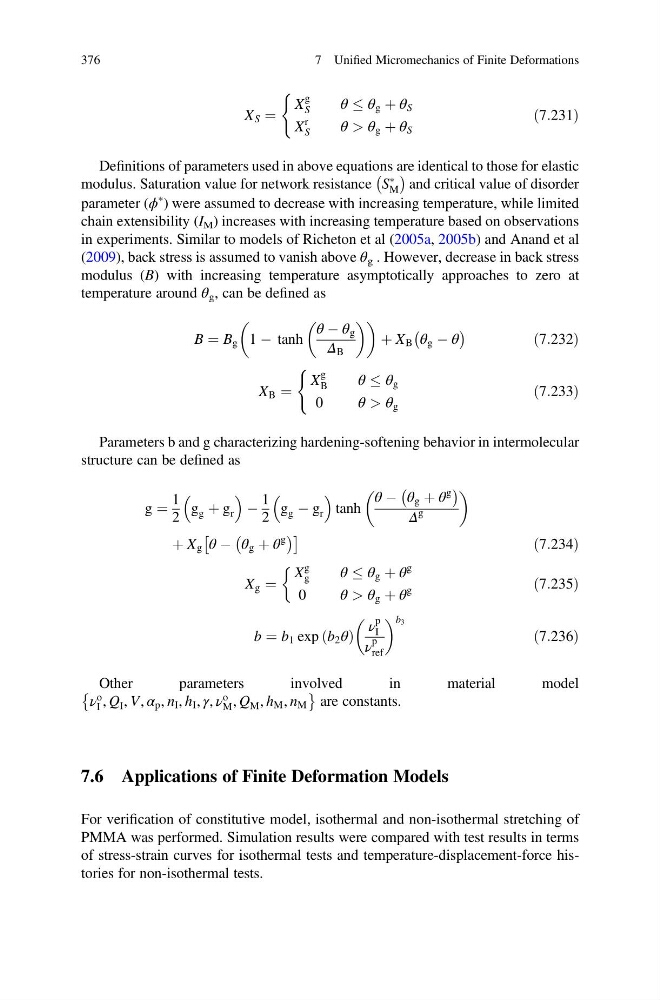
Definitions of parameters used in above equations are identical to those for elastic
modulus. Saturation value for network resistance S
Ã
M
À Á
and critical value of disorder
parameter (ϕ
à ) were assumed to decrease with increasing temperature, while limited
chain extensibility (I M ) increases with increasing temperature based on observations
in experiments. Similar to models of Richeton et al (2005a, 2005b) and Anand et al
(2009), back stress is assumed to vanish above θ g . However, decrease in back stress
modulus (B) with increasing temperature asymptotically approaches to zero at
temperature around θ g , can be defined as
B ¼ B g 1 À tanh
θ À θ g
Δ B
þ X B θ g À θ
À
Á
ð7:232Þ
X B ¼
X
g
B
θ θ g
0
θ > θ g
(
ð7:233Þ
Parameters b and g characterizing hardening-softening behavior in intermolecular
structure can be defined as
g ¼
1
2
g g þ g r
À
1
2
g g À g r
tanh
θ À θ g þ θ
g
À
Á
Δ
g
þ X g θ À θ g þ θ
g
À
Á
Â
Ã
ð7:234Þ
X g ¼
X
g
g
θ θ g þ θ
g
0
θ > θ g þ θ
g
&
ð7:235Þ
b ¼ b 1 exp b 2 θ
ð Þ
ν
p
I
ν
p
ref
b 3
ð7:236Þ
Other
parameters
involved
in
material
model
ν
o
I , Q I , V, α p , n I , h I , γ, ν
o
M , Q M , h M , n M
È
É
are constants.
7.6 Applications of Finite Deformation Models
For verification of constitutive model, isothermal and non-isothermal stretching of
PMMA was performed. Simulation results were compared with test results in terms
of stress-strain curves for isothermal tests and temperature-displacement-force histories for non-isothermal tests.
376
7 Unified Micromechanics of Finite Deformations
X
g
S
θ θ g þ θ S
X
r
S
θ > θ g þ θ S
(
ð7:231Þ
Definitions of parameters used in above equations are identical to those for elastic
modulus. Saturation value for network resistance S
Ã
M
À Á
and critical value of disorder
parameter (ϕ
à ) were assumed to decrease with increasing temperature, while limited
chain extensibility (I M ) increases with increasing temperature based on observations
in experiments. Similar to models of Richeton et al (2005a, 2005b) and Anand et al
(2009), back stress is assumed to vanish above θ g . However, decrease in back stress
modulus (B) with increasing temperature asymptotically approaches to zero at
temperature around θ g , can be defined as
B ¼ B g 1 À tanh
θ À θ g
Δ B
þ X B θ g À θ
À
Á
ð7:232Þ
X B ¼
X
g
B
θ θ g
0
θ > θ g
(
ð7:233Þ
Parameters b and g characterizing hardening-softening behavior in intermolecular
structure can be defined as
g ¼
1
2
g g þ g r
À
1
2
g g À g r
tanh
θ À θ g þ θ
g
À
Á
Δ
g
þ X g θ À θ g þ θ
g
À
Á
Â
Ã
ð7:234Þ
X g ¼
X
g
g
θ θ g þ θ
g
0
θ > θ g þ θ
g
&
ð7:235Þ
b ¼ b 1 exp b 2 θ
ð Þ
ν
p
I
ν
p
ref
b 3
ð7:236Þ
Other
parameters
involved
in
material
model
ν
o
I , Q I , V, α p , n I , h I , γ, ν
o
M , Q M , h M , n M
È
É
are constants.
7.6 Applications of Finite Deformation Models
For verification of constitutive model, isothermal and non-isothermal stretching of
PMMA was performed. Simulation results were compared with test results in terms
of stress-strain curves for isothermal tests and temperature-displacement-force histories for non-isothermal tests.
376
7 Unified Micromechanics of Finite Deformations