

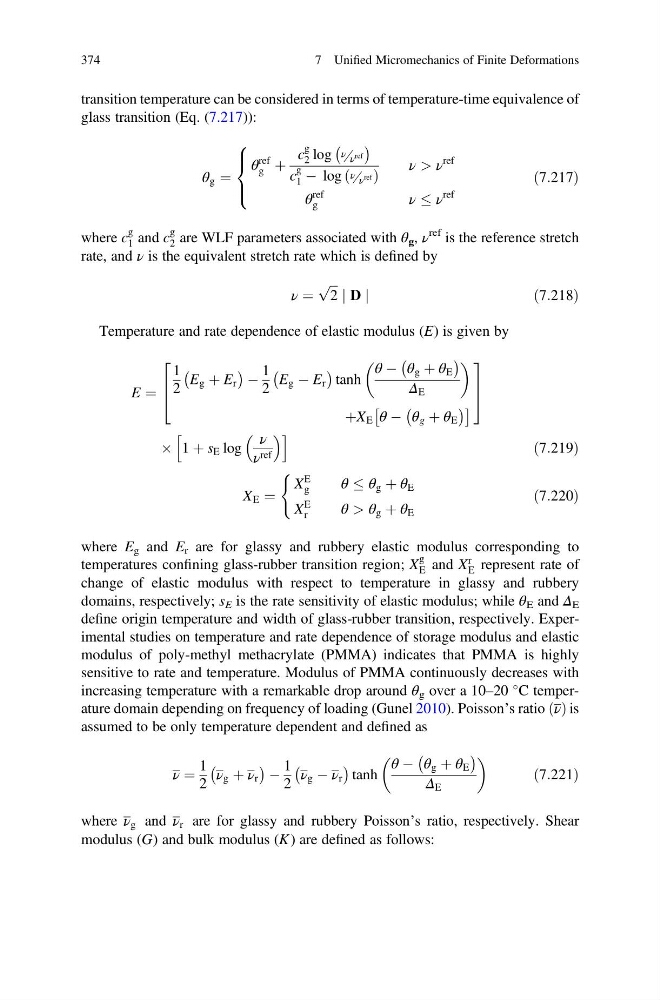
transition temperature can be considered in terms of temperature-time equivalence of
glass transition (Eq. (7.217)):
θ g ¼
θ
ref
g þ
c
g
2 log ν = ν
ref
À
Á
c
g
1 À log ν = ν
ref
ð
Þ
ν > ν
ref
θ
ref
g
ν ν
ref
8
> <
> :
ð7:217Þ
where c
g
1 and c
g
2 are WLF parameters associated with θ g , ν
ref is the reference stretch
rate, and ν is the equivalent stretch rate which is defined by
ν ¼
ffiffi ffi
2
p j D j
ð 7:218Þ
Temperature and rate dependence of elastic modulus (E) is given by
E ¼
1
2
E g þ E r
À
Á À
1
2
E g À E r
À
Á
tanh
θ À θ g þ θ E
À
Á
Δ E
þX E θ À θ g þ θ E
À
Á
Â
Ã
2
6
4
3
7
5
 1 þ s E log
ν
ν ref
h
i
ð7:219Þ
X E ¼
X
E
g
θ θ g þ θ E
X
E
r
θ > θ g þ θ E
(
ð7:220Þ
where E g and E r are for glassy and rubbery elastic modulus corresponding to
temperatures confining glass-rubber transition region; X
g
E and X
r
E represent rate of
change of elastic modulus with respect to temperature in glassy and rubbery
domains, respectively; s E is the rate sensitivity of elastic modulus; while θ E and Δ E
define origin temperature and width of glass-rubber transition, respectively. Experimental studies on temperature and rate dependence of storage modulus and elastic
modulus of poly-methyl methacrylate (PMMA) indicates that PMMA is highly
sensitive to rate and temperature. Modulus of PMMA continuously decreases with
increasing temperature with a remarkable drop around θ g over a 10–20
C temperature domain depending on frequency of loading (Gunel 2010). Poisson’s ratio ν
ð Þ is
assumed to be only temperature dependent and defined as
ν ¼
1
2
ν g þ ν r
À
Á À
1
2
ν g À ν r
À
Á
tanh
θ À θ g þ θ E
À
Á
Δ E
ð7:221Þ
where ν g and ν r are for glassy and rubbery Poisson’s ratio, respectively. Shear
modulus (G) and bulk modulus (K ) are defined as follows:
374
7 Unified Micromechanics of Finite Deformations
glass transition (Eq. (7.217)):
θ g ¼
θ
ref
g þ
c
g
2 log ν = ν
ref
À
Á
c
g
1 À log ν = ν
ref
ð
Þ
ν > ν
ref
θ
ref
g
ν ν
ref
8
> <
> :
ð7:217Þ
where c
g
1 and c
g
2 are WLF parameters associated with θ g , ν
ref is the reference stretch
rate, and ν is the equivalent stretch rate which is defined by
ν ¼
ffiffi ffi
2
p j D j
ð 7:218Þ
Temperature and rate dependence of elastic modulus (E) is given by
E ¼
1
2
E g þ E r
À
Á À
1
2
E g À E r
À
Á
tanh
θ À θ g þ θ E
À
Á
Δ E
þX E θ À θ g þ θ E
À
Á
Â
Ã
2
6
4
3
7
5
 1 þ s E log
ν
ν ref
h
i
ð7:219Þ
X E ¼
X
E
g
θ θ g þ θ E
X
E
r
θ > θ g þ θ E
(
ð7:220Þ
where E g and E r are for glassy and rubbery elastic modulus corresponding to
temperatures confining glass-rubber transition region; X
g
E and X
r
E represent rate of
change of elastic modulus with respect to temperature in glassy and rubbery
domains, respectively; s E is the rate sensitivity of elastic modulus; while θ E and Δ E
define origin temperature and width of glass-rubber transition, respectively. Experimental studies on temperature and rate dependence of storage modulus and elastic
modulus of poly-methyl methacrylate (PMMA) indicates that PMMA is highly
sensitive to rate and temperature. Modulus of PMMA continuously decreases with
increasing temperature with a remarkable drop around θ g over a 10–20
C temperature domain depending on frequency of loading (Gunel 2010). Poisson’s ratio ν
ð Þ is
assumed to be only temperature dependent and defined as
ν ¼
1
2
ν g þ ν r
À
Á À
1
2
ν g À ν r
À
Á
tanh
θ À θ g þ θ E
À
Á
Δ E
ð7:221Þ
where ν g and ν r are for glassy and rubbery Poisson’s ratio, respectively. Shear
modulus (G) and bulk modulus (K ) are defined as follows:
374
7 Unified Micromechanics of Finite Deformations