

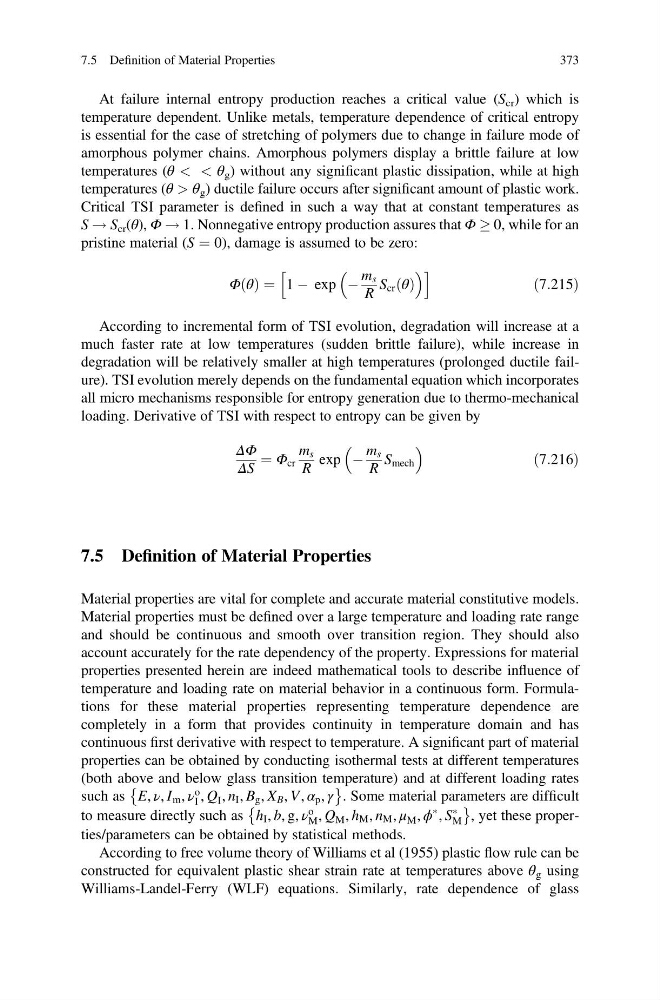
At failure internal entropy production reaches a critical value (S cr ) which is
temperature dependent. Unlike metals, temperature dependence of critical entropy
is essential for the case of stretching of polymers due to change in failure mode of
amorphous polymer chains. Amorphous polymers display a brittle failure at low
temperatures (θ < < θ g ) without any significant plastic dissipation, while at high
temperatures (θ > θ g ) ductile failure occurs after significant amount of plastic work.
Critical TSI parameter is defined in such a way that at constant temperatures as
S ! S cr (θ), Φ ! 1. Nonnegative entropy production assures that Φ ! 0, while for an
pristine material (S ¼ 0), damage is assumed to be zero:
Φ θ
ð Þ ¼ 1 À exp À
m s
R
S cr θ
ð Þ
h
i
ð7:215Þ
According to incremental form of TSI evolution, degradation will increase at a
much faster rate at low temperatures (sudden brittle failure), while increase in
degradation will be relatively smaller at high temperatures (prolonged ductile failure). TSI evolution merely depends on the fundamental equation which incorporates
all micro mechanisms responsible for entropy generation due to thermo-mechanical
loading. Derivative of TSI with respect to entropy can be given by
ΔΦ
ΔS
¼ Φ cr
m s
R
exp À
m s
R
S mech
ð7:216Þ
7.5 Definition of Material Properties
Material properties are vital for complete and accurate material constitutive models.
Material properties must be defined over a large temperature and loading rate range
and should be continuous and smooth over transition region. They should also
account accurately for the rate dependency of the property. Expressions for material
properties presented herein are indeed mathematical tools to describe influence of
temperature and loading rate on material behavior in a continuous form. Formulations for these material properties representing temperature dependence are
completely in a form that provides continuity in temperature domain and has
continuous first derivative with respect to temperature. A significant part of material
properties can be obtained by conducting isothermal tests at different temperatures
(both above and below glass transition temperature) and at different loading rates
such as E, ν, I m , ν
o
I , Q I , n I , B g , X B , V, α p , γ
È
É
. Some material parameters are difficult
to measure directly such as h I , b, g, ν
o
M , Q M , h M , n M , μ M , ϕ
à , S
Ã
M
È
É
, yet these properties/parameters can be obtained by statistical methods.
According to free volume theory of Williams et al (1955) plastic flow rule can be
constructed for equivalent plastic shear strain rate at temperatures above θ g using
Williams-Landel-Ferry (WLF) equations. Similarly, rate dependence of glass
7.5 Definition of Material Properties
373
temperature dependent. Unlike metals, temperature dependence of critical entropy
is essential for the case of stretching of polymers due to change in failure mode of
amorphous polymer chains. Amorphous polymers display a brittle failure at low
temperatures (θ < < θ g ) without any significant plastic dissipation, while at high
temperatures (θ > θ g ) ductile failure occurs after significant amount of plastic work.
Critical TSI parameter is defined in such a way that at constant temperatures as
S ! S cr (θ), Φ ! 1. Nonnegative entropy production assures that Φ ! 0, while for an
pristine material (S ¼ 0), damage is assumed to be zero:
Φ θ
ð Þ ¼ 1 À exp À
m s
R
S cr θ
ð Þ
h
i
ð7:215Þ
According to incremental form of TSI evolution, degradation will increase at a
much faster rate at low temperatures (sudden brittle failure), while increase in
degradation will be relatively smaller at high temperatures (prolonged ductile failure). TSI evolution merely depends on the fundamental equation which incorporates
all micro mechanisms responsible for entropy generation due to thermo-mechanical
loading. Derivative of TSI with respect to entropy can be given by
ΔΦ
ΔS
¼ Φ cr
m s
R
exp À
m s
R
S mech
ð7:216Þ
7.5 Definition of Material Properties
Material properties are vital for complete and accurate material constitutive models.
Material properties must be defined over a large temperature and loading rate range
and should be continuous and smooth over transition region. They should also
account accurately for the rate dependency of the property. Expressions for material
properties presented herein are indeed mathematical tools to describe influence of
temperature and loading rate on material behavior in a continuous form. Formulations for these material properties representing temperature dependence are
completely in a form that provides continuity in temperature domain and has
continuous first derivative with respect to temperature. A significant part of material
properties can be obtained by conducting isothermal tests at different temperatures
(both above and below glass transition temperature) and at different loading rates
such as E, ν, I m , ν
o
I , Q I , n I , B g , X B , V, α p , γ
È
É
. Some material parameters are difficult
to measure directly such as h I , b, g, ν
o
M , Q M , h M , n M , μ M , ϕ
à , S
Ã
M
È
É
, yet these properties/parameters can be obtained by statistical methods.
According to free volume theory of Williams et al (1955) plastic flow rule can be
constructed for equivalent plastic shear strain rate at temperatures above θ g using
Williams-Landel-Ferry (WLF) equations. Similarly, rate dependence of glass
7.5 Definition of Material Properties
373