

polymers, heat transfer may take place over a prolonged period of times with
significant thermal gradients. However, thermal gradients cannot be responsible
for failure of chemical bonds since material degradation or damage is a consequence
of formation of small voids or cracks at microscale by breakage of chemical bonds
between molecules. Thermal dissipation may result in deterioration of material
properties which is usually insignificant compared to degradation by mechanical
dissipation and other entropy generation mechanisms.
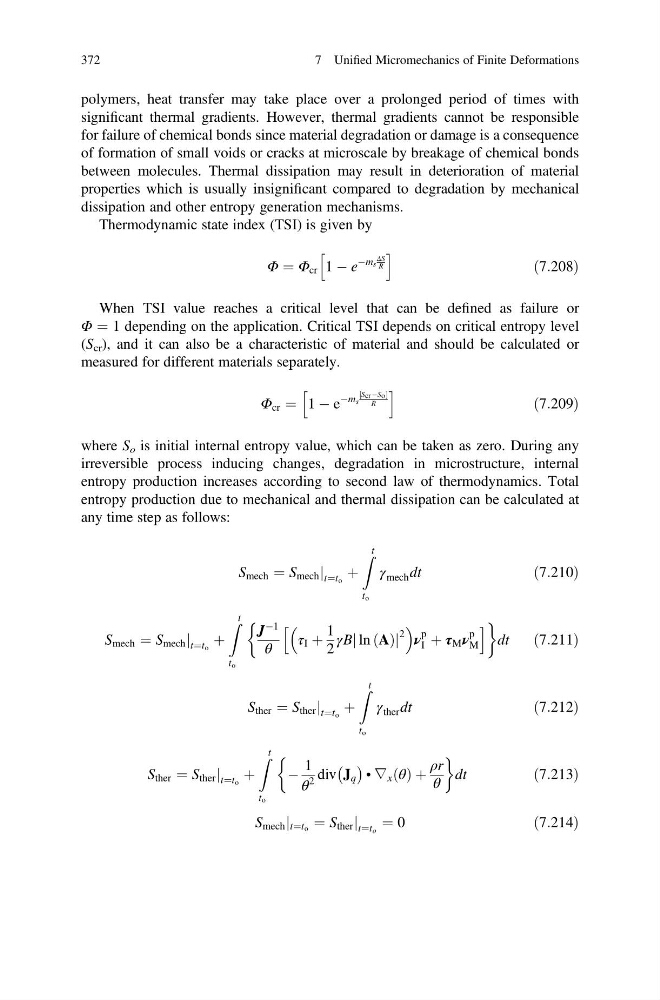
Thermodynamic state index (TSI) is given by
Φ ¼ Φ cr 1 À e
Àm s
ΔS
R
h
i
ð7:208Þ
When TSI value reaches a critical level that can be defined as failure or
Φ ¼ 1 depending on the application. Critical TSI depends on critical entropy level
(S cr ), and it can also be a characteristic of material and should be calculated or
measured for different materials separately.
Φ cr ¼ 1 À e
Àm s
Scr ÀSo
½
R
h
i
ð7:209Þ
where S o is initial internal entropy value, which can be taken as zero. During any
irreversible process inducing changes, degradation in microstructure, internal
entropy production increases according to second law of thermodynamics. Total
entropy production due to mechanical and thermal dissipation can be calculated at
any time step as follows:
S mech ¼ S mech j t¼t o þ
Z t
t o
γ mech dt
ð7:210Þ
S mech ¼ S mech j t¼t o þ
Z t
t o
J
À1
θ
τ I þ
1
2
γB ln A
ð Þ
j
j
2
ν
p
I þ τ M ν
p
M
h
i
&
'
dt
ð7:211Þ
S ther ¼ S ther j t¼t o þ
Z t
t o
γ ther dt
ð7:212Þ
S ther ¼ S ther j t¼t o þ
Z t
t o
À
1
θ
2
div J q
À Á • ∇ x θ
ð Þ þ
ρr
θ
&
'
dt
ð7:213Þ
S mech t¼t o ¼ S ther
j
j t¼t o ¼ 0
ð7:214Þ
372
7 Unified Micromechanics of Finite Deformations
significant thermal gradients. However, thermal gradients cannot be responsible
for failure of chemical bonds since material degradation or damage is a consequence
of formation of small voids or cracks at microscale by breakage of chemical bonds
between molecules. Thermal dissipation may result in deterioration of material
properties which is usually insignificant compared to degradation by mechanical
dissipation and other entropy generation mechanisms.
Thermodynamic state index (TSI) is given by
Φ ¼ Φ cr 1 À e
Àm s
ΔS
R
h
i
ð7:208Þ
When TSI value reaches a critical level that can be defined as failure or
Φ ¼ 1 depending on the application. Critical TSI depends on critical entropy level
(S cr ), and it can also be a characteristic of material and should be calculated or
measured for different materials separately.
Φ cr ¼ 1 À e
Àm s
Scr ÀSo
½
R
h
i
ð7:209Þ
where S o is initial internal entropy value, which can be taken as zero. During any
irreversible process inducing changes, degradation in microstructure, internal
entropy production increases according to second law of thermodynamics. Total
entropy production due to mechanical and thermal dissipation can be calculated at
any time step as follows:
S mech ¼ S mech j t¼t o þ
Z t
t o
γ mech dt
ð7:210Þ
S mech ¼ S mech j t¼t o þ
Z t
t o
J
À1
θ
τ I þ
1
2
γB ln A
ð Þ
j
j
2
ν
p
I þ τ M ν
p
M
h
i
&
'
dt
ð7:211Þ
S ther ¼ S ther j t¼t o þ
Z t
t o
γ ther dt
ð7:212Þ
S ther ¼ S ther j t¼t o þ
Z t
t o
À
1
θ
2
div J q
À Á • ∇ x θ
ð Þ þ
ρr
θ
&
'
dt
ð7:213Þ
S mech t¼t o ¼ S ther
j
j t¼t o ¼ 0
ð7:214Þ
372
7 Unified Micromechanics of Finite Deformations