

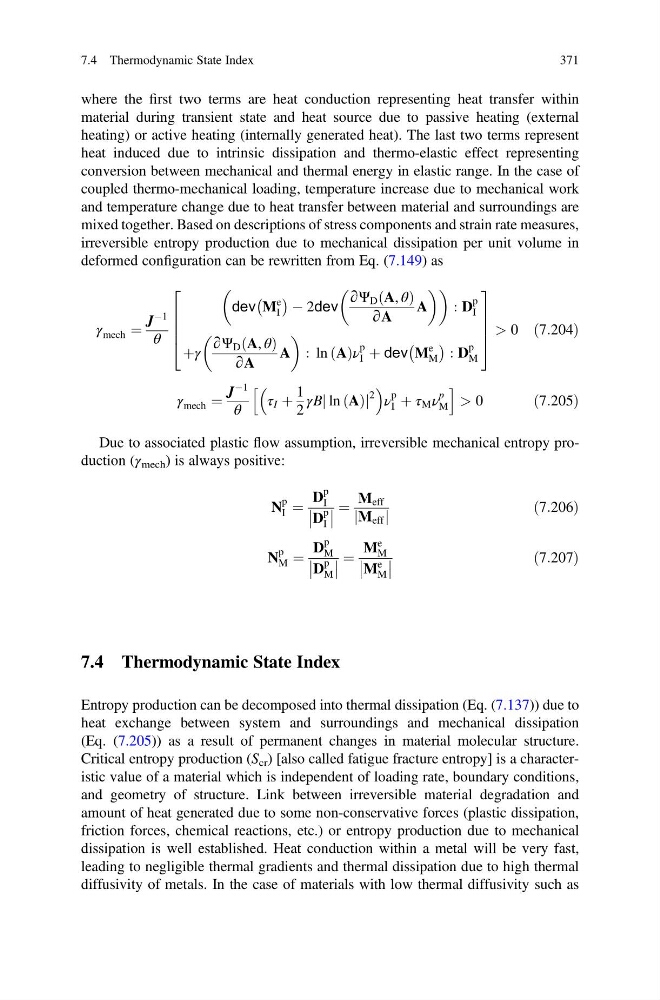
where the first two terms are heat conduction representing heat transfer within
material during transient state and heat source due to passive heating (external
heating) or active heating (internally generated heat). The last two terms represent
heat induced due to intrinsic dissipation and thermo-elastic effect representing
conversion between mechanical and thermal energy in elastic range. In the case of
coupled thermo-mechanical loading, temperature increase due to mechanical work
and temperature change due to heat transfer between material and surroundings are
mixed together. Based on descriptions of stress components and strain rate measures,
irreversible entropy production due to mechanical dissipation per unit volume in
deformed configuration can be rewritten from Eq. (7.149) as
γ mech ¼
J
À1
θ
dev M
e
I
À Á À 2dev
∂Ψ D A, θ
ð
Þ
∂A
A
: D
p
I
þγ
∂Ψ D A, θ
ð
Þ
∂A
A
: ln A
ð Þν
p
I þ dev M
e
M
À
Á : D
p
M
2
6
6
6
4
3
7
7
7
5
> 0 ð7:204Þ
γ mech ¼
J
À1
θ
τ I þ
1
2
γB ln A
ð Þ
j
j
2
ν
p
I þ τ M ν
p
M
h
i
> 0
ð7:205Þ
Due to associated plastic flow assumption, irreversible mechanical entropy production (γ mech ) is always positive:
N
p
I ¼
D
p
I
D
p
I
¼
M eff
M eff
j
j
ð7:206Þ
N
p
M ¼
D
p
M
D
p
M
¼
M
e
M
M
e
M
ð7:207Þ
7.4 Thermodynamic State Index
Entropy production can be decomposed into thermal dissipation (Eq. (7.137)) due to
heat exchange between system and surroundings and mechanical dissipation
(Eq. (7.205)) as a result of permanent changes in material molecular structure.
Critical entropy production (S cr ) [also called fatigue fracture entropy] is a characteristic value of a material which is independent of loading rate, boundary conditions,
and geometry of structure. Link between irreversible material degradation and
amount of heat generated due to some non-conservative forces (plastic dissipation,
friction forces, chemical reactions, etc.) or entropy production due to mechanical
dissipation is well established. Heat conduction within a metal will be very fast,
leading to negligible thermal gradients and thermal dissipation due to high thermal
diffusivity of metals. In the case of materials with low thermal diffusivity such as
7.4 Thermodynamic State Index
371
material during transient state and heat source due to passive heating (external
heating) or active heating (internally generated heat). The last two terms represent
heat induced due to intrinsic dissipation and thermo-elastic effect representing
conversion between mechanical and thermal energy in elastic range. In the case of
coupled thermo-mechanical loading, temperature increase due to mechanical work
and temperature change due to heat transfer between material and surroundings are
mixed together. Based on descriptions of stress components and strain rate measures,
irreversible entropy production due to mechanical dissipation per unit volume in
deformed configuration can be rewritten from Eq. (7.149) as
γ mech ¼
J
À1
θ
dev M
e
I
À Á À 2dev
∂Ψ D A, θ
ð
Þ
∂A
A
: D
p
I
þγ
∂Ψ D A, θ
ð
Þ
∂A
A
: ln A
ð Þν
p
I þ dev M
e
M
À
Á : D
p
M
2
6
6
6
4
3
7
7
7
5
> 0 ð7:204Þ
γ mech ¼
J
À1
θ
τ I þ
1
2
γB ln A
ð Þ
j
j
2
ν
p
I þ τ M ν
p
M
h
i
> 0
ð7:205Þ
Due to associated plastic flow assumption, irreversible mechanical entropy production (γ mech ) is always positive:
N
p
I ¼
D
p
I
D
p
I
¼
M eff
M eff
j
j
ð7:206Þ
N
p
M ¼
D
p
M
D
p
M
¼
M
e
M
M
e
M
ð7:207Þ
7.4 Thermodynamic State Index
Entropy production can be decomposed into thermal dissipation (Eq. (7.137)) due to
heat exchange between system and surroundings and mechanical dissipation
(Eq. (7.205)) as a result of permanent changes in material molecular structure.
Critical entropy production (S cr ) [also called fatigue fracture entropy] is a characteristic value of a material which is independent of loading rate, boundary conditions,
and geometry of structure. Link between irreversible material degradation and
amount of heat generated due to some non-conservative forces (plastic dissipation,
friction forces, chemical reactions, etc.) or entropy production due to mechanical
dissipation is well established. Heat conduction within a metal will be very fast,
leading to negligible thermal gradients and thermal dissipation due to high thermal
diffusivity of metals. In the case of materials with low thermal diffusivity such as
7.4 Thermodynamic State Index
371