

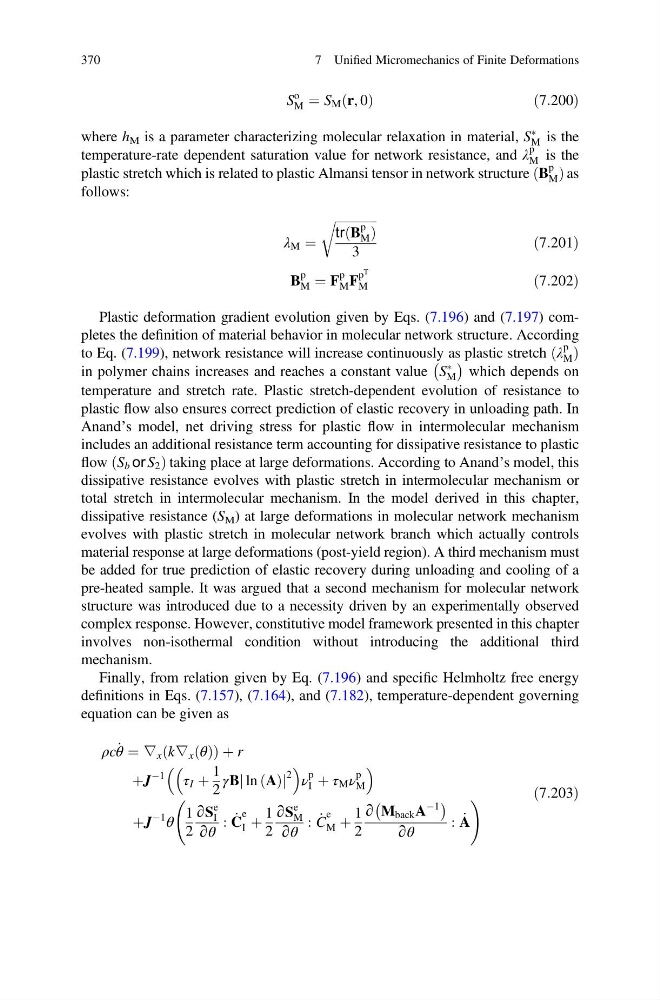
S
o
M ¼ S M r, 0
ð Þ
ð7:200Þ
where h M is a parameter characterizing molecular relaxation in material, S
Ã
M is the
temperature-rate dependent saturation value for network resistance, and λ
p
M is the
plastic stretch which is related to plastic Almansi tensor in network structure B
p
M
ð Þas
follows:
λ M ¼
ffiffiffiffiffiffiffiffiffiffiffiffiffi ffi
tr B
p
M
ð Þ
3
r
ð7:201Þ
B
p
M ¼ F
p
M F
p
T
M
ð7:202Þ
Plastic deformation gradient evolution given by Eqs. (7.196) and (7.197) completes the definition of material behavior in molecular network structure. According
to Eq. (7.199), network resistance will increase continuously as plastic stretch λ
p
M
ð Þ
in polymer chains increases and reaches a constant value S
Ã
M
À Á
which depends on
temperature and stretch rate. Plastic stretch-dependent evolution of resistance to
plastic flow also ensures correct prediction of elastic recovery in unloading path. In
Anand’s model, net driving stress for plastic flow in intermolecular mechanism
includes an additional resistance term accounting for dissipative resistance to plastic
flow S b or S 2
ð
Þtaking place at large deformations. According to Anand’s model, this
dissipative resistance evolves with plastic stretch in intermolecular mechanism or
total stretch in intermolecular mechanism. In the model derived in this chapter,
dissipative resistance (S M ) at large deformations in molecular network mechanism
evolves with plastic stretch in molecular network branch which actually controls
material response at large deformations (post-yield region). A third mechanism must
be added for true prediction of elastic recovery during unloading and cooling of a
pre-heated sample. It was argued that a second mechanism for molecular network
structure was introduced due to a necessity driven by an experimentally observed
complex response. However, constitutive model framework presented in this chapter
involves non-isothermal condition without introducing the additional third
mechanism.
Finally, from relation given by Eq. (7.196) and specific Helmholtz free energy
definitions in Eqs. (7.157), (7.164), and (7.182), temperature-dependent governing
equation can be given as
ρc _
θ ¼ ∇ x k∇ x θ
ð Þ
ð
Þþr
þJ
À1
τ I þ
1
2
γB ln A
ð Þ
j
j
2
ν
p
I þ τ M ν
p
M
þJ
À1
θ
1
2
∂S
e
I
∂θ
: _
C
e
I þ
1
2
∂S
e
M
∂θ
: _
C
e
M þ
1
2
∂ M back A
À1
À
Á
∂θ
: _
A
!
ð7:203Þ
370
7 Unified Micromechanics of Finite Deformations
o
M ¼ S M r, 0
ð Þ
ð7:200Þ
where h M is a parameter characterizing molecular relaxation in material, S
Ã
M is the
temperature-rate dependent saturation value for network resistance, and λ
p
M is the
plastic stretch which is related to plastic Almansi tensor in network structure B
p
M
ð Þas
follows:
λ M ¼
ffiffiffiffiffiffiffiffiffiffiffiffiffi ffi
tr B
p
M
ð Þ
3
r
ð7:201Þ
B
p
M ¼ F
p
M F
p
T
M
ð7:202Þ
Plastic deformation gradient evolution given by Eqs. (7.196) and (7.197) completes the definition of material behavior in molecular network structure. According
to Eq. (7.199), network resistance will increase continuously as plastic stretch λ
p
M
ð Þ
in polymer chains increases and reaches a constant value S
Ã
M
À Á
which depends on
temperature and stretch rate. Plastic stretch-dependent evolution of resistance to
plastic flow also ensures correct prediction of elastic recovery in unloading path. In
Anand’s model, net driving stress for plastic flow in intermolecular mechanism
includes an additional resistance term accounting for dissipative resistance to plastic
flow S b or S 2
ð
Þtaking place at large deformations. According to Anand’s model, this
dissipative resistance evolves with plastic stretch in intermolecular mechanism or
total stretch in intermolecular mechanism. In the model derived in this chapter,
dissipative resistance (S M ) at large deformations in molecular network mechanism
evolves with plastic stretch in molecular network branch which actually controls
material response at large deformations (post-yield region). A third mechanism must
be added for true prediction of elastic recovery during unloading and cooling of a
pre-heated sample. It was argued that a second mechanism for molecular network
structure was introduced due to a necessity driven by an experimentally observed
complex response. However, constitutive model framework presented in this chapter
involves non-isothermal condition without introducing the additional third
mechanism.
Finally, from relation given by Eq. (7.196) and specific Helmholtz free energy
definitions in Eqs. (7.157), (7.164), and (7.182), temperature-dependent governing
equation can be given as
ρc _
θ ¼ ∇ x k∇ x θ
ð Þ
ð
Þþr
þJ
À1
τ I þ
1
2
γB ln A
ð Þ
j
j
2
ν
p
I þ τ M ν
p
M
þJ
À1
θ
1
2
∂S
e
I
∂θ
: _
C
e
I þ
1
2
∂S
e
M
∂θ
: _
C
e
M þ
1
2
∂ M back A
À1
À
Á
∂θ
: _
A
!
ð7:203Þ
370
7 Unified Micromechanics of Finite Deformations