

B
e
M
À Á
d
¼ F
e
M
À Á
d
F
e
M
À Á T
d
ð7:191Þ
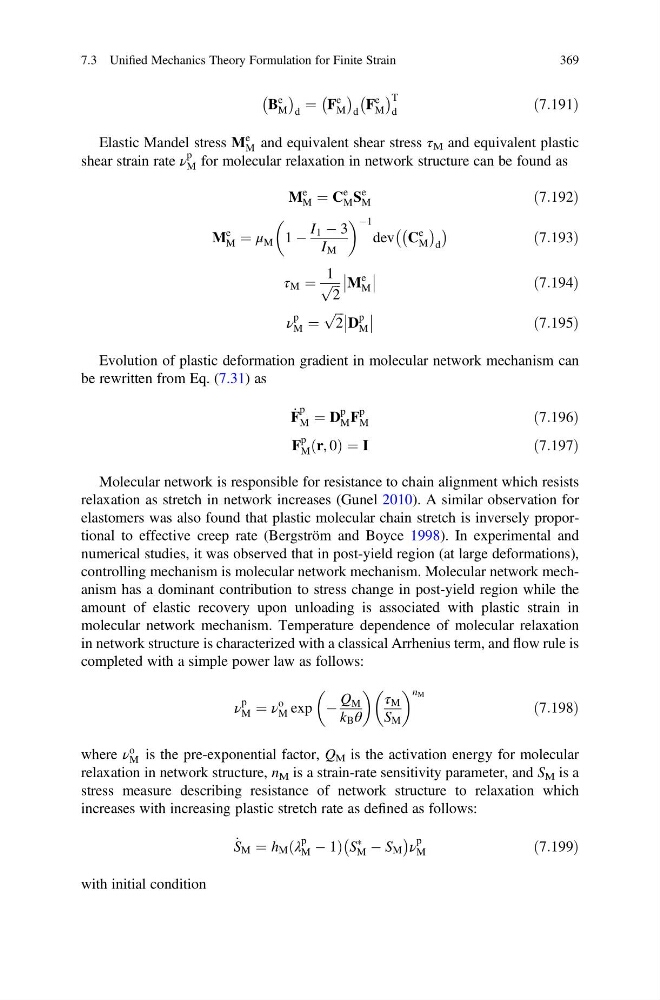
Elastic Mandel stress M
e
M and equivalent shear stress τ M and equivalent plastic
shear strain rate ν
p
M for molecular relaxation in network structure can be found as
M
e
M ¼ C
e
M S
e
M
ð7:192Þ
M
e
M ¼ μ M 1 À
I 1 À 3
I M
À1
dev C
e
M
À Á
d
À
Á
ð7:193Þ
τ M ¼
1
ffiffi ffi
2
p M
e
M
ð7:194Þ
ν
p
M ¼
ffiffi ffi
2
p
D
p
M
ð7:195Þ
Evolution of plastic deformation gradient in molecular network mechanism can
be rewritten from Eq. (7.31) as
_
F
p
M ¼ D
p
M F
p
M
ð7:196Þ
F
p
M r, 0
ð Þ ¼ I
ð7:197Þ
Molecular network is responsible for resistance to chain alignment which resists
relaxation as stretch in network increases (Gunel 2010). A similar observation for
elastomers was also found that plastic molecular chain stretch is inversely proportional to effective creep rate (Bergström and Boyce 1998). In experimental and
numerical studies, it was observed that in post-yield region (at large deformations),
controlling mechanism is molecular network mechanism. Molecular network mechanism has a dominant contribution to stress change in post-yield region while the
amount of elastic recovery upon unloading is associated with plastic strain in
molecular network mechanism. Temperature dependence of molecular relaxation
in network structure is characterized with a classical Arrhenius term, and flow rule is
completed with a simple power law as follows:
ν
p
M ¼ ν
o
M exp À
Q M
k B θ
τ M
S M
n M
ð7:198Þ
where ν
o
M is the pre-exponential factor, Q M is the activation energy for molecular
relaxation in network structure, n M is a strain-rate sensitivity parameter, and S M is a
stress measure describing resistance of network structure to relaxation which
increases with increasing plastic stretch rate as defined as follows:
_
S M ¼ h M λ
p
M À 1
ð
Þ S
Ã
M À S M
À
Á ν
p
M
ð7:199Þ
with initial condition
7.3 Unified Mechanics Theory Formulation for Finite Strain
369
e
M
À Á
d
¼ F
e
M
À Á
d
F
e
M
À Á T
d
ð7:191Þ
Elastic Mandel stress M
e
M and equivalent shear stress τ M and equivalent plastic
shear strain rate ν
p
M for molecular relaxation in network structure can be found as
M
e
M ¼ C
e
M S
e
M
ð7:192Þ
M
e
M ¼ μ M 1 À
I 1 À 3
I M
À1
dev C
e
M
À Á
d
À
Á
ð7:193Þ
τ M ¼
1
ffiffi ffi
2
p M
e
M
ð7:194Þ
ν
p
M ¼
ffiffi ffi
2
p
D
p
M
ð7:195Þ
Evolution of plastic deformation gradient in molecular network mechanism can
be rewritten from Eq. (7.31) as
_
F
p
M ¼ D
p
M F
p
M
ð7:196Þ
F
p
M r, 0
ð Þ ¼ I
ð7:197Þ
Molecular network is responsible for resistance to chain alignment which resists
relaxation as stretch in network increases (Gunel 2010). A similar observation for
elastomers was also found that plastic molecular chain stretch is inversely proportional to effective creep rate (Bergström and Boyce 1998). In experimental and
numerical studies, it was observed that in post-yield region (at large deformations),
controlling mechanism is molecular network mechanism. Molecular network mechanism has a dominant contribution to stress change in post-yield region while the
amount of elastic recovery upon unloading is associated with plastic strain in
molecular network mechanism. Temperature dependence of molecular relaxation
in network structure is characterized with a classical Arrhenius term, and flow rule is
completed with a simple power law as follows:
ν
p
M ¼ ν
o
M exp À
Q M
k B θ
τ M
S M
n M
ð7:198Þ
where ν
o
M is the pre-exponential factor, Q M is the activation energy for molecular
relaxation in network structure, n M is a strain-rate sensitivity parameter, and S M is a
stress measure describing resistance of network structure to relaxation which
increases with increasing plastic stretch rate as defined as follows:
_
S M ¼ h M λ
p
M À 1
ð
Þ S
Ã
M À S M
À
Á ν
p
M
ð7:199Þ
with initial condition
7.3 Unified Mechanics Theory Formulation for Finite Strain
369