

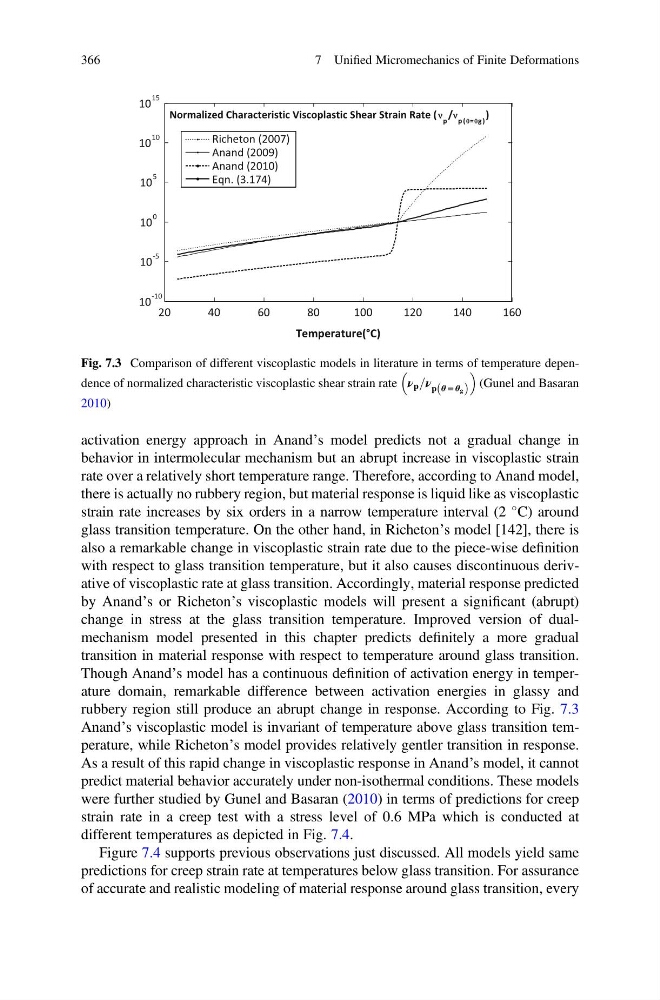
activation energy approach in Anand’s model predicts not a gradual change in
behavior in intermolecular mechanism but an abrupt increase in viscoplastic strain
rate over a relatively short temperature range. Therefore, according to Anand model,
there is actually no rubbery region, but material response is liquid like as viscoplastic
strain rate increases by six orders in a narrow temperature interval (2
C) around
glass transition temperature. On the other hand, in Richeton’s model [142], there is
also a remarkable change in viscoplastic strain rate due to the piece-wise definition
with respect to glass transition temperature, but it also causes discontinuous derivative of viscoplastic rate at glass transition. Accordingly, material response predicted
by Anand’s or Richeton’s viscoplastic models will present a significant (abrupt)
change in stress at the glass transition temperature. Improved version of dualmechanism model presented in this chapter predicts definitely a more gradual
transition in material response with respect to temperature around glass transition.
Though Anand’s model has a continuous definition of activation energy in temperature domain, remarkable difference between activation energies in glassy and
rubbery region still produce an abrupt change in response. According to Fig. 7.3
Anand’s viscoplastic model is invariant of temperature above glass transition temperature, while Richeton’s model provides relatively gentler transition in response.
As a result of this rapid change in viscoplastic response in Anand’s model, it cannot
predict material behavior accurately under non-isothermal conditions. These models
were further studied by Gunel and Basaran (2010) in terms of predictions for creep
strain rate in a creep test with a stress level of 0.6 MPa which is conducted at
different temperatures as depicted in Fig. 7.4.
Figure 7.4 supports previous observations just discussed. All models yield same
predictions for creep strain rate at temperatures below glass transition. For assurance
of accurate and realistic modeling of material response around glass transition, every
20
40
60
80
100
120
140
160
10
-10
10
-5
10
0
10
5
10
10
10
15
Temperature(°C)
Normalized Characteristic Viscoplastic Shear Strain Rate ( ν p /ν p (θ=θg) )
Richeton (2007)
Anand (2009)
Anand (2010)
Eqn. (3.174)
Fig. 7.3 Comparison of different viscoplastic models in literature in terms of temperature dependence of normalized characteristic viscoplastic shear strain rate ν p =ν p θ = θg
ð
Þ
(Gunel and Basaran
2010)
366
7 Unified Micromechanics of Finite Deformations
behavior in intermolecular mechanism but an abrupt increase in viscoplastic strain
rate over a relatively short temperature range. Therefore, according to Anand model,
there is actually no rubbery region, but material response is liquid like as viscoplastic
strain rate increases by six orders in a narrow temperature interval (2
C) around
glass transition temperature. On the other hand, in Richeton’s model [142], there is
also a remarkable change in viscoplastic strain rate due to the piece-wise definition
with respect to glass transition temperature, but it also causes discontinuous derivative of viscoplastic rate at glass transition. Accordingly, material response predicted
by Anand’s or Richeton’s viscoplastic models will present a significant (abrupt)
change in stress at the glass transition temperature. Improved version of dualmechanism model presented in this chapter predicts definitely a more gradual
transition in material response with respect to temperature around glass transition.
Though Anand’s model has a continuous definition of activation energy in temperature domain, remarkable difference between activation energies in glassy and
rubbery region still produce an abrupt change in response. According to Fig. 7.3
Anand’s viscoplastic model is invariant of temperature above glass transition temperature, while Richeton’s model provides relatively gentler transition in response.
As a result of this rapid change in viscoplastic response in Anand’s model, it cannot
predict material behavior accurately under non-isothermal conditions. These models
were further studied by Gunel and Basaran (2010) in terms of predictions for creep
strain rate in a creep test with a stress level of 0.6 MPa which is conducted at
different temperatures as depicted in Fig. 7.4.
Figure 7.4 supports previous observations just discussed. All models yield same
predictions for creep strain rate at temperatures below glass transition. For assurance
of accurate and realistic modeling of material response around glass transition, every
20
40
60
80
100
120
140
160
10
-10
10
-5
10
0
10
5
10
10
10
15
Temperature(°C)
Normalized Characteristic Viscoplastic Shear Strain Rate ( ν p /ν p (θ=θg) )
Richeton (2007)
Anand (2009)
Anand (2010)
Eqn. (3.174)
Fig. 7.3 Comparison of different viscoplastic models in literature in terms of temperature dependence of normalized characteristic viscoplastic shear strain rate ν p =ν p θ = θg
ð
Þ
(Gunel and Basaran
2010)
366
7 Unified Micromechanics of Finite Deformations