

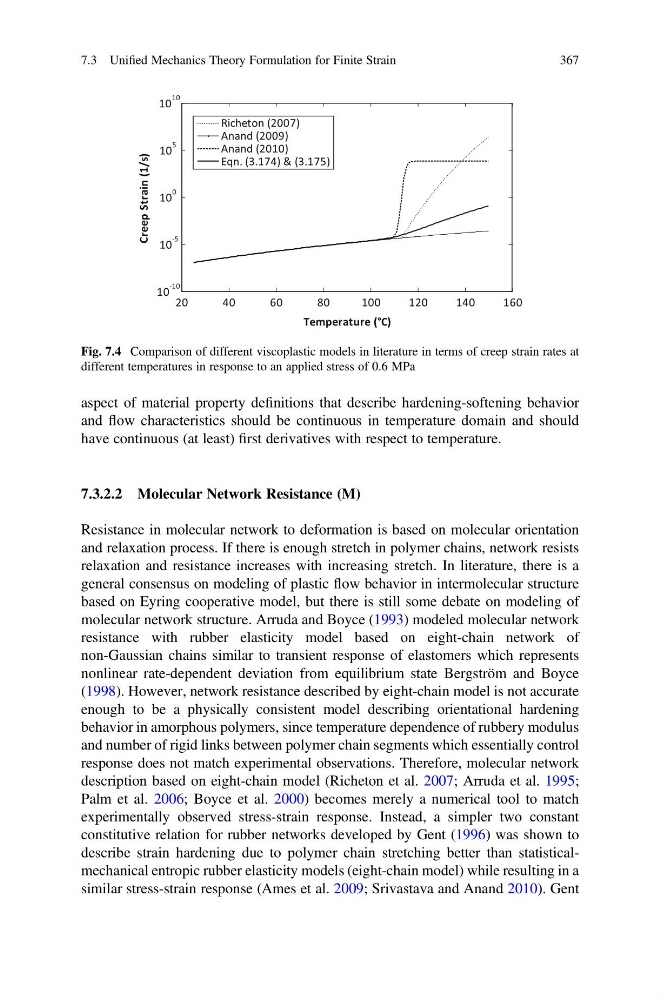
aspect of material property definitions that describe hardening-softening behavior
and flow characteristics should be continuous in temperature domain and should
have continuous (at least) first derivatives with respect to temperature.
7.3.2.2 Molecular Network Resistance (M)
Resistance in molecular network to deformation is based on molecular orientation
and relaxation process. If there is enough stretch in polymer chains, network resists
relaxation and resistance increases with increasing stretch. In literature, there is a
general consensus on modeling of plastic flow behavior in intermolecular structure
based on Eyring cooperative model, but there is still some debate on modeling of
molecular network structure. Arruda and Boyce (1993) modeled molecular network
resistance with rubber elasticity model based on eight-chain network of
non-Gaussian chains similar to transient response of elastomers which represents
nonlinear rate-dependent deviation from equilibrium state Bergström and Boyce
(1998). However, network resistance described by eight-chain model is not accurate
enough to be a physically consistent model describing orientational hardening
behavior in amorphous polymers, since temperature dependence of rubbery modulus
and number of rigid links between polymer chain segments which essentially control
response does not match experimental observations. Therefore, molecular network
description based on eight-chain model (Richeton et al. 2007; Arruda et al. 1995;
Palm et al. 2006; Boyce et al. 2000) becomes merely a numerical tool to match
experimentally observed stress-strain response. Instead, a simpler two constant
constitutive relation for rubber networks developed by Gent (1996) was shown to
describe strain hardening due to polymer chain stretching better than statisticalmechanical entropic rubber elasticity models (eight-chain model) while resulting in a
similar stress-strain response (Ames et al. 2009; Srivastava and Anand 2010). Gent
20
40
60
80
100
120
140
160
10
-10
10
-5
10
0
10
5
10
10
Temperature (°C)
Creep Strain (1/s)
Richeton (2007)
Anand (2009)
Anand (2010)
Eqn. (3.174) & (3.175)
Fig. 7.4 Comparison of different viscoplastic models in literature in terms of creep strain rates at
different temperatures in response to an applied stress of 0.6 MPa
7.3 Unified Mechanics Theory Formulation for Finite Strain
367
and flow characteristics should be continuous in temperature domain and should
have continuous (at least) first derivatives with respect to temperature.
7.3.2.2 Molecular Network Resistance (M)
Resistance in molecular network to deformation is based on molecular orientation
and relaxation process. If there is enough stretch in polymer chains, network resists
relaxation and resistance increases with increasing stretch. In literature, there is a
general consensus on modeling of plastic flow behavior in intermolecular structure
based on Eyring cooperative model, but there is still some debate on modeling of
molecular network structure. Arruda and Boyce (1993) modeled molecular network
resistance with rubber elasticity model based on eight-chain network of
non-Gaussian chains similar to transient response of elastomers which represents
nonlinear rate-dependent deviation from equilibrium state Bergström and Boyce
(1998). However, network resistance described by eight-chain model is not accurate
enough to be a physically consistent model describing orientational hardening
behavior in amorphous polymers, since temperature dependence of rubbery modulus
and number of rigid links between polymer chain segments which essentially control
response does not match experimental observations. Therefore, molecular network
description based on eight-chain model (Richeton et al. 2007; Arruda et al. 1995;
Palm et al. 2006; Boyce et al. 2000) becomes merely a numerical tool to match
experimentally observed stress-strain response. Instead, a simpler two constant
constitutive relation for rubber networks developed by Gent (1996) was shown to
describe strain hardening due to polymer chain stretching better than statisticalmechanical entropic rubber elasticity models (eight-chain model) while resulting in a
similar stress-strain response (Ames et al. 2009; Srivastava and Anand 2010). Gent
20
40
60
80
100
120
140
160
10
-10
10
-5
10
0
10
5
10
10
Temperature (°C)
Creep Strain (1/s)
Richeton (2007)
Anand (2009)
Anand (2010)
Eqn. (3.174) & (3.175)
Fig. 7.4 Comparison of different viscoplastic models in literature in terms of creep strain rates at
different temperatures in response to an applied stress of 0.6 MPa
7.3 Unified Mechanics Theory Formulation for Finite Strain
367