

S
Ã
I ¼ b ϕ
Ã
À ϕ
ð
Þ
ð7:179Þ
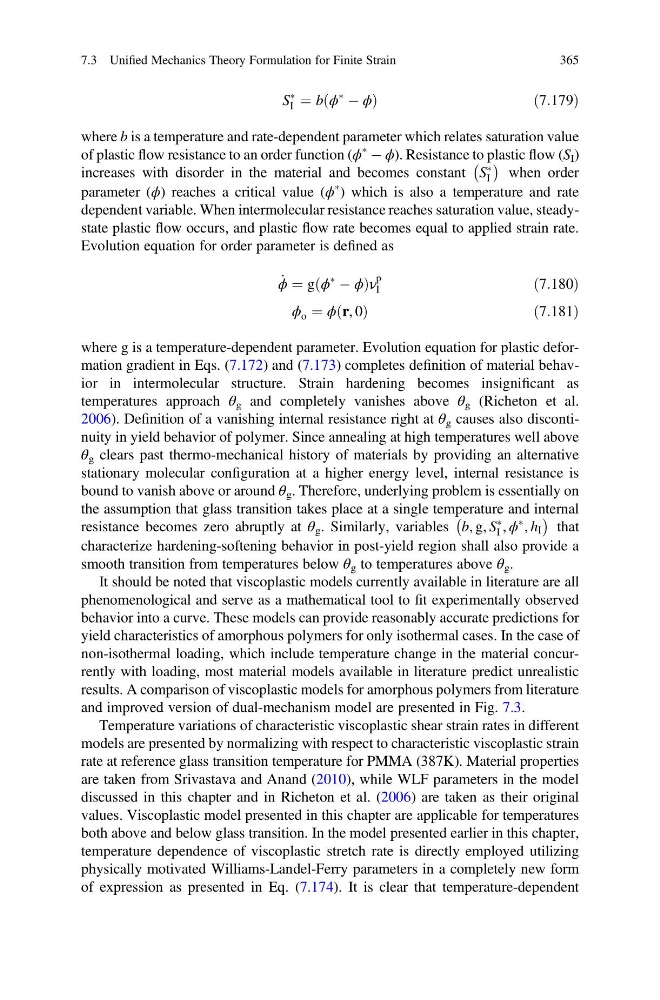
where b is a temperature and rate-dependent parameter which relates saturation value
of plastic flow resistance to an order function (ϕ
Ã
À ϕ). Resistance to plastic flow (S I )
increases with disorder in the material and becomes constant S
Ã
I
À Á
when order
parameter (ϕ) reaches a critical value (ϕ
à ) which is also a temperature and rate
dependent variable. When intermolecular resistance reaches saturation value, steadystate plastic flow occurs, and plastic flow rate becomes equal to applied strain rate.
Evolution equation for order parameter is defined as
_
ϕ ¼ g ϕ
Ã
À ϕ
ð
Þν
p
I
ð7:180Þ
ϕ o ¼ ϕ r, 0
ð Þ
ð7:181Þ
where g is a temperature-dependent parameter. Evolution equation for plastic deformation gradient in Eqs. (7.172) and (7.173) completes definition of material behavior in intermolecular structure. Strain hardening becomes insignificant as
temperatures approach θ g and completely vanishes above θ g (Richeton et al.
2006). Definition of a vanishing internal resistance right at θ g causes also discontinuity in yield behavior of polymer. Since annealing at high temperatures well above
θ g clears past thermo-mechanical history of materials by providing an alternative
stationary molecular configuration at a higher energy level, internal resistance is
bound to vanish above or around θ g . Therefore, underlying problem is essentially on
the assumption that glass transition takes place at a single temperature and internal
resistance becomes zero abruptly at θ g . Similarly, variables b, g, S
Ã
I , ϕ
à , h I
À
Á
that
characterize hardening-softening behavior in post-yield region shall also provide a
smooth transition from temperatures below θ g to temperatures above θ g .
It should be noted that viscoplastic models currently available in literature are all
phenomenological and serve as a mathematical tool to fit experimentally observed
behavior into a curve. These models can provide reasonably accurate predictions for
yield characteristics of amorphous polymers for only isothermal cases. In the case of
non-isothermal loading, which include temperature change in the material concurrently with loading, most material models available in literature predict unrealistic
results. A comparison of viscoplastic models for amorphous polymers from literature
and improved version of dual-mechanism model are presented in Fig. 7.3.
Temperature variations of characteristic viscoplastic shear strain rates in different
models are presented by normalizing with respect to characteristic viscoplastic strain
rate at reference glass transition temperature for PMMA (387K). Material properties
are taken from Srivastava and Anand (2010), while WLF parameters in the model
discussed in this chapter and in Richeton et al. (2006) are taken as their original
values. Viscoplastic model presented in this chapter are applicable for temperatures
both above and below glass transition. In the model presented earlier in this chapter,
temperature dependence of viscoplastic stretch rate is directly employed utilizing
physically motivated Williams-Landel-Ferry parameters in a completely new form
of expression as presented in Eq. (7.174). It is clear that temperature-dependent
7.3 Unified Mechanics Theory Formulation for Finite Strain
365
Ã
I ¼ b ϕ
Ã
À ϕ
ð
Þ
ð7:179Þ
where b is a temperature and rate-dependent parameter which relates saturation value
of plastic flow resistance to an order function (ϕ
Ã
À ϕ). Resistance to plastic flow (S I )
increases with disorder in the material and becomes constant S
Ã
I
À Á
when order
parameter (ϕ) reaches a critical value (ϕ
à ) which is also a temperature and rate
dependent variable. When intermolecular resistance reaches saturation value, steadystate plastic flow occurs, and plastic flow rate becomes equal to applied strain rate.
Evolution equation for order parameter is defined as
_
ϕ ¼ g ϕ
Ã
À ϕ
ð
Þν
p
I
ð7:180Þ
ϕ o ¼ ϕ r, 0
ð Þ
ð7:181Þ
where g is a temperature-dependent parameter. Evolution equation for plastic deformation gradient in Eqs. (7.172) and (7.173) completes definition of material behavior in intermolecular structure. Strain hardening becomes insignificant as
temperatures approach θ g and completely vanishes above θ g (Richeton et al.
2006). Definition of a vanishing internal resistance right at θ g causes also discontinuity in yield behavior of polymer. Since annealing at high temperatures well above
θ g clears past thermo-mechanical history of materials by providing an alternative
stationary molecular configuration at a higher energy level, internal resistance is
bound to vanish above or around θ g . Therefore, underlying problem is essentially on
the assumption that glass transition takes place at a single temperature and internal
resistance becomes zero abruptly at θ g . Similarly, variables b, g, S
Ã
I , ϕ
à , h I
À
Á
that
characterize hardening-softening behavior in post-yield region shall also provide a
smooth transition from temperatures below θ g to temperatures above θ g .
It should be noted that viscoplastic models currently available in literature are all
phenomenological and serve as a mathematical tool to fit experimentally observed
behavior into a curve. These models can provide reasonably accurate predictions for
yield characteristics of amorphous polymers for only isothermal cases. In the case of
non-isothermal loading, which include temperature change in the material concurrently with loading, most material models available in literature predict unrealistic
results. A comparison of viscoplastic models for amorphous polymers from literature
and improved version of dual-mechanism model are presented in Fig. 7.3.
Temperature variations of characteristic viscoplastic shear strain rates in different
models are presented by normalizing with respect to characteristic viscoplastic strain
rate at reference glass transition temperature for PMMA (387K). Material properties
are taken from Srivastava and Anand (2010), while WLF parameters in the model
discussed in this chapter and in Richeton et al. (2006) are taken as their original
values. Viscoplastic model presented in this chapter are applicable for temperatures
both above and below glass transition. In the model presented earlier in this chapter,
temperature dependence of viscoplastic stretch rate is directly employed utilizing
physically motivated Williams-Landel-Ferry parameters in a completely new form
of expression as presented in Eq. (7.174). It is clear that temperature-dependent
7.3 Unified Mechanics Theory Formulation for Finite Strain
365