

low temperatures near secondary transition temperature (θ β ), secondary molecular
motions are restricted and chains become stiffer which also increase yield stress,
while increase in temperature provides more energy to polymer chains facilitating
relative motion between polymer molecular chains. For temperatures above glass
transition temperature θ g , characteristic plastic strain rate equation was modified by
Williams-Landel-Ferry (WLF) parameters (c 1 , c 2 ). Although characteristic plastic
strain rate definitions at temperatures below and above θ g are continuous functions
of temperature in separate domains, piece-wise definition with respect to glass
transition (θ g ) results in unrealistic change in plastic flow behavior around glass
transition, i.e., derivative of plastic strain rate equation is discontinuous at θ g .
Srivastava and Anand (2010) proposed a modified version of flow rule in
intermolecular structure which incorporates different values of activation energy
for glassy region and rubbery region but still abrupt change in activation energies at
θ g which creates problem in material response. In order to provide a smoother
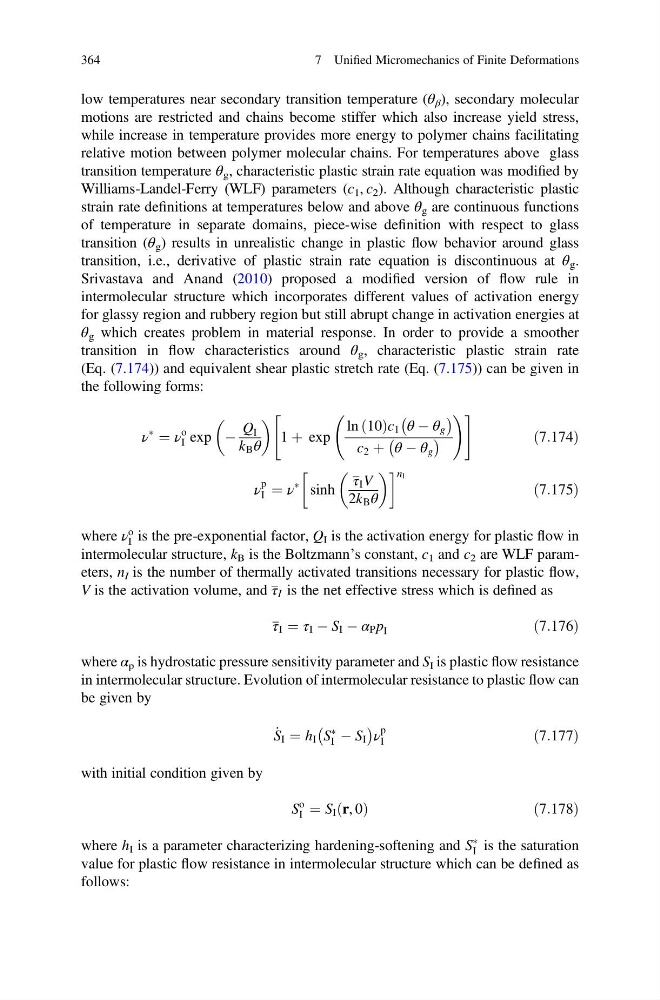
transition in flow characteristics around θ g , characteristic plastic strain rate
(Eq. (7.174)) and equivalent shear plastic stretch rate (Eq. (7.175)) can be given in
the following forms:
ν
Ã
¼ ν
o
I exp À
Q I
k B θ
1 þ exp
ln 10
ð Þc 1 θ À θ g
À
Á
c 2 þ θ À θ g
À
Á
!
"
#
ð7:174Þ
ν
p
I ¼ ν
à sinh
τ I V
2k B θ
! n I
ð7:175Þ
where ν
o
I is the pre-exponential factor, Q I is the activation energy for plastic flow in
intermolecular structure, k B is the Boltzmann’s constant, c 1 and c 2 are WLF parameters, n I is the number of thermally activated transitions necessary for plastic flow,
V is the activation volume, and τ I is the net effective stress which is defined as
τ I ¼ τ I À S I À α P p I
ð7:176Þ
where α p is hydrostatic pressure sensitivity parameter and S I is plastic flow resistance
in intermolecular structure. Evolution of intermolecular resistance to plastic flow can
be given by
_
S I ¼ h I S
Ã
I À S I
À
Á ν
p
I
ð7:177Þ
with initial condition given by
S
o
I ¼ S I r, 0
ð Þ
ð7:178Þ
where h I is a parameter characterizing hardening-softening and S
Ã
I is the saturation
value for plastic flow resistance in intermolecular structure which can be defined as
follows:
364
7 Unified Micromechanics of Finite Deformations
motions are restricted and chains become stiffer which also increase yield stress,
while increase in temperature provides more energy to polymer chains facilitating
relative motion between polymer molecular chains. For temperatures above glass
transition temperature θ g , characteristic plastic strain rate equation was modified by
Williams-Landel-Ferry (WLF) parameters (c 1 , c 2 ). Although characteristic plastic
strain rate definitions at temperatures below and above θ g are continuous functions
of temperature in separate domains, piece-wise definition with respect to glass
transition (θ g ) results in unrealistic change in plastic flow behavior around glass
transition, i.e., derivative of plastic strain rate equation is discontinuous at θ g .
Srivastava and Anand (2010) proposed a modified version of flow rule in
intermolecular structure which incorporates different values of activation energy
for glassy region and rubbery region but still abrupt change in activation energies at
θ g which creates problem in material response. In order to provide a smoother
transition in flow characteristics around θ g , characteristic plastic strain rate
(Eq. (7.174)) and equivalent shear plastic stretch rate (Eq. (7.175)) can be given in
the following forms:
ν
Ã
¼ ν
o
I exp À
Q I
k B θ
1 þ exp
ln 10
ð Þc 1 θ À θ g
À
Á
c 2 þ θ À θ g
À
Á
!
"
#
ð7:174Þ
ν
p
I ¼ ν
à sinh
τ I V
2k B θ
! n I
ð7:175Þ
where ν
o
I is the pre-exponential factor, Q I is the activation energy for plastic flow in
intermolecular structure, k B is the Boltzmann’s constant, c 1 and c 2 are WLF parameters, n I is the number of thermally activated transitions necessary for plastic flow,
V is the activation volume, and τ I is the net effective stress which is defined as
τ I ¼ τ I À S I À α P p I
ð7:176Þ
where α p is hydrostatic pressure sensitivity parameter and S I is plastic flow resistance
in intermolecular structure. Evolution of intermolecular resistance to plastic flow can
be given by
_
S I ¼ h I S
Ã
I À S I
À
Á ν
p
I
ð7:177Þ
with initial condition given by
S
o
I ¼ S I r, 0
ð Þ
ð7:178Þ
where h I is a parameter characterizing hardening-softening and S
Ã
I is the saturation
value for plastic flow resistance in intermolecular structure which can be defined as
follows:
364
7 Unified Micromechanics of Finite Deformations