

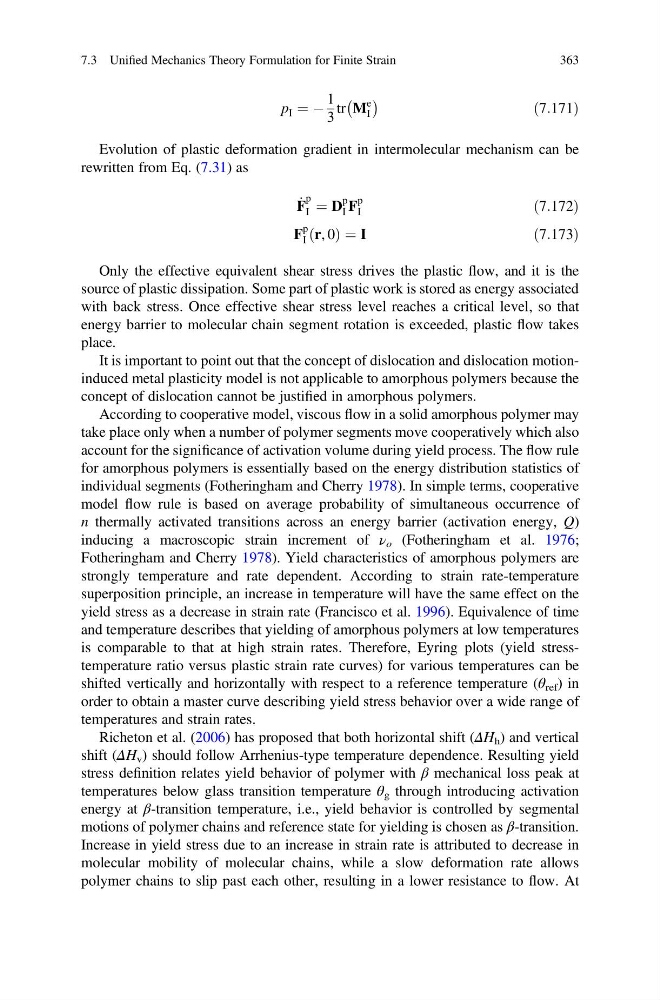
p I ¼ À
1
3
tr M
e
I
À Á
ð7:171Þ
Evolution of plastic deformation gradient in intermolecular mechanism can be
rewritten from Eq. (7.31) as
_
F
p
I ¼ D
p
I F
p
I
ð7:172Þ
F
p
I r, 0
ð Þ ¼ I
ð7:173Þ
Only the effective equivalent shear stress drives the plastic flow, and it is the
source of plastic dissipation. Some part of plastic work is stored as energy associated
with back stress. Once effective shear stress level reaches a critical level, so that
energy barrier to molecular chain segment rotation is exceeded, plastic flow takes
place.
It is important to point out that the concept of dislocation and dislocation motioninduced metal plasticity model is not applicable to amorphous polymers because the
concept of dislocation cannot be justified in amorphous polymers.
According to cooperative model, viscous flow in a solid amorphous polymer may
take place only when a number of polymer segments move cooperatively which also
account for the significance of activation volume during yield process. The flow rule
for amorphous polymers is essentially based on the energy distribution statistics of
individual segments (Fotheringham and Cherry 1978). In simple terms, cooperative
model flow rule is based on average probability of simultaneous occurrence of
n thermally activated transitions across an energy barrier (activation energy, Q)
inducing a macroscopic strain increment of ν o (Fotheringham et al. 1976;
Fotheringham and Cherry 1978). Yield characteristics of amorphous polymers are
strongly temperature and rate dependent. According to strain rate-temperature
superposition principle, an increase in temperature will have the same effect on the
yield stress as a decrease in strain rate (Francisco et al. 1996). Equivalence of time
and temperature describes that yielding of amorphous polymers at low temperatures
is comparable to that at high strain rates. Therefore, Eyring plots (yield stresstemperature ratio versus plastic strain rate curves) for various temperatures can be
shifted vertically and horizontally with respect to a reference temperature (θ ref ) in
order to obtain a master curve describing yield stress behavior over a wide range of
temperatures and strain rates.
Richeton et al. (2006) has proposed that both horizontal shift (ΔH h ) and vertical
shift (ΔH v ) should follow Arrhenius-type temperature dependence. Resulting yield
stress definition relates yield behavior of polymer with β mechanical loss peak at
temperatures below glass transition temperature θ g through introducing activation
energy at β-transition temperature, i.e., yield behavior is controlled by segmental
motions of polymer chains and reference state for yielding is chosen as β-transition.
Increase in yield stress due to an increase in strain rate is attributed to decrease in
molecular mobility of molecular chains, while a slow deformation rate allows
polymer chains to slip past each other, resulting in a lower resistance to flow. At
7.3 Unified Mechanics Theory Formulation for Finite Strain
363
1
3
tr M
e
I
À Á
ð7:171Þ
Evolution of plastic deformation gradient in intermolecular mechanism can be
rewritten from Eq. (7.31) as
_
F
p
I ¼ D
p
I F
p
I
ð7:172Þ
F
p
I r, 0
ð Þ ¼ I
ð7:173Þ
Only the effective equivalent shear stress drives the plastic flow, and it is the
source of plastic dissipation. Some part of plastic work is stored as energy associated
with back stress. Once effective shear stress level reaches a critical level, so that
energy barrier to molecular chain segment rotation is exceeded, plastic flow takes
place.
It is important to point out that the concept of dislocation and dislocation motioninduced metal plasticity model is not applicable to amorphous polymers because the
concept of dislocation cannot be justified in amorphous polymers.
According to cooperative model, viscous flow in a solid amorphous polymer may
take place only when a number of polymer segments move cooperatively which also
account for the significance of activation volume during yield process. The flow rule
for amorphous polymers is essentially based on the energy distribution statistics of
individual segments (Fotheringham and Cherry 1978). In simple terms, cooperative
model flow rule is based on average probability of simultaneous occurrence of
n thermally activated transitions across an energy barrier (activation energy, Q)
inducing a macroscopic strain increment of ν o (Fotheringham et al. 1976;
Fotheringham and Cherry 1978). Yield characteristics of amorphous polymers are
strongly temperature and rate dependent. According to strain rate-temperature
superposition principle, an increase in temperature will have the same effect on the
yield stress as a decrease in strain rate (Francisco et al. 1996). Equivalence of time
and temperature describes that yielding of amorphous polymers at low temperatures
is comparable to that at high strain rates. Therefore, Eyring plots (yield stresstemperature ratio versus plastic strain rate curves) for various temperatures can be
shifted vertically and horizontally with respect to a reference temperature (θ ref ) in
order to obtain a master curve describing yield stress behavior over a wide range of
temperatures and strain rates.
Richeton et al. (2006) has proposed that both horizontal shift (ΔH h ) and vertical
shift (ΔH v ) should follow Arrhenius-type temperature dependence. Resulting yield
stress definition relates yield behavior of polymer with β mechanical loss peak at
temperatures below glass transition temperature θ g through introducing activation
energy at β-transition temperature, i.e., yield behavior is controlled by segmental
motions of polymer chains and reference state for yielding is chosen as β-transition.
Increase in yield stress due to an increase in strain rate is attributed to decrease in
molecular mobility of molecular chains, while a slow deformation rate allows
polymer chains to slip past each other, resulting in a lower resistance to flow. At
7.3 Unified Mechanics Theory Formulation for Finite Strain
363