

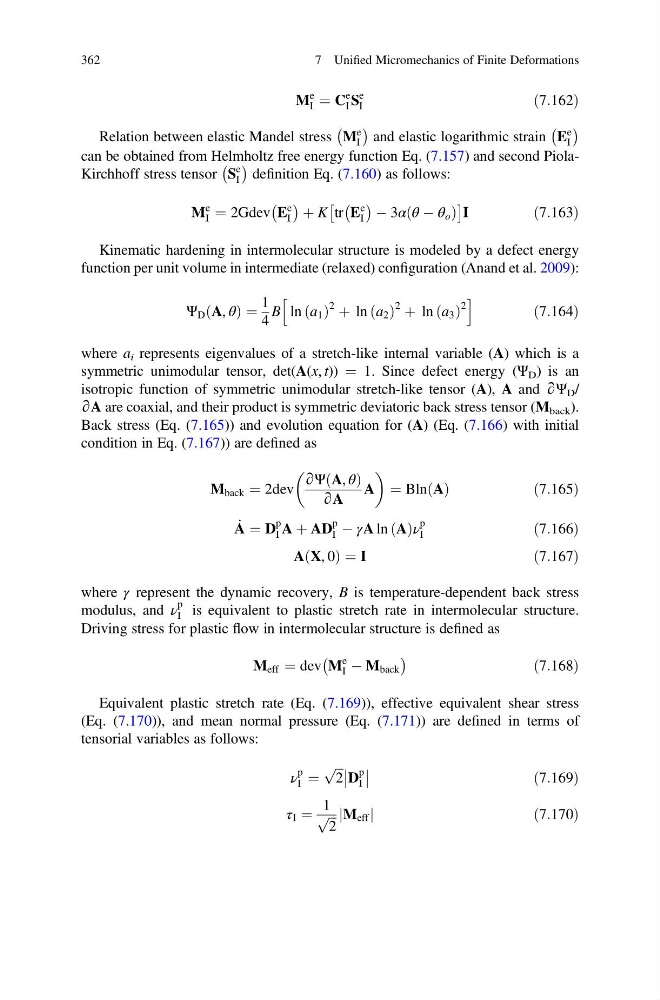
M
e
I ¼ C
e
I S
e
I
ð7:162Þ
Relation between elastic Mandel stress M
e
I
À Á
and elastic logarithmic strain E
e
I
À Á
can be obtained from Helmholtz free energy function Eq. (7.157) and second PiolaKirchhoff stress tensor S
e
I
À Á
definition Eq. (7.160) as follows:
M
e
I ¼ 2Gdev E
e
I
À Á þ K tr E
e
I
À Á À 3α θ À θ o
ð
Þ
Â
Ã
I
ð7:163Þ
Kinematic hardening in intermolecular structure is modeled by a defect energy
function per unit volume in intermediate (relaxed) configuration (Anand et al. 2009):
Ψ D A, θ
ð
Þ ¼
1
4
B ln a 1
ð Þ
2 þ ln a 2
ð Þ
2 þ ln a 3
ð Þ
2
h
i
ð7:164Þ
where a i represents eigenvalues of a stretch-like internal variable (A) which is a
symmetric unimodular tensor, det(A(x, t)) ¼ 1. Since defect energy (Ψ D ) is an
isotropic function of symmetric unimodular stretch-like tensor (A), A and ∂Ψ D /
∂A are coaxial, and their product is symmetric deviatoric back stress tensor (M back ).
Back stress (Eq. (7.165)) and evolution equation for (A) (Eq. (7.166) with initial
condition in Eq. (7.167)) are defined as
M back ¼ 2dev
∂Ψ A, θ
ð
Þ
∂A
A
¼ Bln A
ð Þ
ð7:165Þ
_
A ¼ D
p
I A þ AD
p
I À γA ln A
ð Þν
p
I
ð7:166Þ
A X, 0
ð
Þ ¼ I
ð7:167Þ
where γ represent the dynamic recovery, B is temperature-dependent back stress
modulus, and ν
p
I is equivalent to plastic stretch rate in intermolecular structure.
Driving stress for plastic flow in intermolecular structure is defined as
M eff ¼ dev M
e
I À M back
À
Á
ð7:168Þ
Equivalent plastic stretch rate (Eq. (7.169)), effective equivalent shear stress
(Eq. (7.170)), and mean normal pressure (Eq. (7.171)) are defined in terms of
tensorial variables as follows:
ν
p
I ¼
ffiffi ffi
2
p
D
p
I
ð7:169Þ
τ I ¼
1
ffiffi ffi
2
p M eff
j
j
ð7:170Þ
362
7 Unified Micromechanics of Finite Deformations
e
I ¼ C
e
I S
e
I
ð7:162Þ
Relation between elastic Mandel stress M
e
I
À Á
and elastic logarithmic strain E
e
I
À Á
can be obtained from Helmholtz free energy function Eq. (7.157) and second PiolaKirchhoff stress tensor S
e
I
À Á
definition Eq. (7.160) as follows:
M
e
I ¼ 2Gdev E
e
I
À Á þ K tr E
e
I
À Á À 3α θ À θ o
ð
Þ
Â
Ã
I
ð7:163Þ
Kinematic hardening in intermolecular structure is modeled by a defect energy
function per unit volume in intermediate (relaxed) configuration (Anand et al. 2009):
Ψ D A, θ
ð
Þ ¼
1
4
B ln a 1
ð Þ
2 þ ln a 2
ð Þ
2 þ ln a 3
ð Þ
2
h
i
ð7:164Þ
where a i represents eigenvalues of a stretch-like internal variable (A) which is a
symmetric unimodular tensor, det(A(x, t)) ¼ 1. Since defect energy (Ψ D ) is an
isotropic function of symmetric unimodular stretch-like tensor (A), A and ∂Ψ D /
∂A are coaxial, and their product is symmetric deviatoric back stress tensor (M back ).
Back stress (Eq. (7.165)) and evolution equation for (A) (Eq. (7.166) with initial
condition in Eq. (7.167)) are defined as
M back ¼ 2dev
∂Ψ A, θ
ð
Þ
∂A
A
¼ Bln A
ð Þ
ð7:165Þ
_
A ¼ D
p
I A þ AD
p
I À γA ln A
ð Þν
p
I
ð7:166Þ
A X, 0
ð
Þ ¼ I
ð7:167Þ
where γ represent the dynamic recovery, B is temperature-dependent back stress
modulus, and ν
p
I is equivalent to plastic stretch rate in intermolecular structure.
Driving stress for plastic flow in intermolecular structure is defined as
M eff ¼ dev M
e
I À M back
À
Á
ð7:168Þ
Equivalent plastic stretch rate (Eq. (7.169)), effective equivalent shear stress
(Eq. (7.170)), and mean normal pressure (Eq. (7.171)) are defined in terms of
tensorial variables as follows:
ν
p
I ¼
ffiffi ffi
2
p
D
p
I
ð7:169Þ
τ I ¼
1
ffiffi ffi
2
p M eff
j
j
ð7:170Þ
362
7 Unified Micromechanics of Finite Deformations