

intermolecular and molecular network components of associated quantity,
respectively.
F ¼ F I ¼ F M
ð7:155Þ
T ¼ T I þ T M
ð7:156Þ
7.3.2.1 Intermolecular Resistance (I)
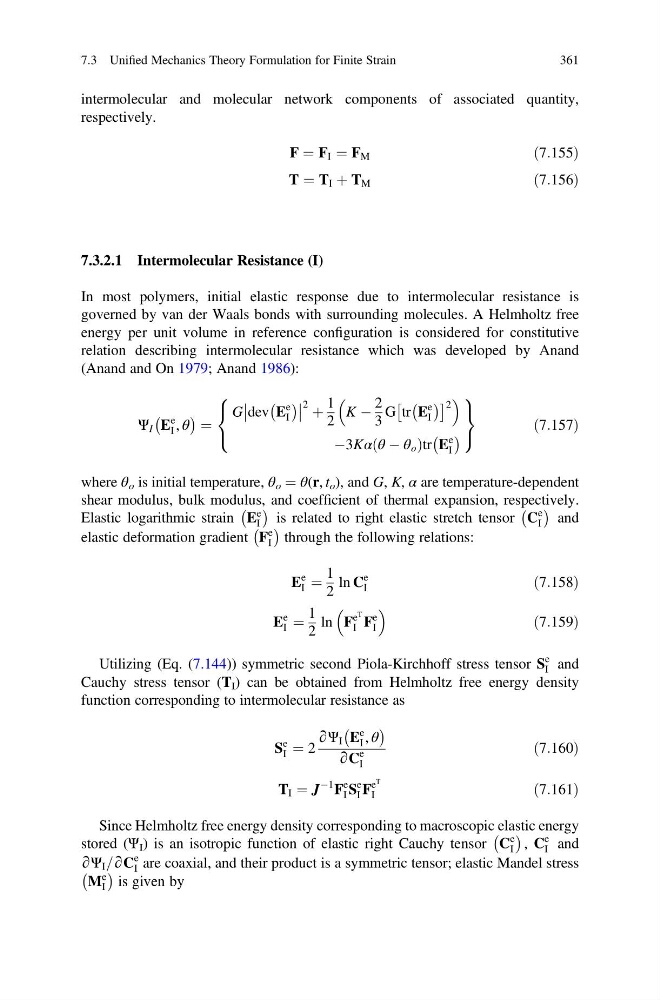
In most polymers, initial elastic response due to intermolecular resistance is
governed by van der Waals bonds with surrounding molecules. A Helmholtz free
energy per unit volume in reference configuration is considered for constitutive
relation describing intermolecular resistance which was developed by Anand
(Anand and On 1979; Anand 1986):
Ψ I E
e
I , θ
À
Á ¼
G dev E
e
I
À Á
2 þ
1
2
K À
2
3
G tr E
e
I
À Á
Â
à 2
À3Kα θ À θ o
ð
Þtr E
e
I
À Á
8
<
:
9
=
;
ð7:157Þ
where θ o is initial temperature, θ o ¼ θ(r, t o ), and G, K, α are temperature-dependent
shear modulus, bulk modulus, and coefficient of thermal expansion, respectively.
Elastic logarithmic strain E
e
I
À Á
is related to right elastic stretch tensor C
e
I
À Á
and
elastic deformation gradient F
e
I
À Á
through the following relations:
E
e
I ¼
1
2
ln C
e
I
ð7:158Þ
E
e
I ¼
1
2
ln F
e
T
I F
e
I
ð7:159Þ
Utilizing (Eq. (7.144)) symmetric second Piola-Kirchhoff stress tensor S
e
I and
Cauchy stress tensor (T I ) can be obtained from Helmholtz free energy density
function corresponding to intermolecular resistance as
S
e
I ¼ 2
∂Ψ I E
e
I , θ
À
Á
∂C
e
I
ð7:160Þ
T I ¼ J
À1 F
e
I S
e
I F
e
T
I
ð7:161Þ
Since Helmholtz free energy density corresponding to macroscopic elastic energy
stored (Ψ I ) is an isotropic function of elastic right Cauchy tensor C
e
I
À Á
, C
e
I and
∂Ψ I =∂C
e
I are coaxial, and their product is a symmetric tensor; elastic Mandel stress
M
e
I
À Á
is given by
7.3 Unified Mechanics Theory Formulation for Finite Strain
361
respectively.
F ¼ F I ¼ F M
ð7:155Þ
T ¼ T I þ T M
ð7:156Þ
7.3.2.1 Intermolecular Resistance (I)
In most polymers, initial elastic response due to intermolecular resistance is
governed by van der Waals bonds with surrounding molecules. A Helmholtz free
energy per unit volume in reference configuration is considered for constitutive
relation describing intermolecular resistance which was developed by Anand
(Anand and On 1979; Anand 1986):
Ψ I E
e
I , θ
À
Á ¼
G dev E
e
I
À Á
2 þ
1
2
K À
2
3
G tr E
e
I
À Á
Â
à 2
À3Kα θ À θ o
ð
Þtr E
e
I
À Á
8
<
:
9
=
;
ð7:157Þ
where θ o is initial temperature, θ o ¼ θ(r, t o ), and G, K, α are temperature-dependent
shear modulus, bulk modulus, and coefficient of thermal expansion, respectively.
Elastic logarithmic strain E
e
I
À Á
is related to right elastic stretch tensor C
e
I
À Á
and
elastic deformation gradient F
e
I
À Á
through the following relations:
E
e
I ¼
1
2
ln C
e
I
ð7:158Þ
E
e
I ¼
1
2
ln F
e
T
I F
e
I
ð7:159Þ
Utilizing (Eq. (7.144)) symmetric second Piola-Kirchhoff stress tensor S
e
I and
Cauchy stress tensor (T I ) can be obtained from Helmholtz free energy density
function corresponding to intermolecular resistance as
S
e
I ¼ 2
∂Ψ I E
e
I , θ
À
Á
∂C
e
I
ð7:160Þ
T I ¼ J
À1 F
e
I S
e
I F
e
T
I
ð7:161Þ
Since Helmholtz free energy density corresponding to macroscopic elastic energy
stored (Ψ I ) is an isotropic function of elastic right Cauchy tensor C
e
I
À Á
, C
e
I and
∂Ψ I =∂C
e
I are coaxial, and their product is a symmetric tensor; elastic Mandel stress
M
e
I
À Á
is given by
7.3 Unified Mechanics Theory Formulation for Finite Strain
361