

c ¼ θ
∂s E
e
I , C
e
M , A, θ
À
Á
∂θ
ð7:151Þ
c ¼ θ
∂s I E
e
I , θ
À
Á
∂θ
þ
∂s M C
e
M , θ
À
Á
∂θ
þ
∂s D A, θ
ð
Þ
∂θ
ð7:152Þ
c ¼ Àθ
∂
∂θ
J
À1
ρ
∂Ψ E
e
I , C
e
M , A, θ
À
Á
∂θ
!
ð7:153Þ
c ¼ Àθ
∂
∂θ
J
À1
ρ
∂Ψ I E
e
I , θ
À
Á
∂θ
þ
∂Ψ M C
e
M , θ
À
Á
∂θ
þ
∂Ψ D A, θ
ð
Þ
∂θ
!
ð7:154Þ
7.3.2 Constitutive Relations
In viscoplastic constitutive modeling of amorphous polymers for large deformations,
dual decomposition of material response into two parallel working mechanisms of
intermolecular structure and molecular network structure is widely used, Gunel and
Basaran (2009, 2011a, 2011b). More recently, a trial mechanism has been also
proposed to include a secondary mechanism for molecular network structure
(Srivastava and Anand 2010). Both dual- and triple-mechanism models are proven
to be successful in describing large deformation behavior of amorphous polymers at
different isothermal test conditions. In order to extend applicability of such models
to non-isothermal conditions, several refinements on material property definitions
and viscoplastic flow rule definitions are necessary.
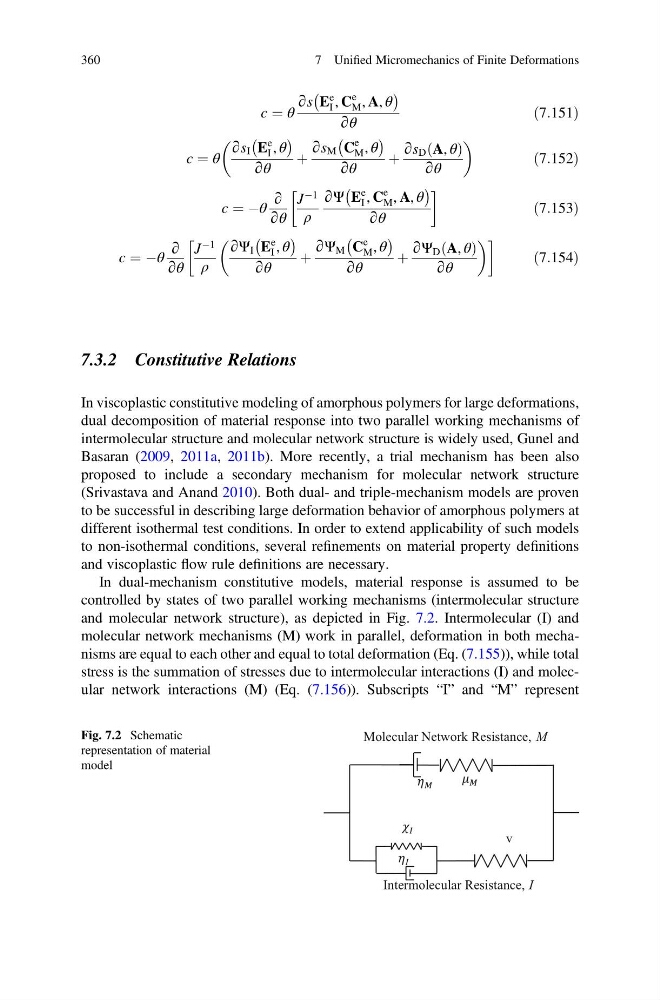
In dual-mechanism constitutive models, material response is assumed to be
controlled by states of two parallel working mechanisms (intermolecular structure
and molecular network structure), as depicted in Fig. 7.2. Intermolecular (I) and
molecular network mechanisms (M) work in parallel, deformation in both mechanisms are equal to each other and equal to total deformation (Eq. (7.155)), while total
stress is the summation of stresses due to intermolecular interactions (I) and molecular network interactions (M) (Eq. (7.156)). Subscripts “I” and “M” represent
Molecular Network Resistance, M
Intermolecular Resistance, I
v
Fig. 7.2 Schematic
representation of material
model
360
7 Unified Micromechanics of Finite Deformations
∂s E
e
I , C
e
M , A, θ
À
Á
∂θ
ð7:151Þ
c ¼ θ
∂s I E
e
I , θ
À
Á
∂θ
þ
∂s M C
e
M , θ
À
Á
∂θ
þ
∂s D A, θ
ð
Þ
∂θ
ð7:152Þ
c ¼ Àθ
∂
∂θ
J
À1
ρ
∂Ψ E
e
I , C
e
M , A, θ
À
Á
∂θ
!
ð7:153Þ
c ¼ Àθ
∂
∂θ
J
À1
ρ
∂Ψ I E
e
I , θ
À
Á
∂θ
þ
∂Ψ M C
e
M , θ
À
Á
∂θ
þ
∂Ψ D A, θ
ð
Þ
∂θ
!
ð7:154Þ
7.3.2 Constitutive Relations
In viscoplastic constitutive modeling of amorphous polymers for large deformations,
dual decomposition of material response into two parallel working mechanisms of
intermolecular structure and molecular network structure is widely used, Gunel and
Basaran (2009, 2011a, 2011b). More recently, a trial mechanism has been also
proposed to include a secondary mechanism for molecular network structure
(Srivastava and Anand 2010). Both dual- and triple-mechanism models are proven
to be successful in describing large deformation behavior of amorphous polymers at
different isothermal test conditions. In order to extend applicability of such models
to non-isothermal conditions, several refinements on material property definitions
and viscoplastic flow rule definitions are necessary.
In dual-mechanism constitutive models, material response is assumed to be
controlled by states of two parallel working mechanisms (intermolecular structure
and molecular network structure), as depicted in Fig. 7.2. Intermolecular (I) and
molecular network mechanisms (M) work in parallel, deformation in both mechanisms are equal to each other and equal to total deformation (Eq. (7.155)), while total
stress is the summation of stresses due to intermolecular interactions (I) and molecular network interactions (M) (Eq. (7.156)). Subscripts “I” and “M” represent
Molecular Network Resistance, M
Intermolecular Resistance, I
v
Fig. 7.2 Schematic
representation of material
model
360
7 Unified Micromechanics of Finite Deformations