

7.2 Frame of Reference Indifference
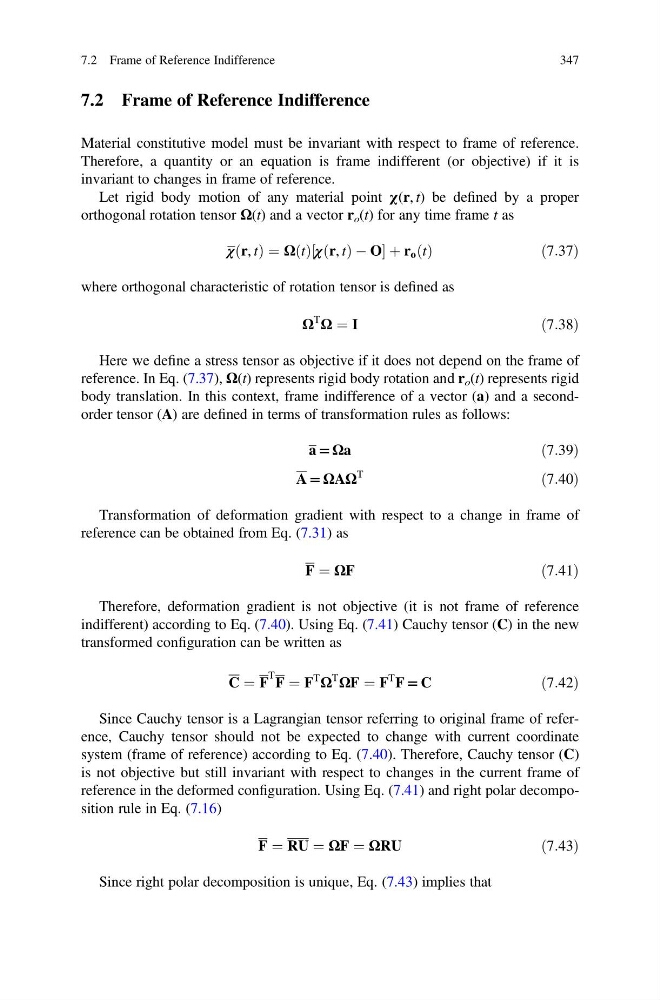
Material constitutive model must be invariant with respect to frame of reference.
Therefore, a quantity or an equation is frame indifferent (or objective) if it is
invariant to changes in frame of reference.
Let rigid body motion of any material point χ(r, t) be defined by a proper
orthogonal rotation tensor Ω(t) and a vector r o (t) for any time frame t as
χ r, t
ð Þ ¼ Ω t
ð Þ χ r, t
ð Þ À O
½
þr o t
ð Þ
ð7:37Þ
where orthogonal characteristic of rotation tensor is defined as
Ω
T
Ω ¼ I
ð7:38Þ
Here we define a stress tensor as objective if it does not depend on the frame of
reference. In Eq. (7.37), Ω(t) represents rigid body rotation and r o (t) represents rigid
body translation. In this context, frame indifference of a vector (a) and a secondorder tensor (A) are defined in terms of transformation rules as follows:
a = Ωa
ð7:39Þ
A = ΩAΩ
T
ð7:40Þ
Transformation of deformation gradient with respect to a change in frame of
reference can be obtained from Eq. (7.31) as
F ¼ ΩF
ð7:41Þ
Therefore, deformation gradient is not objective (it is not frame of reference
indifferent) according to Eq. (7.40). Using Eq. (7.41) Cauchy tensor (C) in the new
transformed configuration can be written as
C ¼ F
T F ¼ F
T
Ω
T
ΩF ¼ F
T F = C
ð7:42Þ
Since Cauchy tensor is a Lagrangian tensor referring to original frame of reference, Cauchy tensor should not be expected to change with current coordinate
system (frame of reference) according to Eq. (7.40). Therefore, Cauchy tensor (C)
is not objective but still invariant with respect to changes in the current frame of
reference in the deformed configuration. Using Eq. (7.41) and right polar decomposition rule in Eq. (7.16)
F ¼ RU ¼ ΩF ¼ ΩRU
ð7:43Þ
Since right polar decomposition is unique, Eq. (7.43) implies that
7.2 Frame of Reference Indifference
347
Material constitutive model must be invariant with respect to frame of reference.
Therefore, a quantity or an equation is frame indifferent (or objective) if it is
invariant to changes in frame of reference.
Let rigid body motion of any material point χ(r, t) be defined by a proper
orthogonal rotation tensor Ω(t) and a vector r o (t) for any time frame t as
χ r, t
ð Þ ¼ Ω t
ð Þ χ r, t
ð Þ À O
½
þr o t
ð Þ
ð7:37Þ
where orthogonal characteristic of rotation tensor is defined as
Ω
T
Ω ¼ I
ð7:38Þ
Here we define a stress tensor as objective if it does not depend on the frame of
reference. In Eq. (7.37), Ω(t) represents rigid body rotation and r o (t) represents rigid
body translation. In this context, frame indifference of a vector (a) and a secondorder tensor (A) are defined in terms of transformation rules as follows:
a = Ωa
ð7:39Þ
A = ΩAΩ
T
ð7:40Þ
Transformation of deformation gradient with respect to a change in frame of
reference can be obtained from Eq. (7.31) as
F ¼ ΩF
ð7:41Þ
Therefore, deformation gradient is not objective (it is not frame of reference
indifferent) according to Eq. (7.40). Using Eq. (7.41) Cauchy tensor (C) in the new
transformed configuration can be written as
C ¼ F
T F ¼ F
T
Ω
T
ΩF ¼ F
T F = C
ð7:42Þ
Since Cauchy tensor is a Lagrangian tensor referring to original frame of reference, Cauchy tensor should not be expected to change with current coordinate
system (frame of reference) according to Eq. (7.40). Therefore, Cauchy tensor (C)
is not objective but still invariant with respect to changes in the current frame of
reference in the deformed configuration. Using Eq. (7.41) and right polar decomposition rule in Eq. (7.16)
F ¼ RU ¼ ΩF ¼ ΩRU
ð7:43Þ
Since right polar decomposition is unique, Eq. (7.43) implies that
7.2 Frame of Reference Indifference
347