

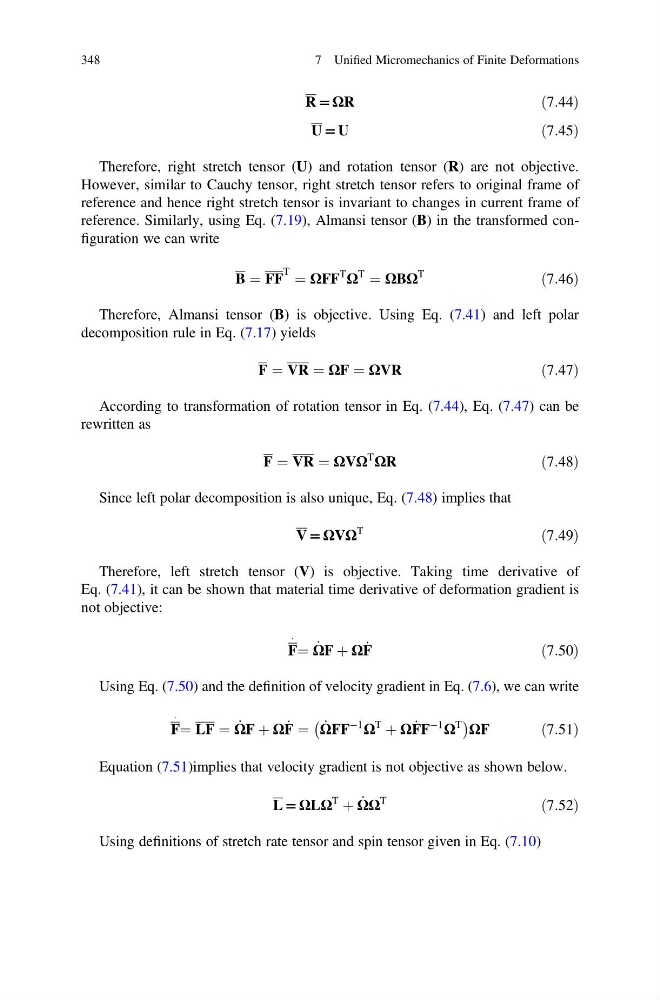
R = ΩR
ð7:44Þ
U = U
ð7:45Þ
Therefore, right stretch tensor (U) and rotation tensor (R) are not objective.
However, similar to Cauchy tensor, right stretch tensor refers to original frame of
reference and hence right stretch tensor is invariant to changes in current frame of
reference. Similarly, using Eq. (7.19), Almansi tensor (B) in the transformed configuration we can write
B ¼ FF
T ¼ ΩFF
T
Ω
T
¼ ΩBΩ
T
ð7:46Þ
Therefore, Almansi tensor (B) is objective. Using Eq. (7.41) and left polar
decomposition rule in Eq. (7.17) yields
F ¼ VR ¼ ΩF ¼ ΩVR
ð7:47Þ
According to transformation of rotation tensor in Eq. (7.44), Eq. (7.47) can be
rewritten as
F ¼ VR ¼ ΩVΩ
T
ΩR
ð7:48Þ
Since left polar decomposition is also unique, Eq. (7.48) implies that
V = ΩVΩ
T
ð7:49Þ
Therefore, left stretch tensor (V) is objective. Taking time derivative of
Eq. (7.41), it can be shown that material time derivative of deformation gradient is
not objective:
F
:
¼ _
ΩF þ Ω _
F
ð7:50Þ
Using Eq. (7.50) and the definition of velocity gradient in Eq. (7.6), we can write
F
:
¼ LF ¼ _
ΩF þ Ω _
F ¼ _
ΩFF
À1
Ω
T
þ Ω _
FF
À1
Ω
T
À
Á ΩF
ð7:51Þ
Equation (7.51)implies that velocity gradient is not objective as shown below.
L = ΩLΩ
T
þ _
ΩΩ
T
ð7:52Þ
Using definitions of stretch rate tensor and spin tensor given in Eq. (7.10)
348
7 Unified Micromechanics of Finite Deformations
ð7:44Þ
U = U
ð7:45Þ
Therefore, right stretch tensor (U) and rotation tensor (R) are not objective.
However, similar to Cauchy tensor, right stretch tensor refers to original frame of
reference and hence right stretch tensor is invariant to changes in current frame of
reference. Similarly, using Eq. (7.19), Almansi tensor (B) in the transformed configuration we can write
B ¼ FF
T ¼ ΩFF
T
Ω
T
¼ ΩBΩ
T
ð7:46Þ
Therefore, Almansi tensor (B) is objective. Using Eq. (7.41) and left polar
decomposition rule in Eq. (7.17) yields
F ¼ VR ¼ ΩF ¼ ΩVR
ð7:47Þ
According to transformation of rotation tensor in Eq. (7.44), Eq. (7.47) can be
rewritten as
F ¼ VR ¼ ΩVΩ
T
ΩR
ð7:48Þ
Since left polar decomposition is also unique, Eq. (7.48) implies that
V = ΩVΩ
T
ð7:49Þ
Therefore, left stretch tensor (V) is objective. Taking time derivative of
Eq. (7.41), it can be shown that material time derivative of deformation gradient is
not objective:
F
:
¼ _
ΩF þ Ω _
F
ð7:50Þ
Using Eq. (7.50) and the definition of velocity gradient in Eq. (7.6), we can write
F
:
¼ LF ¼ _
ΩF þ Ω _
F ¼ _
ΩFF
À1
Ω
T
þ Ω _
FF
À1
Ω
T
À
Á ΩF
ð7:51Þ
Equation (7.51)implies that velocity gradient is not objective as shown below.
L = ΩLΩ
T
þ _
ΩΩ
T
ð7:52Þ
Using definitions of stretch rate tensor and spin tensor given in Eq. (7.10)
348
7 Unified Micromechanics of Finite Deformations