

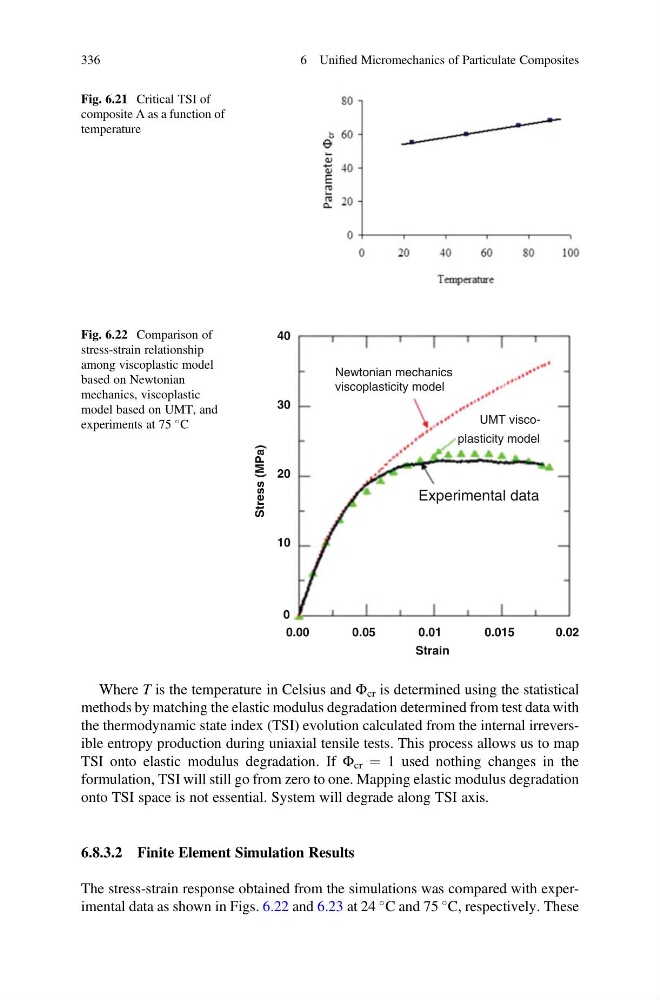
Where T is the temperature in Celsius and Φ cr is determined using the statistical
methods by matching the elastic modulus degradation determined from test data with
the thermodynamic state index (TSI) evolution calculated from the internal irreversible entropy production during uniaxial tensile tests. This process allows us to map
TSI onto elastic modulus degradation. If Φ cr ¼ 1 used nothing changes in the
formulation, TSI will still go from zero to one. Mapping elastic modulus degradation
onto TSI space is not essential. System will degrade along TSI axis.
6.8.3.2 Finite Element Simulation Results
The stress-strain response obtained from the simulations was compared with experimental data as shown in Figs. 6.22 and 6.23 at 24
C and 75
C, respectively. These
40
30
20
Stress (MPa)
10
0
0.00
0.05
0.01
0.015
0.02
Strain
Experimental data
UMT viscoplasticity model
Newtonian mechanics
viscoplasticity model
Fig. 6.22 Comparison of
stress-strain relationship
among viscoplastic model
based on Newtonian
mechanics, viscoplastic
model based on UMT, and
experiments at 75
C
Fig. 6.21 Critical TSI of
composite A as a function of
temperature
336
6 Unified Micromechanics of Particulate Composites
methods by matching the elastic modulus degradation determined from test data with
the thermodynamic state index (TSI) evolution calculated from the internal irreversible entropy production during uniaxial tensile tests. This process allows us to map
TSI onto elastic modulus degradation. If Φ cr ¼ 1 used nothing changes in the
formulation, TSI will still go from zero to one. Mapping elastic modulus degradation
onto TSI space is not essential. System will degrade along TSI axis.
6.8.3.2 Finite Element Simulation Results
The stress-strain response obtained from the simulations was compared with experimental data as shown in Figs. 6.22 and 6.23 at 24
C and 75
C, respectively. These
40
30
20
Stress (MPa)
10
0
0.00
0.05
0.01
0.015
0.02
Strain
Experimental data
UMT viscoplasticity model
Newtonian mechanics
viscoplasticity model
Fig. 6.22 Comparison of
stress-strain relationship
among viscoplastic model
based on Newtonian
mechanics, viscoplastic
model based on UMT, and
experiments at 75
C
Fig. 6.21 Critical TSI of
composite A as a function of
temperature
336
6 Unified Micromechanics of Particulate Composites