

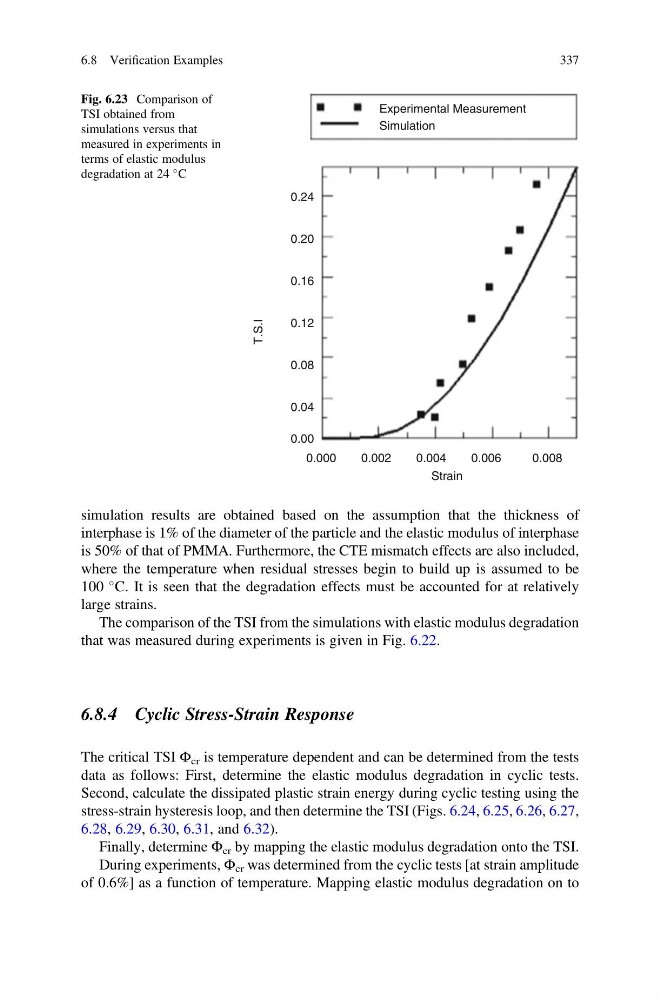
simulation results are obtained based on the assumption that the thickness of
interphase is 1% of the diameter of the particle and the elastic modulus of interphase
is 50% of that of PMMA. Furthermore, the CTE mismatch effects are also included,
where the temperature when residual stresses begin to build up is assumed to be
100
C. It is seen that the degradation effects must be accounted for at relatively
large strains.
The comparison of the TSI from the simulations with elastic modulus degradation
that was measured during experiments is given in Fig. 6.22.
6.8.4 Cyclic Stress-Strain Response
The critical TSI Φ cr is temperature dependent and can be determined from the tests
data as follows: First, determine the elastic modulus degradation in cyclic tests.
Second, calculate the dissipated plastic strain energy during cyclic testing using the
stress-strain hysteresis loop, and then determine the TSI (Figs. 6.24, 6.25, 6.26, 6.27,
6.28, 6.29, 6.30, 6.31, and 6.32).
Finally, determine Φ cr by mapping the elastic modulus degradation onto the TSI.
During experiments, Φ cr was determined from the cyclic tests [at strain amplitude
of 0.6%] as a function of temperature. Mapping elastic modulus degradation on to
0.24
Experimental Measurement
Simulation
0.20
0.16
0.12
T.S.I
0.08
0.04
0.00
0.000
0.002
0.004
0.006
0.008
Strain
Fig. 6.23 Comparison of
TSI obtained from
simulations versus that
measured in experiments in
terms of elastic modulus
degradation at 24
C
6.8 Verification Examples
337
interphase is 1% of the diameter of the particle and the elastic modulus of interphase
is 50% of that of PMMA. Furthermore, the CTE mismatch effects are also included,
where the temperature when residual stresses begin to build up is assumed to be
100
C. It is seen that the degradation effects must be accounted for at relatively
large strains.
The comparison of the TSI from the simulations with elastic modulus degradation
that was measured during experiments is given in Fig. 6.22.
6.8.4 Cyclic Stress-Strain Response
The critical TSI Φ cr is temperature dependent and can be determined from the tests
data as follows: First, determine the elastic modulus degradation in cyclic tests.
Second, calculate the dissipated plastic strain energy during cyclic testing using the
stress-strain hysteresis loop, and then determine the TSI (Figs. 6.24, 6.25, 6.26, 6.27,
6.28, 6.29, 6.30, 6.31, and 6.32).
Finally, determine Φ cr by mapping the elastic modulus degradation onto the TSI.
During experiments, Φ cr was determined from the cyclic tests [at strain amplitude
of 0.6%] as a function of temperature. Mapping elastic modulus degradation on to
0.24
Experimental Measurement
Simulation
0.20
0.16
0.12
T.S.I
0.08
0.04
0.00
0.000
0.002
0.004
0.006
0.008
Strain
Fig. 6.23 Comparison of
TSI obtained from
simulations versus that
measured in experiments in
terms of elastic modulus
degradation at 24
C
6.8 Verification Examples
337