

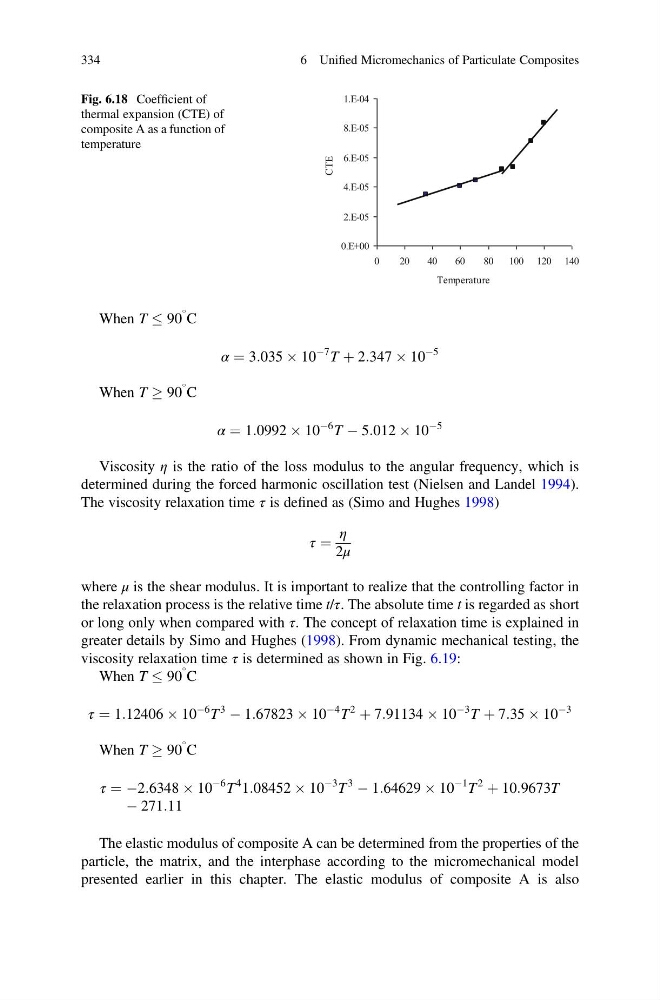
When T 90
C
α ¼ 3:035 Â 10
À7 T þ 2:347 Â 10
À5
When T ! 90
C
α ¼ 1:0992 Â 10
À6 T À 5:012 Â 10
À5
Viscosity η is the ratio of the loss modulus to the angular frequency, which is
determined during the forced harmonic oscillation test (Nielsen and Landel 1994).
The viscosity relaxation time τ is defined as (Simo and Hughes 1998)
τ ¼
η
2μ
where μ is the shear modulus. It is important to realize that the controlling factor in
the relaxation process is the relative time t/τ. The absolute time t is regarded as short
or long only when compared with τ. The concept of relaxation time is explained in
greater details by Simo and Hughes (1998). From dynamic mechanical testing, the
viscosity relaxation time τ is determined as shown in Fig. 6.19:
When T 90
C
τ ¼ 1:12406 Â 10
À6 T
3
À 1:67823 Â 10
À4 T
2
þ 7:91134 Â 10
À3 T þ 7:35 Â 10
À3
When T ! 90
C
τ ¼ À2:6348 Â 10
À6 T
4 1:08452 Â 10
À3 T
3
À 1:64629 Â 10
À1 T
2
þ 10:9673T
À 271:11
The elastic modulus of composite A can be determined from the properties of the
particle, the matrix, and the interphase according to the micromechanical model
presented earlier in this chapter. The elastic modulus of composite A is also
0.E+00
2.E-05
4.E-05
6.E-05
8.E-05
1.E-04
0
2 0
4 0
6 0
8 0
1 0 0 1 2 0 1 4 0
Temperature
E
T
C
Fig. 6.18 Coefficient of
thermal expansion (CTE) of
composite A as a function of
temperature
334
6 Unified Micromechanics of Particulate Composites
C
α ¼ 3:035 Â 10
À7 T þ 2:347 Â 10
À5
When T ! 90
C
α ¼ 1:0992 Â 10
À6 T À 5:012 Â 10
À5
Viscosity η is the ratio of the loss modulus to the angular frequency, which is
determined during the forced harmonic oscillation test (Nielsen and Landel 1994).
The viscosity relaxation time τ is defined as (Simo and Hughes 1998)
τ ¼
η
2μ
where μ is the shear modulus. It is important to realize that the controlling factor in
the relaxation process is the relative time t/τ. The absolute time t is regarded as short
or long only when compared with τ. The concept of relaxation time is explained in
greater details by Simo and Hughes (1998). From dynamic mechanical testing, the
viscosity relaxation time τ is determined as shown in Fig. 6.19:
When T 90
C
τ ¼ 1:12406 Â 10
À6 T
3
À 1:67823 Â 10
À4 T
2
þ 7:91134 Â 10
À3 T þ 7:35 Â 10
À3
When T ! 90
C
τ ¼ À2:6348 Â 10
À6 T
4 1:08452 Â 10
À3 T
3
À 1:64629 Â 10
À1 T
2
þ 10:9673T
À 271:11
The elastic modulus of composite A can be determined from the properties of the
particle, the matrix, and the interphase according to the micromechanical model
presented earlier in this chapter. The elastic modulus of composite A is also
0.E+00
2.E-05
4.E-05
6.E-05
8.E-05
1.E-04
0
2 0
4 0
6 0
8 0
1 0 0 1 2 0 1 4 0
Temperature
E
T
C
Fig. 6.18 Coefficient of
thermal expansion (CTE) of
composite A as a function of
temperature
334
6 Unified Micromechanics of Particulate Composites