

E m ¼ À0:0234T þ 4:124 GPa
ð
Þ
where T is the temperature in Celsius.
Poisson’s ratio of PMMA is ν m ¼ 0.31.
6.8.3 Properties of Matrix-Filler Interphase
The interphase around the particle is also regarded as an isotropic elastic material.
Young’s modulus and thickness of the interphase are adjustable parameters in the
proposed model. In addition, it is reasonable to assume that Poisson’s ratio and CTE
of the interphase are the same as that of the matrix (PMMA); however, Young’s
modulus of the interphase is less than that of PMMA. For these simulations, the
thickness of the interphase is taken as 1% of the diameter of filler particles; Young’s
modulus is half of that of PMMA except where specified differently.
6.8.3.1 Properties of Particulate Composites
The following thermo-mechanical properties of the particulate composite A are
determined according to the data provided by the material supplier (Basaran and
Nie 2007).
The average specific mass for the composite is m s ¼ 85 g/mol, and the density of
the composite is ρ ¼ 1750 kg/m
3 . The volume fraction of particle in the composite is
φ ¼ 0.48
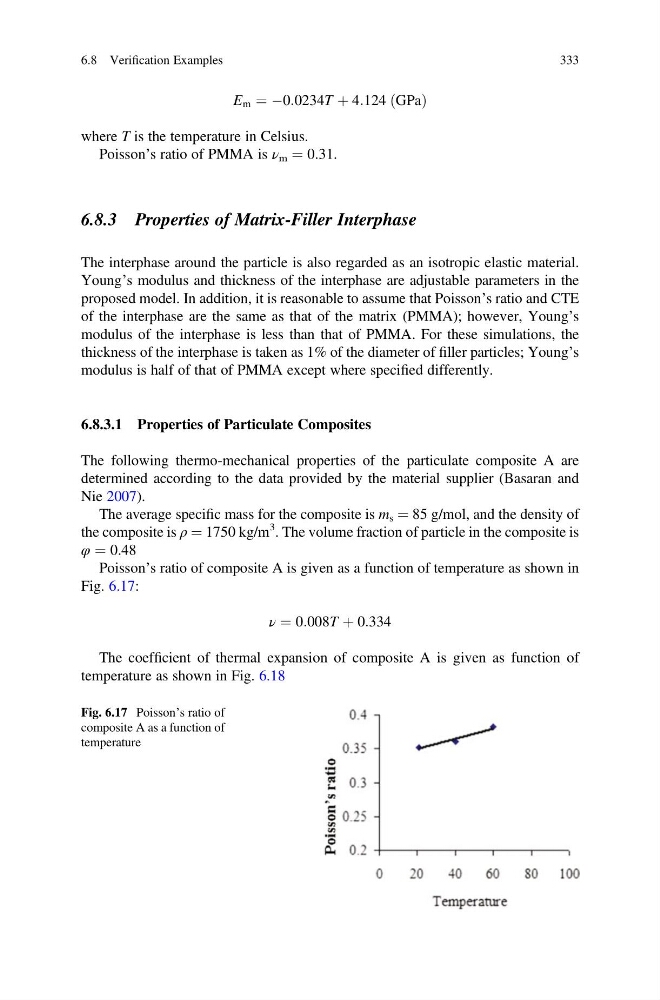
Poisson’s ratio of composite A is given as a function of temperature as shown in
Fig. 6.17:
ν ¼ 0:008T þ 0:334
The coefficient of thermal expansion of composite A is given as function of
temperature as shown in Fig. 6.18
Fig. 6.17 Poisson’s ratio of
composite A as a function of
temperature
6.8 Verification Examples
333
ð
Þ
where T is the temperature in Celsius.
Poisson’s ratio of PMMA is ν m ¼ 0.31.
6.8.3 Properties of Matrix-Filler Interphase
The interphase around the particle is also regarded as an isotropic elastic material.
Young’s modulus and thickness of the interphase are adjustable parameters in the
proposed model. In addition, it is reasonable to assume that Poisson’s ratio and CTE
of the interphase are the same as that of the matrix (PMMA); however, Young’s
modulus of the interphase is less than that of PMMA. For these simulations, the
thickness of the interphase is taken as 1% of the diameter of filler particles; Young’s
modulus is half of that of PMMA except where specified differently.
6.8.3.1 Properties of Particulate Composites
The following thermo-mechanical properties of the particulate composite A are
determined according to the data provided by the material supplier (Basaran and
Nie 2007).
The average specific mass for the composite is m s ¼ 85 g/mol, and the density of
the composite is ρ ¼ 1750 kg/m
3 . The volume fraction of particle in the composite is
φ ¼ 0.48
Poisson’s ratio of composite A is given as a function of temperature as shown in
Fig. 6.17:
ν ¼ 0:008T þ 0:334
The coefficient of thermal expansion of composite A is given as function of
temperature as shown in Fig. 6.18
Fig. 6.17 Poisson’s ratio of
composite A as a function of
temperature
6.8 Verification Examples
333