

increment of γ over a time step, and Δ
2
γ denotes the increment of Δγ between
iterations.
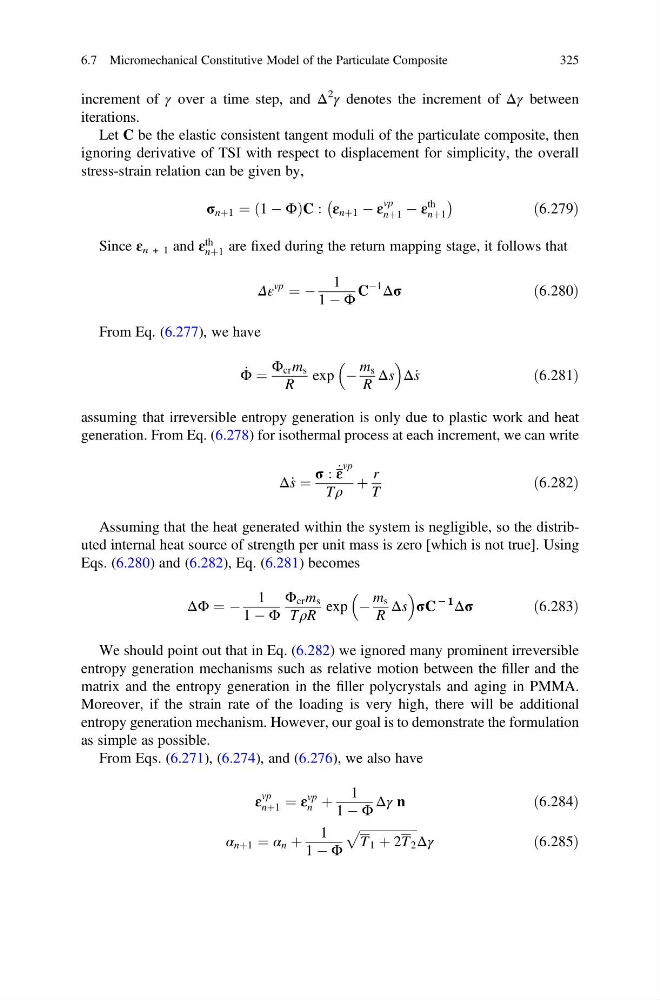
Let C be the elastic consistent tangent moduli of the particulate composite, then
ignoring derivative of TSI with respect to displacement for simplicity, the overall
stress-strain relation can be given by,
σ nþ1 ¼ 1 À Φ
ð
ÞC : ε nþ1 À ε
vp
nþ1 À ε
th
nþ1
À
Á
ð6:279Þ
Since ε n + 1 and ε
th
nþ1 are fixed during the return mapping stage, it follows that
Δε
vp
¼ À
1
1 À Φ
C
À1
Δσ
ð6:280Þ
From Eq. (6.277), we have
_
Φ ¼
Φ cr m s
R
exp À
m s
R
Δs
Δ_ s
ð6:281Þ
assuming that irreversible entropy generation is only due to plastic work and heat
generation. From Eq. (6.278) for isothermal process at each increment, we can write
Δ_ s ¼
σ : _
ε
vp
Tρ
þ
r
T
ð6:282Þ
Assuming that the heat generated within the system is negligible, so the distributed internal heat source of strength per unit mass is zero [which is not true]. Using
Eqs. (6.280) and (6.282), Eq. (6.281) becomes
ΔΦ ¼ À
1
1 À Φ
Φ cr m s
TρR
exp À
m s
R
Δs
σC
2 1
Δσ
ð6:283Þ
We should point out that in Eq. (6.282) we ignored many prominent irreversible
entropy generation mechanisms such as relative motion between the filler and the
matrix and the entropy generation in the filler polycrystals and aging in PMMA.
Moreover, if the strain rate of the loading is very high, there will be additional
entropy generation mechanism. However, our goal is to demonstrate the formulation
as simple as possible.
From Eqs. (6.271), (6.274), and (6.276), we also have
ε
vp
nþ1 ¼ ε
vp
n þ
1
1 À Φ
Δγ n
ð6:284Þ
α nþ1 ¼ α n þ
1
1 À Φ
ffiffiffiffiffiffiffiffiffiffiffiffiffiffiffiffiffiffi ffi
T 1 þ 2T 2
p
Δγ
ð6:285Þ
6.7 Micromechanical Constitutive Model of the Particulate Composite
325
2
γ denotes the increment of Δγ between
iterations.
Let C be the elastic consistent tangent moduli of the particulate composite, then
ignoring derivative of TSI with respect to displacement for simplicity, the overall
stress-strain relation can be given by,
σ nþ1 ¼ 1 À Φ
ð
ÞC : ε nþ1 À ε
vp
nþ1 À ε
th
nþ1
À
Á
ð6:279Þ
Since ε n + 1 and ε
th
nþ1 are fixed during the return mapping stage, it follows that
Δε
vp
¼ À
1
1 À Φ
C
À1
Δσ
ð6:280Þ
From Eq. (6.277), we have
_
Φ ¼
Φ cr m s
R
exp À
m s
R
Δs
Δ_ s
ð6:281Þ
assuming that irreversible entropy generation is only due to plastic work and heat
generation. From Eq. (6.278) for isothermal process at each increment, we can write
Δ_ s ¼
σ : _
ε
vp
Tρ
þ
r
T
ð6:282Þ
Assuming that the heat generated within the system is negligible, so the distributed internal heat source of strength per unit mass is zero [which is not true]. Using
Eqs. (6.280) and (6.282), Eq. (6.281) becomes
ΔΦ ¼ À
1
1 À Φ
Φ cr m s
TρR
exp À
m s
R
Δs
σC
2 1
Δσ
ð6:283Þ
We should point out that in Eq. (6.282) we ignored many prominent irreversible
entropy generation mechanisms such as relative motion between the filler and the
matrix and the entropy generation in the filler polycrystals and aging in PMMA.
Moreover, if the strain rate of the loading is very high, there will be additional
entropy generation mechanism. However, our goal is to demonstrate the formulation
as simple as possible.
From Eqs. (6.271), (6.274), and (6.276), we also have
ε
vp
nþ1 ¼ ε
vp
n þ
1
1 À Φ
Δγ n
ð6:284Þ
α nþ1 ¼ α n þ
1
1 À Φ
ffiffiffiffiffiffiffiffiffiffiffiffiffiffiffiffiffiffi ffi
T 1 þ 2T 2
p
Δγ
ð6:285Þ
6.7 Micromechanical Constitutive Model of the Particulate Composite
325