

dβ ¼
T 1 þ 2T 2
À
Á 1:5
T 1 þ 2T 2
À
Á 2 þ 2T 1
2
H
0 _
α n
ð6:276Þ
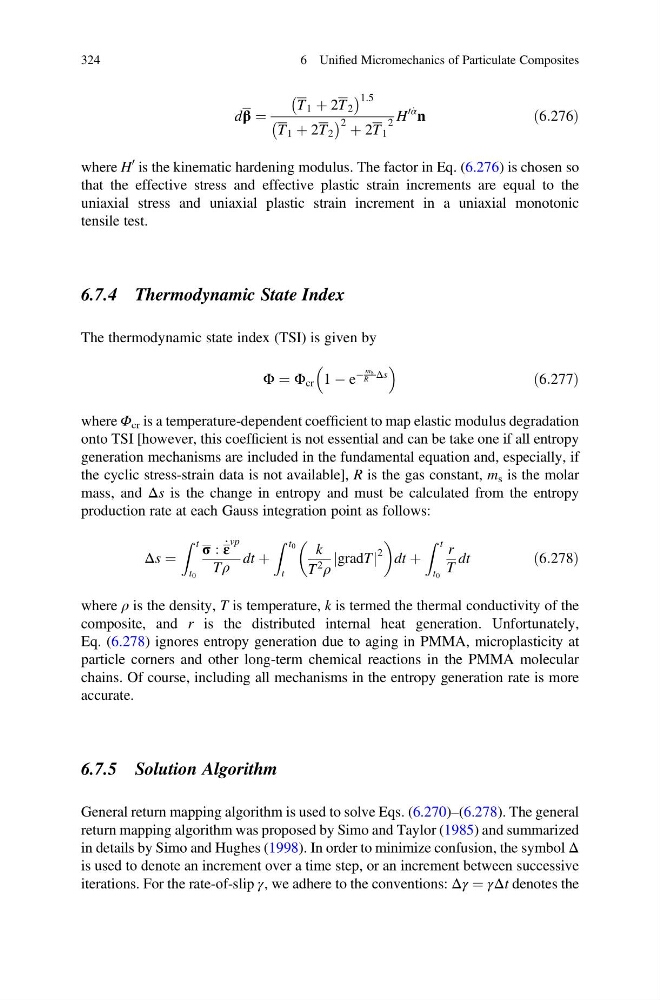
where H
0 is the kinematic hardening modulus. The factor in Eq. (6.276) is chosen so
that the effective stress and effective plastic strain increments are equal to the
uniaxial stress and uniaxial plastic strain increment in a uniaxial monotonic
tensile test.
6.7.4 Thermodynamic State Index
The thermodynamic state index (TSI) is given by
Φ ¼ Φ cr 1 À e
À
ms
R Δs
ð6:277Þ
where Φ cr is a temperature-dependent coefficient to map elastic modulus degradation
onto TSI [however, this coefficient is not essential and can be take one if all entropy
generation mechanisms are included in the fundamental equation and, especially, if
the cyclic stress-strain data is not available], R is the gas constant, m s is the molar
mass, and Δs is the change in entropy and must be calculated from the entropy
production rate at each Gauss integration point as follows:
Δs ¼
Z t
t 0
σ : _
ε
vp
Tρ
dt þ
Z t 0
t
k
T
2
ρ
gradT
j
j
2
dt þ
Z t
t 0
r
T
dt
ð6:278Þ
where ρ is the density, T is temperature, k is termed the thermal conductivity of the
composite, and r is the distributed internal heat generation. Unfortunately,
Eq. (6.278) ignores entropy generation due to aging in PMMA, microplasticity at
particle corners and other long-term chemical reactions in the PMMA molecular
chains. Of course, including all mechanisms in the entropy generation rate is more
accurate.
6.7.5 Solution Algorithm
General return mapping algorithm is used to solve Eqs. (6.270)–(6.278). The general
return mapping algorithm was proposed by Simo and Taylor (1985) and summarized
in details by Simo and Hughes (1998). In order to minimize confusion, the symbol Δ
is used to denote an increment over a time step, or an increment between successive
iterations. For the rate-of-slip γ, we adhere to the conventions: Δγ ¼ γΔt denotes the
324
6 Unified Micromechanics of Particulate Composites
T 1 þ 2T 2
À
Á 1:5
T 1 þ 2T 2
À
Á 2 þ 2T 1
2
H
0 _
α n
ð6:276Þ
where H
0 is the kinematic hardening modulus. The factor in Eq. (6.276) is chosen so
that the effective stress and effective plastic strain increments are equal to the
uniaxial stress and uniaxial plastic strain increment in a uniaxial monotonic
tensile test.
6.7.4 Thermodynamic State Index
The thermodynamic state index (TSI) is given by
Φ ¼ Φ cr 1 À e
À
ms
R Δs
ð6:277Þ
where Φ cr is a temperature-dependent coefficient to map elastic modulus degradation
onto TSI [however, this coefficient is not essential and can be take one if all entropy
generation mechanisms are included in the fundamental equation and, especially, if
the cyclic stress-strain data is not available], R is the gas constant, m s is the molar
mass, and Δs is the change in entropy and must be calculated from the entropy
production rate at each Gauss integration point as follows:
Δs ¼
Z t
t 0
σ : _
ε
vp
Tρ
dt þ
Z t 0
t
k
T
2
ρ
gradT
j
j
2
dt þ
Z t
t 0
r
T
dt
ð6:278Þ
where ρ is the density, T is temperature, k is termed the thermal conductivity of the
composite, and r is the distributed internal heat generation. Unfortunately,
Eq. (6.278) ignores entropy generation due to aging in PMMA, microplasticity at
particle corners and other long-term chemical reactions in the PMMA molecular
chains. Of course, including all mechanisms in the entropy generation rate is more
accurate.
6.7.5 Solution Algorithm
General return mapping algorithm is used to solve Eqs. (6.270)–(6.278). The general
return mapping algorithm was proposed by Simo and Taylor (1985) and summarized
in details by Simo and Hughes (1998). In order to minimize confusion, the symbol Δ
is used to denote an increment over a time step, or an increment between successive
iterations. For the rate-of-slip γ, we adhere to the conventions: Δγ ¼ γΔt denotes the
324
6 Unified Micromechanics of Particulate Composites