

H
h i m x
ð Þ ¼ σ 2 β À σ
T
À
Á : T : σ 2 β À σ
T
À
Á
ð6:269Þ
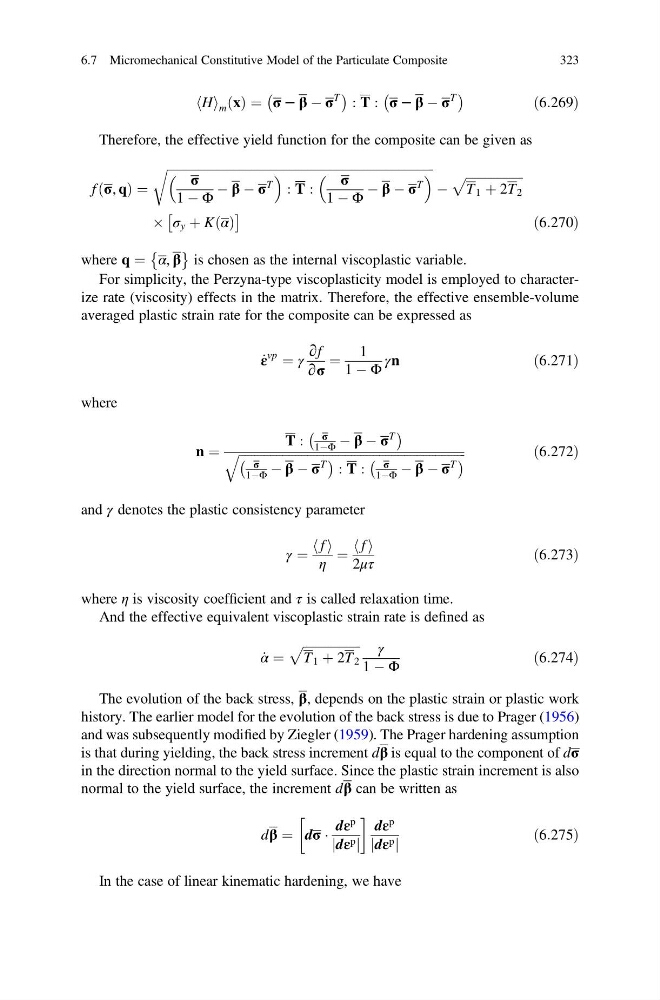
Therefore, the effective yield function for the composite can be given as
f σ, q
ð
Þ ¼
ffiffiffiffiffiffiffiffiffiffiffiffiffiffiffiffiffiffiffiffiffiffiffiffiffiffiffiffiffiffiffiffiffiffiffiffiffiffiffiffiffiffiffiffiffiffiffiffiffiffiffiffiffiffiffiffiffiffiffiffiffiffiffiffiffiffiffiffiffiffiffiffiffiffiffiffiffiffiffiffiffiffiffiffiffi ffi
σ
1 À Φ
À β À σ
T
: T :
σ
1 À Φ
À β À σ
T
r
À
ffiffiffiffiffiffiffiffiffiffiffiffiffiffiffiffiffiffi ffi
T 1 þ 2T 2
p
 σ y þ K α
ð Þ
Â
Ã
ð6:270Þ
where q ¼ α, β
È
É
is chosen as the internal viscoplastic variable.
For simplicity, the Perzyna-type viscoplasticity model is employed to characterize rate (viscosity) effects in the matrix. Therefore, the effective ensemble-volume
averaged plastic strain rate for the composite can be expressed as
_
ε
vp
¼ γ
∂f
∂σ
¼
1
1 À Φ
γn
ð6:271Þ
where
n ¼
T :
σ
1ÀΦ À β À σ
T
À
Á
ffiffiffiffiffiffiffiffiffiffiffiffiffiffiffiffiffiffiffiffiffiffiffiffiffiffiffiffiffiffiffiffiffiffiffiffiffiffiffiffiffiffiffiffiffiffiffiffiffiffiffiffiffiffiffiffiffiffiffiffiffiffiffiffiffiffiffiffiffiffiffiffi ffi
σ
1ÀΦ À β À σ
T
À
Á : T :
σ
1ÀΦ À β À σ
T
À
Á
q
ð6:272Þ
and γ denotes the plastic consistency parameter
γ ¼
f
h i
η
¼
f
h i
2μτ
ð6:273Þ
where η is viscosity coefficient and τ is called relaxation time.
And the effective equivalent viscoplastic strain rate is defined as
_
α ¼
ffiffiffiffiffiffiffiffiffiffiffiffiffiffiffiffiffiffi ffi
T 1 þ 2T 2
p
γ
1 À Φ
ð6:274Þ
The evolution of the back stress, β, depends on the plastic strain or plastic work
history. The earlier model for the evolution of the back stress is due to Prager (1956)
and was subsequently modified by Ziegler (1959). The Prager hardening assumption
is that during yielding, the back stress increment dβ is equal to the component of dσ
in the direction normal to the yield surface. Since the plastic strain increment is also
normal to the yield surface, the increment dβ can be written as
dβ ¼ dσ Á
dε
p
dε p
j j
! dε
p
dε p
j j
ð6:275Þ
In the case of linear kinematic hardening, we have
6.7 Micromechanical Constitutive Model of the Particulate Composite
323
h i m x
ð Þ ¼ σ 2 β À σ
T
À
Á : T : σ 2 β À σ
T
À
Á
ð6:269Þ
Therefore, the effective yield function for the composite can be given as
f σ, q
ð
Þ ¼
ffiffiffiffiffiffiffiffiffiffiffiffiffiffiffiffiffiffiffiffiffiffiffiffiffiffiffiffiffiffiffiffiffiffiffiffiffiffiffiffiffiffiffiffiffiffiffiffiffiffiffiffiffiffiffiffiffiffiffiffiffiffiffiffiffiffiffiffiffiffiffiffiffiffiffiffiffiffiffiffiffiffiffiffiffi ffi
σ
1 À Φ
À β À σ
T
: T :
σ
1 À Φ
À β À σ
T
r
À
ffiffiffiffiffiffiffiffiffiffiffiffiffiffiffiffiffiffi ffi
T 1 þ 2T 2
p
 σ y þ K α
ð Þ
Â
Ã
ð6:270Þ
where q ¼ α, β
È
É
is chosen as the internal viscoplastic variable.
For simplicity, the Perzyna-type viscoplasticity model is employed to characterize rate (viscosity) effects in the matrix. Therefore, the effective ensemble-volume
averaged plastic strain rate for the composite can be expressed as
_
ε
vp
¼ γ
∂f
∂σ
¼
1
1 À Φ
γn
ð6:271Þ
where
n ¼
T :
σ
1ÀΦ À β À σ
T
À
Á
ffiffiffiffiffiffiffiffiffiffiffiffiffiffiffiffiffiffiffiffiffiffiffiffiffiffiffiffiffiffiffiffiffiffiffiffiffiffiffiffiffiffiffiffiffiffiffiffiffiffiffiffiffiffiffiffiffiffiffiffiffiffiffiffiffiffiffiffiffiffiffiffi ffi
σ
1ÀΦ À β À σ
T
À
Á : T :
σ
1ÀΦ À β À σ
T
À
Á
q
ð6:272Þ
and γ denotes the plastic consistency parameter
γ ¼
f
h i
η
¼
f
h i
2μτ
ð6:273Þ
where η is viscosity coefficient and τ is called relaxation time.
And the effective equivalent viscoplastic strain rate is defined as
_
α ¼
ffiffiffiffiffiffiffiffiffiffiffiffiffiffiffiffiffiffi ffi
T 1 þ 2T 2
p
γ
1 À Φ
ð6:274Þ
The evolution of the back stress, β, depends on the plastic strain or plastic work
history. The earlier model for the evolution of the back stress is due to Prager (1956)
and was subsequently modified by Ziegler (1959). The Prager hardening assumption
is that during yielding, the back stress increment dβ is equal to the component of dσ
in the direction normal to the yield surface. Since the plastic strain increment is also
normal to the yield surface, the increment dβ can be written as
dβ ¼ dσ Á
dε
p
dε p
j j
! dε
p
dε p
j j
ð6:275Þ
In the case of linear kinematic hardening, we have
6.7 Micromechanical Constitutive Model of the Particulate Composite
323