

6.7.3 A Viscoplasticity Model
Viscoplastic flow occurs only in the matrix because filler particles have a very high
melting temperature, and they are brittle linear elastic. The magnitude of the current
equivalent stress norm of the matrix can be used to determine the viscoplastic
behavior. Regarding the composite as viscoplastic overall, when the ensemblevolume averaged stress norm in the matrix reaches a certain level, the effective
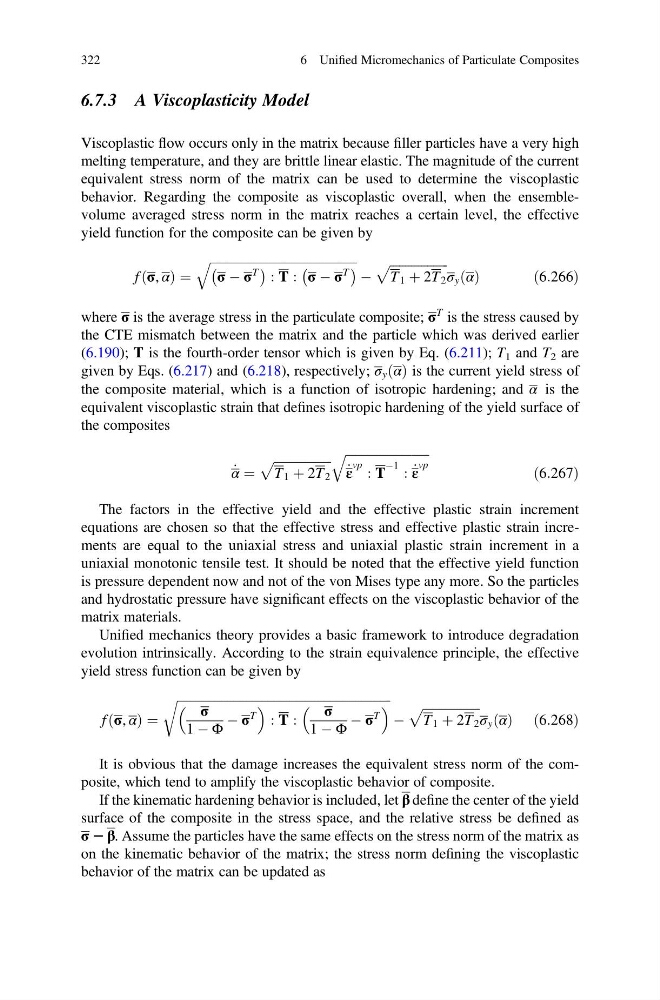
yield function for the composite can be given by
f σ, α
ð
Þ ¼
ffiffiffiffiffiffiffiffiffiffiffiffiffiffiffiffiffiffiffiffiffiffiffiffiffiffiffiffiffiffiffiffiffiffiffiffiffiffiffiffiffiffiffiffiffiffiffi
σ À σ
T
À
Á : T : σ À σ
T
À
Á
q
À
ffiffiffiffiffiffiffiffiffiffiffiffiffiffiffiffiffiffi ffi
T 1 þ 2T 2
p
σ y α
ð Þ
ð6:266Þ
where σ is the average stress in the particulate composite; σ
T is the stress caused by
the CTE mismatch between the matrix and the particle which was derived earlier
(6.190); T is the fourth-order tensor which is given by Eq. (6.211); T 1 and T 2 are
given by Eqs. (6.217) and (6.218), respectively; σ y α
ð Þ is the current yield stress of
the composite material, which is a function of isotropic hardening; and α is the
equivalent viscoplastic strain that defines isotropic hardening of the yield surface of
the composites
_
α ¼
ffiffiffiffiffiffiffiffiffiffiffiffiffiffiffiffiffiffi ffi
T 1 þ 2T 2
p
ffiffiffiffiffiffiffiffiffiffiffiffiffiffiffiffiffiffiffiffiffiffiffiffiffiffiffi
_
ε
vp : T
À1 : _
ε
vp
q
ð6:267Þ
The factors in the effective yield and the effective plastic strain increment
equations are chosen so that the effective stress and effective plastic strain increments are equal to the uniaxial stress and uniaxial plastic strain increment in a
uniaxial monotonic tensile test. It should be noted that the effective yield function
is pressure dependent now and not of the von Mises type any more. So the particles
and hydrostatic pressure have significant effects on the viscoplastic behavior of the
matrix materials.
Unified mechanics theory provides a basic framework to introduce degradation
evolution intrinsically. According to the strain equivalence principle, the effective
yield stress function can be given by
f σ, α
ð
Þ ¼
ffiffiffiffiffiffiffiffiffiffiffiffiffiffiffiffiffiffiffiffiffiffiffiffiffiffiffiffiffiffiffiffiffiffiffiffiffiffiffiffiffiffiffiffiffiffiffiffiffiffiffiffiffiffiffiffiffiffiffiffiffiffiffiffiffiffiffiffi ffi
σ
1 À Φ
À σ
T
: T :
σ
1 À Φ
À σ
T
r
À
ffiffiffiffiffiffiffiffiffiffiffiffiffiffiffiffiffiffi ffi
T 1 þ 2T 2
p
σ y α
ð Þ ð6:268Þ
It is obvious that the damage increases the equivalent stress norm of the composite, which tend to amplify the viscoplastic behavior of composite.
If the kinematic hardening behavior is included, let β define the center of the yield
surface of the composite in the stress space, and the relative stress be defined as
σ 2 β. Assume the particles have the same effects on the stress norm of the matrix as
on the kinematic behavior of the matrix; the stress norm defining the viscoplastic
behavior of the matrix can be updated as
322
6 Unified Micromechanics of Particulate Composites
Viscoplastic flow occurs only in the matrix because filler particles have a very high
melting temperature, and they are brittle linear elastic. The magnitude of the current
equivalent stress norm of the matrix can be used to determine the viscoplastic
behavior. Regarding the composite as viscoplastic overall, when the ensemblevolume averaged stress norm in the matrix reaches a certain level, the effective
yield function for the composite can be given by
f σ, α
ð
Þ ¼
ffiffiffiffiffiffiffiffiffiffiffiffiffiffiffiffiffiffiffiffiffiffiffiffiffiffiffiffiffiffiffiffiffiffiffiffiffiffiffiffiffiffiffiffiffiffiffi
σ À σ
T
À
Á : T : σ À σ
T
À
Á
q
À
ffiffiffiffiffiffiffiffiffiffiffiffiffiffiffiffiffiffi ffi
T 1 þ 2T 2
p
σ y α
ð Þ
ð6:266Þ
where σ is the average stress in the particulate composite; σ
T is the stress caused by
the CTE mismatch between the matrix and the particle which was derived earlier
(6.190); T is the fourth-order tensor which is given by Eq. (6.211); T 1 and T 2 are
given by Eqs. (6.217) and (6.218), respectively; σ y α
ð Þ is the current yield stress of
the composite material, which is a function of isotropic hardening; and α is the
equivalent viscoplastic strain that defines isotropic hardening of the yield surface of
the composites
_
α ¼
ffiffiffiffiffiffiffiffiffiffiffiffiffiffiffiffiffiffi ffi
T 1 þ 2T 2
p
ffiffiffiffiffiffiffiffiffiffiffiffiffiffiffiffiffiffiffiffiffiffiffiffiffiffiffi
_
ε
vp : T
À1 : _
ε
vp
q
ð6:267Þ
The factors in the effective yield and the effective plastic strain increment
equations are chosen so that the effective stress and effective plastic strain increments are equal to the uniaxial stress and uniaxial plastic strain increment in a
uniaxial monotonic tensile test. It should be noted that the effective yield function
is pressure dependent now and not of the von Mises type any more. So the particles
and hydrostatic pressure have significant effects on the viscoplastic behavior of the
matrix materials.
Unified mechanics theory provides a basic framework to introduce degradation
evolution intrinsically. According to the strain equivalence principle, the effective
yield stress function can be given by
f σ, α
ð
Þ ¼
ffiffiffiffiffiffiffiffiffiffiffiffiffiffiffiffiffiffiffiffiffiffiffiffiffiffiffiffiffiffiffiffiffiffiffiffiffiffiffiffiffiffiffiffiffiffiffiffiffiffiffiffiffiffiffiffiffiffiffiffiffiffiffiffiffiffiffiffi ffi
σ
1 À Φ
À σ
T
: T :
σ
1 À Φ
À σ
T
r
À
ffiffiffiffiffiffiffiffiffiffiffiffiffiffiffiffiffiffi ffi
T 1 þ 2T 2
p
σ y α
ð Þ ð6:268Þ
It is obvious that the damage increases the equivalent stress norm of the composite, which tend to amplify the viscoplastic behavior of composite.
If the kinematic hardening behavior is included, let β define the center of the yield
surface of the composite in the stress space, and the relative stress be defined as
σ 2 β. Assume the particles have the same effects on the stress norm of the matrix as
on the kinematic behavior of the matrix; the stress norm defining the viscoplastic
behavior of the matrix can be updated as
322
6 Unified Micromechanics of Particulate Composites