

6.3.1 Average Stress Norm in Matrix
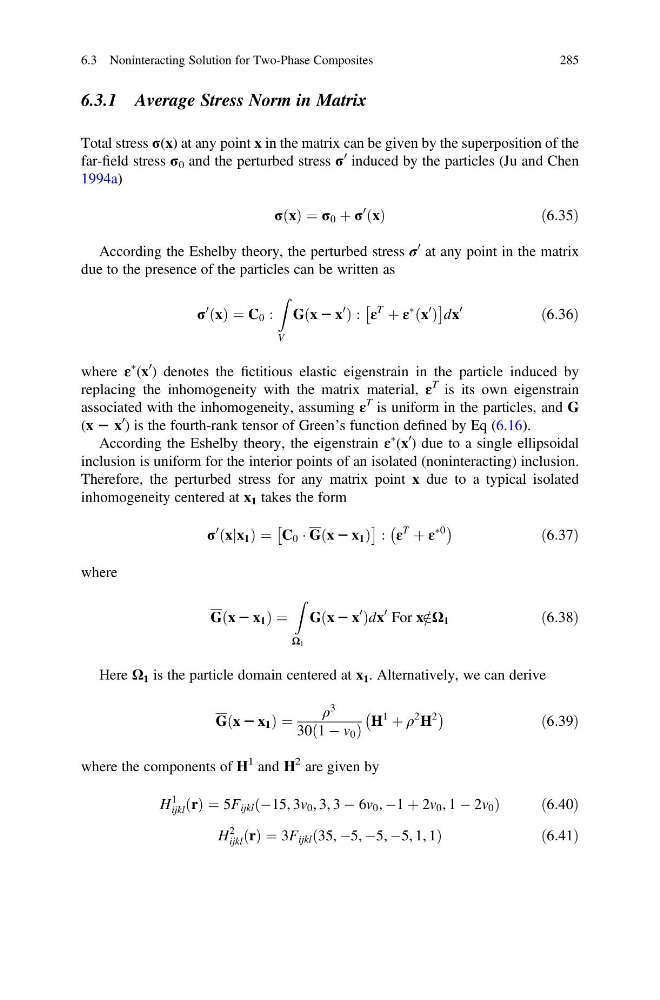
Total stress σ(x) at any point x in the matrix can be given by the superposition of the
far-field stress σ 0 and the perturbed stress σ
0 induced by the particles (Ju and Chen
1994a)
σ x
ð Þ ¼ σ 0 þ σ
0 x
ð Þ
ð6:35Þ
According the Eshelby theory, the perturbed stress σ
0 at any point in the matrix
due to the presence of the particles can be written as
σ
0 x
ð Þ ¼ C 0 :
Z
V
G x 2 x
0
ð
Þ: ε
T
þ ε
à x
0
ð Þ
Â
Ã
dx
0
ð6:36Þ
where ε
à (x
0 ) denotes the fictitious elastic eigenstrain in the particle induced by
replacing the inhomogeneity with the matrix material, ε
T is its own eigenstrain
associated with the inhomogeneity, assuming ε
T is uniform in the particles, and G
(x 2 x
0 ) is the fourth-rank tensor of Green’s function defined by Eq (6.16).
According the Eshelby theory, the eigenstrain ε
à (x
0
) due to a single ellipsoidal
inclusion is uniform for the interior points of an isolated (noninteracting) inclusion.
Therefore, the perturbed stress for any matrix point x due to a typical isolated
inhomogeneity centered at x 1 takes the form
σ
0 xjx 1
ð
Þ ¼ C 0 Á G x 2 x 1
ð
Þ
Â
à : ε
T
þ ε
Ã0
À
Á
ð6:37Þ
where
G x 2 x 1
ð
Þ¼
Z
Ω 1
G x 2 x
0
ð
Þdx
0 For x= 2Ω 1
ð6:38Þ
Here Ω 1 is the particle domain centered at x 1 . Alternatively, we can derive
G x 2 x 1
ð
Þ¼
ρ
3
30 1 À v 0
ð
Þ
H
1
þ ρ
2 H
2
À
Á
ð6:39Þ
where the components of H
1 and H
2 are given by
H
1
ijkl r
ð Þ ¼ 5F ijkl À15, 3v 0 , 3, 3 À 6v 0 , À1 þ 2v 0 , 1 À 2v 0
ð
Þ
ð 6:40Þ
H
2
ijkl r
ð Þ ¼ 3F ijkl 35, À5, À5, À5, 1, 1
ð
Þ
ð 6:41Þ
6.3 Noninteracting Solution for Two-Phase Composites
285
Total stress σ(x) at any point x in the matrix can be given by the superposition of the
far-field stress σ 0 and the perturbed stress σ
0 induced by the particles (Ju and Chen
1994a)
σ x
ð Þ ¼ σ 0 þ σ
0 x
ð Þ
ð6:35Þ
According the Eshelby theory, the perturbed stress σ
0 at any point in the matrix
due to the presence of the particles can be written as
σ
0 x
ð Þ ¼ C 0 :
Z
V
G x 2 x
0
ð
Þ: ε
T
þ ε
à x
0
ð Þ
Â
Ã
dx
0
ð6:36Þ
where ε
à (x
0 ) denotes the fictitious elastic eigenstrain in the particle induced by
replacing the inhomogeneity with the matrix material, ε
T is its own eigenstrain
associated with the inhomogeneity, assuming ε
T is uniform in the particles, and G
(x 2 x
0 ) is the fourth-rank tensor of Green’s function defined by Eq (6.16).
According the Eshelby theory, the eigenstrain ε
à (x
0
) due to a single ellipsoidal
inclusion is uniform for the interior points of an isolated (noninteracting) inclusion.
Therefore, the perturbed stress for any matrix point x due to a typical isolated
inhomogeneity centered at x 1 takes the form
σ
0 xjx 1
ð
Þ ¼ C 0 Á G x 2 x 1
ð
Þ
Â
à : ε
T
þ ε
Ã0
À
Á
ð6:37Þ
where
G x 2 x 1
ð
Þ¼
Z
Ω 1
G x 2 x
0
ð
Þdx
0 For x= 2Ω 1
ð6:38Þ
Here Ω 1 is the particle domain centered at x 1 . Alternatively, we can derive
G x 2 x 1
ð
Þ¼
ρ
3
30 1 À v 0
ð
Þ
H
1
þ ρ
2 H
2
À
Á
ð6:39Þ
where the components of H
1 and H
2 are given by
H
1
ijkl r
ð Þ ¼ 5F ijkl À15, 3v 0 , 3, 3 À 6v 0 , À1 þ 2v 0 , 1 À 2v 0
ð
Þ
ð 6:40Þ
H
2
ijkl r
ð Þ ¼ 3F ijkl 35, À5, À5, À5, 1, 1
ð
Þ
ð 6:41Þ
6.3 Noninteracting Solution for Two-Phase Composites
285