

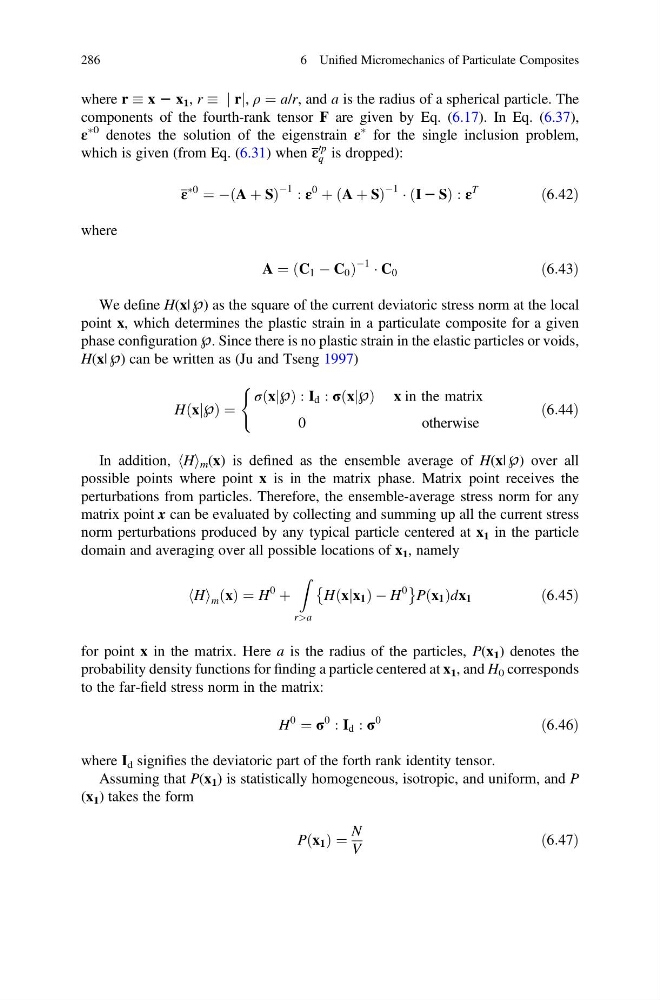
where r x 2 x 1 , r j rj, ρ ¼ a/r, and a is the radius of a spherical particle. The
components of the fourth-rank tensor F are given by Eq. (6.17). In Eq. (6.37),
ε
Ã0 denotes the solution of the eigenstrain ε
à for the single inclusion problem,
which is given (from Eq. (6.31) when ε
0p
q is dropped):
ε
Ã0
¼ À A þ S
ð
Þ
À1 : ε
0
þ A þ S
ð
Þ
À1 Á I 2 S
ð
Þ: ε
T
ð6:42Þ
where
A ¼ C 1 À C 0
ð
Þ
À1 Á C 0
ð6:43Þ
We define H(x| ℘) as the square of the current deviatoric stress norm at the local
point x, which determines the plastic strain in a particulate composite for a given
phase configuration ℘. Since there is no plastic strain in the elastic particles or voids,
H(x| ℘) can be written as (Ju and Tseng 1997)
H xj℘
ð Þ ¼
σ xj℘
ð Þ : I d : σ xj℘
ð Þ x in the matrix
0
otherwise
(
ð6:44Þ
In addition, hHi m (x) is defined as the ensemble average of H(x| ℘) over all
possible points where point x is in the matrix phase. Matrix point receives the
perturbations from particles. Therefore, the ensemble-average stress norm for any
matrix point x can be evaluated by collecting and summing up all the current stress
norm perturbations produced by any typical particle centered at x 1 in the particle
domain and averaging over all possible locations of x 1 , namely
H
h i m x
ð Þ ¼ H
0
þ
Z
r>a
H xjx 1
ð
ÞÀH
0
È
É
P x 1
ð Þdx 1
ð6:45Þ
for point x in the matrix. Here a is the radius of the particles, P(x 1 ) denotes the
probability density functions for finding a particle centered at x 1 , and H 0 corresponds
to the far-field stress norm in the matrix:
H
0
¼ σ
0
: I d : σ
0
ð6:46Þ
where I d signifies the deviatoric part of the forth rank identity tensor.
Assuming that P(x 1 ) is statistically homogeneous, isotropic, and uniform, and P
(x 1 ) takes the form
P x 1
ð Þ ¼
N
V
ð6:47Þ
286
6 Unified Micromechanics of Particulate Composites
components of the fourth-rank tensor F are given by Eq. (6.17). In Eq. (6.37),
ε
Ã0 denotes the solution of the eigenstrain ε
à for the single inclusion problem,
which is given (from Eq. (6.31) when ε
0p
q is dropped):
ε
Ã0
¼ À A þ S
ð
Þ
À1 : ε
0
þ A þ S
ð
Þ
À1 Á I 2 S
ð
Þ: ε
T
ð6:42Þ
where
A ¼ C 1 À C 0
ð
Þ
À1 Á C 0
ð6:43Þ
We define H(x| ℘) as the square of the current deviatoric stress norm at the local
point x, which determines the plastic strain in a particulate composite for a given
phase configuration ℘. Since there is no plastic strain in the elastic particles or voids,
H(x| ℘) can be written as (Ju and Tseng 1997)
H xj℘
ð Þ ¼
σ xj℘
ð Þ : I d : σ xj℘
ð Þ x in the matrix
0
otherwise
(
ð6:44Þ
In addition, hHi m (x) is defined as the ensemble average of H(x| ℘) over all
possible points where point x is in the matrix phase. Matrix point receives the
perturbations from particles. Therefore, the ensemble-average stress norm for any
matrix point x can be evaluated by collecting and summing up all the current stress
norm perturbations produced by any typical particle centered at x 1 in the particle
domain and averaging over all possible locations of x 1 , namely
H
h i m x
ð Þ ¼ H
0
þ
Z
r>a
H xjx 1
ð
ÞÀH
0
È
É
P x 1
ð Þdx 1
ð6:45Þ
for point x in the matrix. Here a is the radius of the particles, P(x 1 ) denotes the
probability density functions for finding a particle centered at x 1 , and H 0 corresponds
to the far-field stress norm in the matrix:
H
0
¼ σ
0
: I d : σ
0
ð6:46Þ
where I d signifies the deviatoric part of the forth rank identity tensor.
Assuming that P(x 1 ) is statistically homogeneous, isotropic, and uniform, and P
(x 1 ) takes the form
P x 1
ð Þ ¼
N
V
ð6:47Þ
286
6 Unified Micromechanics of Particulate Composites