

À A q þ S q
À
Á : ε
Ã
q ¼ ε
0
À ε
T
þ S q : ε
T
q þ ε
0p
q
ð6:31Þ
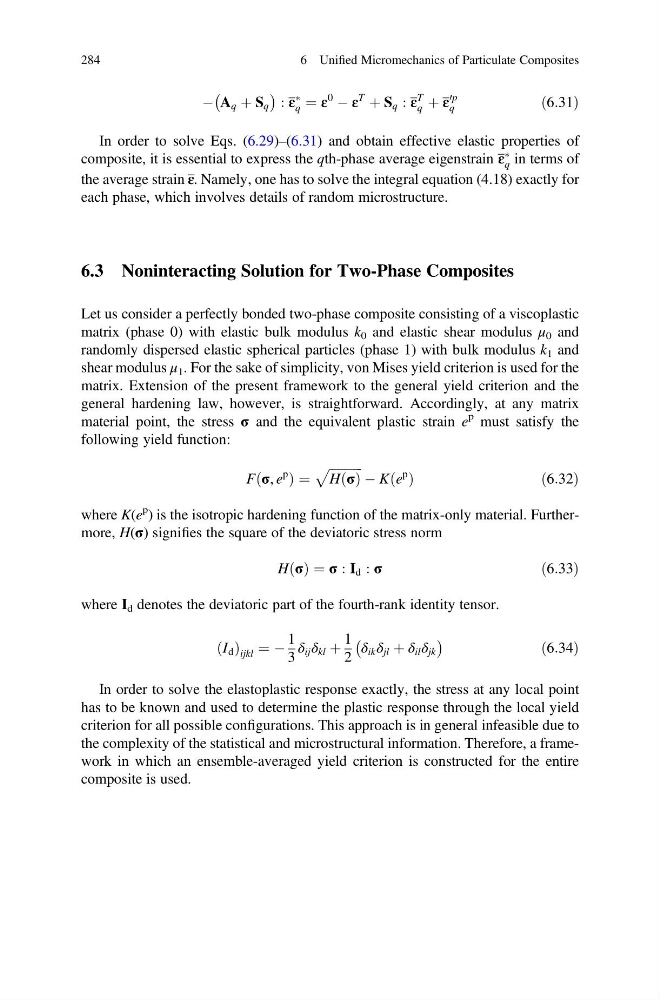
In order to solve Eqs. (6.29)–(6.31) and obtain effective elastic properties of
composite, it is essential to express the qth-phase average eigenstrain ε
Ã
q in terms of
the average strain ε. Namely, one has to solve the integral equation (4.18) exactly for
each phase, which involves details of random microstructure.
6.3 Noninteracting Solution for Two-Phase Composites
Let us consider a perfectly bonded two-phase composite consisting of a viscoplastic
matrix (phase 0) with elastic bulk modulus k 0 and elastic shear modulus μ 0 and
randomly dispersed elastic spherical particles (phase 1) with bulk modulus k 1 and
shear modulus μ 1 . For the sake of simplicity, von Mises yield criterion is used for the
matrix. Extension of the present framework to the general yield criterion and the
general hardening law, however, is straightforward. Accordingly, at any matrix
material point, the stress σ and the equivalent plastic strain e
p must satisfy the
following yield function:
F σ, e
p
ð
Þ¼
ffiffiffiffiffiffiffiffiffiffi ffi
H σ
ð Þ
p
À K e
p
ð Þ
ð6:32Þ
where K(e
p ) is the isotropic hardening function of the matrix-only material. Furthermore, H(σ) signifies the square of the deviatoric stress norm
H σ
ð Þ ¼ σ : I d : σ
ð6:33Þ
where I d denotes the deviatoric part of the fourth-rank identity tensor.
I d
ð Þ ijkl ¼ À
1
3
δ ij δ kl þ
1
2
δ ik δ jl þ δ il δ jk
À
Á
ð6:34Þ
In order to solve the elastoplastic response exactly, the stress at any local point
has to be known and used to determine the plastic response through the local yield
criterion for all possible configurations. This approach is in general infeasible due to
the complexity of the statistical and microstructural information. Therefore, a framework in which an ensemble-averaged yield criterion is constructed for the entire
composite is used.
284
6 Unified Micromechanics of Particulate Composites
À
Á : ε
Ã
q ¼ ε
0
À ε
T
þ S q : ε
T
q þ ε
0p
q
ð6:31Þ
In order to solve Eqs. (6.29)–(6.31) and obtain effective elastic properties of
composite, it is essential to express the qth-phase average eigenstrain ε
Ã
q in terms of
the average strain ε. Namely, one has to solve the integral equation (4.18) exactly for
each phase, which involves details of random microstructure.
6.3 Noninteracting Solution for Two-Phase Composites
Let us consider a perfectly bonded two-phase composite consisting of a viscoplastic
matrix (phase 0) with elastic bulk modulus k 0 and elastic shear modulus μ 0 and
randomly dispersed elastic spherical particles (phase 1) with bulk modulus k 1 and
shear modulus μ 1 . For the sake of simplicity, von Mises yield criterion is used for the
matrix. Extension of the present framework to the general yield criterion and the
general hardening law, however, is straightforward. Accordingly, at any matrix
material point, the stress σ and the equivalent plastic strain e
p must satisfy the
following yield function:
F σ, e
p
ð
Þ¼
ffiffiffiffiffiffiffiffiffiffi ffi
H σ
ð Þ
p
À K e
p
ð Þ
ð6:32Þ
where K(e
p ) is the isotropic hardening function of the matrix-only material. Furthermore, H(σ) signifies the square of the deviatoric stress norm
H σ
ð Þ ¼ σ : I d : σ
ð6:33Þ
where I d denotes the deviatoric part of the fourth-rank identity tensor.
I d
ð Þ ijkl ¼ À
1
3
δ ij δ kl þ
1
2
δ ik δ jl þ δ il δ jk
À
Á
ð6:34Þ
In order to solve the elastoplastic response exactly, the stress at any local point
has to be known and used to determine the plastic response through the local yield
criterion for all possible configurations. This approach is in general infeasible due to
the complexity of the statistical and microstructural information. Therefore, a framework in which an ensemble-averaged yield criterion is constructed for the entire
composite is used.
284
6 Unified Micromechanics of Particulate Composites