

Therefore, the yield condition can be written for a rate-dependent material in the
following form:
F ¼ Θ γη
ð Þ
ð5:194Þ
whereas Θ(γη) ¼ φ
À1 (γη).
5.8.3 Thermodynamic State Index Coupling
In the formulation that is presented below, for the sake of simplicity in presentation,
we will ignore derivatives with respect to entropy. In Cosserat continuum TSI is
introduced into the formulation using the same approach as in the classical continuum. Accordingly, Hooke’s law can be written as
_
σ ij ¼ 1 À Φ
ð
ÞC ijkl _
ε
e
kl
ð5:195aÞ
ℓ
À1
_
m ij ¼ 1 À Φ
ð
ÞD ijkl ℓ _
χ
e
kl
ð5:195bÞ
And the yield function now becomes
F σ, ℓ
À1 m, α
À
Á ¼ jξ
Φ
j À
ffiffi ffi
2
3
r
K α
ð Þ
ð5:196Þ
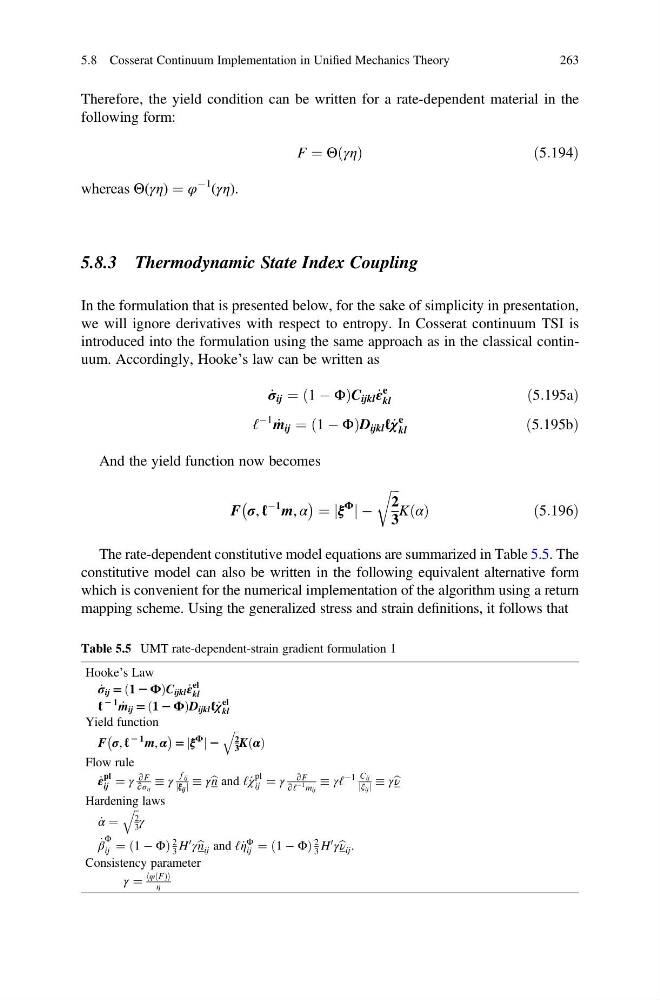
The rate-dependent constitutive model equations are summarized in Table 5.5. The
constitutive model can also be written in the following equivalent alternative form
which is convenient for the numerical implementation of the algorithm using a return
mapping scheme. Using the generalized stress and strain definitions, it follows that
Table 5.5 UMT rate-dependent-strain gradient formulation 1
Hooke’s Law
_
σ ij = 1 2 Φ
ð
ÞC ijkl _
ε
el
kl
ℓ
2 1 _
m ij = 1 2 Φ
ð
ÞD ijkl ℓ _
χ
el
kl
Yield function
F σ, ℓ
2 1 m, α
À
Á = jξ
Φ j 2
ffiffi
2
3
q
K α
ð Þ
Flow rule
_
ε
pl
ij ¼ γ
∂F
∂σij
γ
f ij
jξ ij j γb n and ℓ _
χ
pl
ij ¼ γ
∂F
∂ℓ
À1 mij
γℓ
À1 Cij
jξ ij j γb ν
Hardening laws
_
α ¼
ffiffi
2
3
q
γ
_
β
Φ
ij ¼ 1 À Φ
ð
Þ
2
3 H
0 γb n ij and ℓ _
η
Φ
ij ¼ 1 À Φ
ð
Þ
2
3 H
0 γb ν ij .
Consistency parameter
γ ¼
φ F
ð Þ
h
i
η
5.8 Cosserat Continuum Implementation in Unified Mechanics Theory
263
following form:
F ¼ Θ γη
ð Þ
ð5:194Þ
whereas Θ(γη) ¼ φ
À1 (γη).
5.8.3 Thermodynamic State Index Coupling
In the formulation that is presented below, for the sake of simplicity in presentation,
we will ignore derivatives with respect to entropy. In Cosserat continuum TSI is
introduced into the formulation using the same approach as in the classical continuum. Accordingly, Hooke’s law can be written as
_
σ ij ¼ 1 À Φ
ð
ÞC ijkl _
ε
e
kl
ð5:195aÞ
ℓ
À1
_
m ij ¼ 1 À Φ
ð
ÞD ijkl ℓ _
χ
e
kl
ð5:195bÞ
And the yield function now becomes
F σ, ℓ
À1 m, α
À
Á ¼ jξ
Φ
j À
ffiffi ffi
2
3
r
K α
ð Þ
ð5:196Þ
The rate-dependent constitutive model equations are summarized in Table 5.5. The
constitutive model can also be written in the following equivalent alternative form
which is convenient for the numerical implementation of the algorithm using a return
mapping scheme. Using the generalized stress and strain definitions, it follows that
Table 5.5 UMT rate-dependent-strain gradient formulation 1
Hooke’s Law
_
σ ij = 1 2 Φ
ð
ÞC ijkl _
ε
el
kl
ℓ
2 1 _
m ij = 1 2 Φ
ð
ÞD ijkl ℓ _
χ
el
kl
Yield function
F σ, ℓ
2 1 m, α
À
Á = jξ
Φ j 2
ffiffi
2
3
q
K α
ð Þ
Flow rule
_
ε
pl
ij ¼ γ
∂F
∂σij
γ
f ij
jξ ij j γb n and ℓ _
χ
pl
ij ¼ γ
∂F
∂ℓ
À1 mij
γℓ
À1 Cij
jξ ij j γb ν
Hardening laws
_
α ¼
ffiffi
2
3
q
γ
_
β
Φ
ij ¼ 1 À Φ
ð
Þ
2
3 H
0 γb n ij and ℓ _
η
Φ
ij ¼ 1 À Φ
ð
Þ
2
3 H
0 γb ν ij .
Consistency parameter
γ ¼
φ F
ð Þ
h
i
η
5.8 Cosserat Continuum Implementation in Unified Mechanics Theory
263