

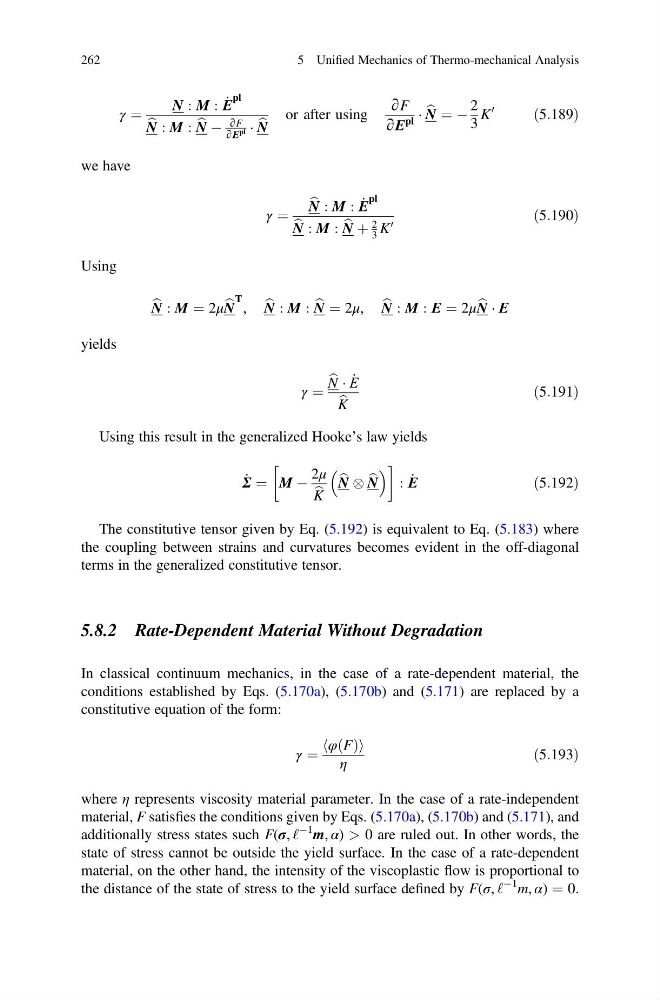
γ ¼
N : M : _
Ε
pl
b
N : M : b
N À
∂F
∂Ε
pl Á b
N
or after using
∂F
∂Ε
pl
Á b
N ¼ À
2
3
K
0
ð5:189Þ
we have
γ ¼
b
N : M : _
Ε
pl
b
N : M : b
N þ
2
3 K
0
ð5:190Þ
Using
b
N : M ¼ 2μ b
N
T
, b
N : M : b
N ¼ 2μ, b
N : M : Ε ¼ 2μ b
N Á Ε
yields
γ ¼
b
N Á _
Ε
b
K
ð5:191Þ
Using this result in the generalized Hooke’s law yields
_
Σ ¼ M À
2μ
b
K
b
N b
N
!
: _
Ε
ð5:192Þ
The constitutive tensor given by Eq. (5.192) is equivalent to Eq. (5.183) where
the coupling between strains and curvatures becomes evident in the off-diagonal
terms in the generalized constitutive tensor.
5.8.2 Rate-Dependent Material Without Degradation
In classical continuum mechanics, in the case of a rate-dependent material, the
conditions established by Eqs. (5.170a), (5.170b) and (5.171) are replaced by a
constitutive equation of the form:
γ ¼
φ F
ð Þ
h
i
η
ð5:193Þ
where η represents viscosity material parameter. In the case of a rate-independent
material, F satisfies the conditions given by Eqs. (5.170a), (5.170b) and (5.171), and
additionally stress states such F(σ, ‘
À1 m, α) > 0 are ruled out. In other words, the
state of stress cannot be outside the yield surface. In the case of a rate-dependent
material, on the other hand, the intensity of the viscoplastic flow is proportional to
the distance of the state of stress to the yield surface defined by F(σ, ‘
À1 m, α) ¼ 0.
262
5 Unified Mechanics of Thermo-mechanical Analysis
N : M : _
Ε
pl
b
N : M : b
N À
∂F
∂Ε
pl Á b
N
or after using
∂F
∂Ε
pl
Á b
N ¼ À
2
3
K
0
ð5:189Þ
we have
γ ¼
b
N : M : _
Ε
pl
b
N : M : b
N þ
2
3 K
0
ð5:190Þ
Using
b
N : M ¼ 2μ b
N
T
, b
N : M : b
N ¼ 2μ, b
N : M : Ε ¼ 2μ b
N Á Ε
yields
γ ¼
b
N Á _
Ε
b
K
ð5:191Þ
Using this result in the generalized Hooke’s law yields
_
Σ ¼ M À
2μ
b
K
b
N b
N
!
: _
Ε
ð5:192Þ
The constitutive tensor given by Eq. (5.192) is equivalent to Eq. (5.183) where
the coupling between strains and curvatures becomes evident in the off-diagonal
terms in the generalized constitutive tensor.
5.8.2 Rate-Dependent Material Without Degradation
In classical continuum mechanics, in the case of a rate-dependent material, the
conditions established by Eqs. (5.170a), (5.170b) and (5.171) are replaced by a
constitutive equation of the form:
γ ¼
φ F
ð Þ
h
i
η
ð5:193Þ
where η represents viscosity material parameter. In the case of a rate-independent
material, F satisfies the conditions given by Eqs. (5.170a), (5.170b) and (5.171), and
additionally stress states such F(σ, ‘
À1 m, α) > 0 are ruled out. In other words, the
state of stress cannot be outside the yield surface. In the case of a rate-dependent
material, on the other hand, the intensity of the viscoplastic flow is proportional to
the distance of the state of stress to the yield surface defined by F(σ, ‘
À1 m, α) ¼ 0.
262
5 Unified Mechanics of Thermo-mechanical Analysis