

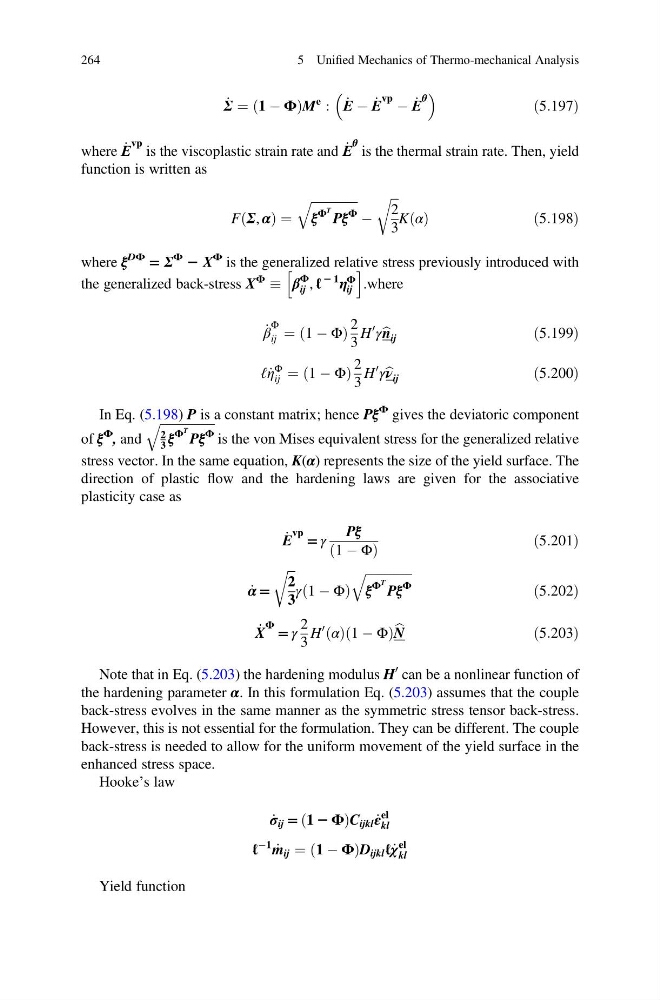
_
Σ ¼ 1 À Φ
ð
ÞM
e
: _
Ε À _
Ε
vp À _
Ε
θ
ð5:197Þ
where _
Ε
vp is the viscoplastic strain rate and _
Ε
θ is the thermal strain rate. Then, yield
function is written as
F Σ, α
ð
Þ ¼
ffiffiffiffiffiffiffiffiffiffiffiffiffiffiffi
ξ
Φ
T
Pξ
Φ
q
À
ffiffi ffi
2
3
r
K α
ð Þ
ð5:198Þ
where ξ
DΦ
= Σ
Φ
2 X
Φ is the generalized relative stress previously introduced with
the generalized back-stress X
Φ
β
Φ
ij , ℓ
2 1
η
Φ
ij
h
i
.where
_
β
Φ
ij ¼ 1 À Φ
ð
Þ
2
3
H
0
γb n ij
ð5:199Þ
ℓ _
η
Φ
ij ¼ 1 À Φ
ð
Þ
2
3
H
0
γb ν ij
ð5:200Þ
In Eq. (5.198) P is a constant matrix; hence Pξ
Φ gives the deviatoric component
of ξ
Φ , and
ffiffiffiffiffiffiffiffiffiffiffiffiffiffiffiffiffi ffi
2
3 ξ
Φ
T
Pξ
Φ
q
is the von Mises equivalent stress for the generalized relative
stress vector. In the same equation, K(α) represents the size of the yield surface. The
direction of plastic flow and the hardening laws are given for the associative
plasticity case as
_
Ε
vp = γ
Pξ
1 À Φ
ð
Þ
ð5:201Þ
_
α =
ffiffi ffi
2
3
r
γ 1 À Φ
ð
Þ
ffiffiffiffiffiffiffiffiffiffiffiffiffiffiffi
ξ
Φ
T
Pξ
Φ
q
ð5:202Þ
_
X
Φ = γ
2
3
H
0
α
ð Þ 1 À Φ
ð
Þ b
N
ð5:203Þ
Note that in Eq. (5.203) the hardening modulus H
0 can be a nonlinear function of
the hardening parameter α. In this formulation Eq. (5.203) assumes that the couple
back-stress evolves in the same manner as the symmetric stress tensor back-stress.
However, this is not essential for the formulation. They can be different. The couple
back-stress is needed to allow for the uniform movement of the yield surface in the
enhanced stress space.
Hooke’s law
_
σ ij = 1 2 Φ
ð
ÞC ijkl _
ε
el
kl
ℓ
À1
_
m ij ¼ 1 À Φ
ð
ÞD ijkl ℓ _
χ
el
kl
Yield function
264
5 Unified Mechanics of Thermo-mechanical Analysis
Σ ¼ 1 À Φ
ð
ÞM
e
: _
Ε À _
Ε
vp À _
Ε
θ
ð5:197Þ
where _
Ε
vp is the viscoplastic strain rate and _
Ε
θ is the thermal strain rate. Then, yield
function is written as
F Σ, α
ð
Þ ¼
ffiffiffiffiffiffiffiffiffiffiffiffiffiffiffi
ξ
Φ
T
Pξ
Φ
q
À
ffiffi ffi
2
3
r
K α
ð Þ
ð5:198Þ
where ξ
DΦ
= Σ
Φ
2 X
Φ is the generalized relative stress previously introduced with
the generalized back-stress X
Φ
β
Φ
ij , ℓ
2 1
η
Φ
ij
h
i
.where
_
β
Φ
ij ¼ 1 À Φ
ð
Þ
2
3
H
0
γb n ij
ð5:199Þ
ℓ _
η
Φ
ij ¼ 1 À Φ
ð
Þ
2
3
H
0
γb ν ij
ð5:200Þ
In Eq. (5.198) P is a constant matrix; hence Pξ
Φ gives the deviatoric component
of ξ
Φ , and
ffiffiffiffiffiffiffiffiffiffiffiffiffiffiffiffiffi ffi
2
3 ξ
Φ
T
Pξ
Φ
q
is the von Mises equivalent stress for the generalized relative
stress vector. In the same equation, K(α) represents the size of the yield surface. The
direction of plastic flow and the hardening laws are given for the associative
plasticity case as
_
Ε
vp = γ
Pξ
1 À Φ
ð
Þ
ð5:201Þ
_
α =
ffiffi ffi
2
3
r
γ 1 À Φ
ð
Þ
ffiffiffiffiffiffiffiffiffiffiffiffiffiffiffi
ξ
Φ
T
Pξ
Φ
q
ð5:202Þ
_
X
Φ = γ
2
3
H
0
α
ð Þ 1 À Φ
ð
Þ b
N
ð5:203Þ
Note that in Eq. (5.203) the hardening modulus H
0 can be a nonlinear function of
the hardening parameter α. In this formulation Eq. (5.203) assumes that the couple
back-stress evolves in the same manner as the symmetric stress tensor back-stress.
However, this is not essential for the formulation. They can be different. The couple
back-stress is needed to allow for the uniform movement of the yield surface in the
enhanced stress space.
Hooke’s law
_
σ ij = 1 2 Φ
ð
ÞC ijkl _
ε
el
kl
ℓ
À1
_
m ij ¼ 1 À Φ
ð
ÞD ijkl ℓ _
χ
el
kl
Yield function
264
5 Unified Mechanics of Thermo-mechanical Analysis