

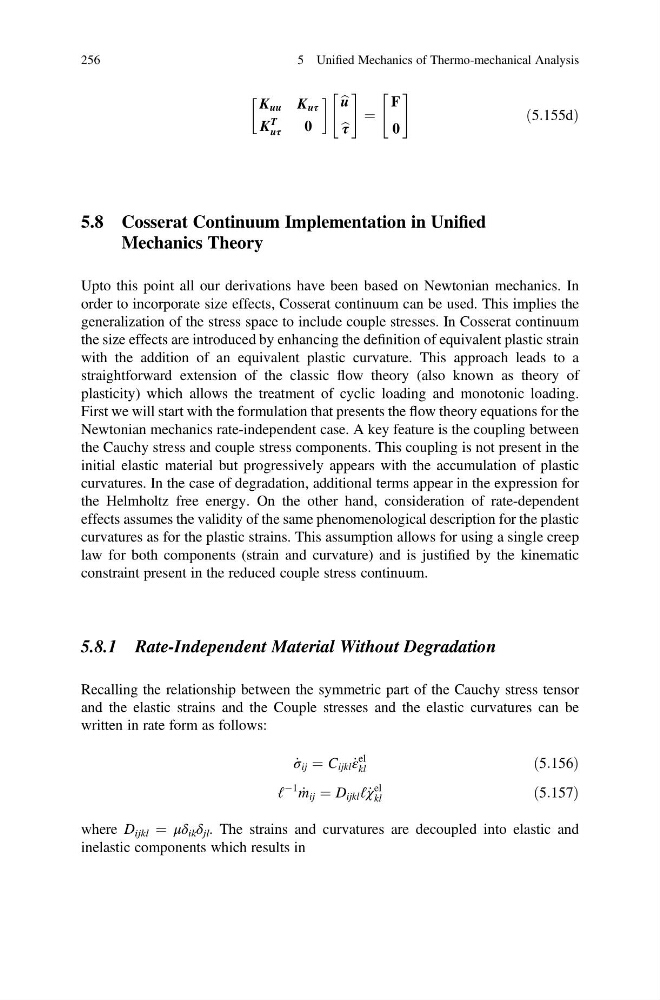
K uu K uτ
K
T
uτ
0
! b u
b τ
" #
¼
F
0
" #
ð5:155dÞ
5.8 Cosserat Continuum Implementation in Unified
Mechanics Theory
Upto this point all our derivations have been based on Newtonian mechanics. In
order to incorporate size effects, Cosserat continuum can be used. This implies the
generalization of the stress space to include couple stresses. In Cosserat continuum
the size effects are introduced by enhancing the definition of equivalent plastic strain
with the addition of an equivalent plastic curvature. This approach leads to a
straightforward extension of the classic flow theory (also known as theory of
plasticity) which allows the treatment of cyclic loading and monotonic loading.
First we will start with the formulation that presents the flow theory equations for the
Newtonian mechanics rate-independent case. A key feature is the coupling between
the Cauchy stress and couple stress components. This coupling is not present in the
initial elastic material but progressively appears with the accumulation of plastic
curvatures. In the case of degradation, additional terms appear in the expression for
the Helmholtz free energy. On the other hand, consideration of rate-dependent
effects assumes the validity of the same phenomenological description for the plastic
curvatures as for the plastic strains. This assumption allows for using a single creep
law for both components (strain and curvature) and is justified by the kinematic
constraint present in the reduced couple stress continuum.
5.8.1 Rate-Independent Material Without Degradation
Recalling the relationship between the symmetric part of the Cauchy stress tensor
and the elastic strains and the Couple stresses and the elastic curvatures can be
written in rate form as follows:
_
σ ij ¼ C ijkl _
ε
el
kl
ð5:156Þ
ℓ
À1
_
m ij ¼ D ijkl ℓ _
χ
el
kl
ð5:157Þ
where D ijkl ¼ μδ ik δ jl . The strains and curvatures are decoupled into elastic and
inelastic components which results in
256
5 Unified Mechanics of Thermo-mechanical Analysis
K
T
uτ
0
! b u
b τ
" #
¼
F
0
" #
ð5:155dÞ
5.8 Cosserat Continuum Implementation in Unified
Mechanics Theory
Upto this point all our derivations have been based on Newtonian mechanics. In
order to incorporate size effects, Cosserat continuum can be used. This implies the
generalization of the stress space to include couple stresses. In Cosserat continuum
the size effects are introduced by enhancing the definition of equivalent plastic strain
with the addition of an equivalent plastic curvature. This approach leads to a
straightforward extension of the classic flow theory (also known as theory of
plasticity) which allows the treatment of cyclic loading and monotonic loading.
First we will start with the formulation that presents the flow theory equations for the
Newtonian mechanics rate-independent case. A key feature is the coupling between
the Cauchy stress and couple stress components. This coupling is not present in the
initial elastic material but progressively appears with the accumulation of plastic
curvatures. In the case of degradation, additional terms appear in the expression for
the Helmholtz free energy. On the other hand, consideration of rate-dependent
effects assumes the validity of the same phenomenological description for the plastic
curvatures as for the plastic strains. This assumption allows for using a single creep
law for both components (strain and curvature) and is justified by the kinematic
constraint present in the reduced couple stress continuum.
5.8.1 Rate-Independent Material Without Degradation
Recalling the relationship between the symmetric part of the Cauchy stress tensor
and the elastic strains and the Couple stresses and the elastic curvatures can be
written in rate form as follows:
_
σ ij ¼ C ijkl _
ε
el
kl
ð5:156Þ
ℓ
À1
_
m ij ¼ D ijkl ℓ _
χ
el
kl
ð5:157Þ
where D ijkl ¼ μδ ik δ jl . The strains and curvatures are decoupled into elastic and
inelastic components which results in
256
5 Unified Mechanics of Thermo-mechanical Analysis