

_
ε ij ¼ _
ε
el
ij þ _
ε
pl
ij
ð5:158Þ
ℓ _
χ ij ¼ ℓ _
χ
el
ij þ ℓ _
χ
pl
ij
ð5:159Þ
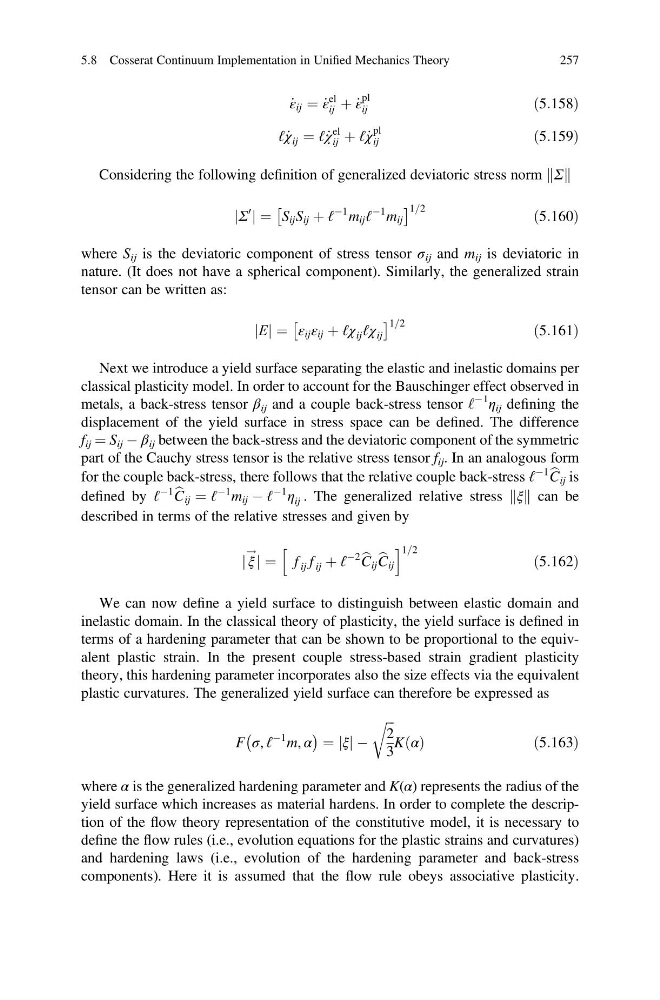
Considering the following definition of generalized deviatoric stress norm kΣk
jΣ
0
j ¼ S ij S ij þ ℓ
À1 m ij ℓ
À1 m ij
Â
à 1=2
ð5:160Þ
where S ij is the deviatoric component of stress tensor σ ij and m ij is deviatoric in
nature. (It does not have a spherical component). Similarly, the generalized strain
tensor can be written as:
jΕj ¼ ε ij ε ij þ ℓχ ij ℓχ ij
Â
à 1=2
ð5:161Þ
Next we introduce a yield surface separating the elastic and inelastic domains per
classical plasticity model. In order to account for the Bauschinger effect observed in
metals, a back-stress tensor β ij and a couple back-stress tensor ‘
À1
η ij defining the
displacement of the yield surface in stress space can be defined. The difference
f ij ¼ S ij À β ij between the back-stress and the deviatoric component of the symmetric
part of the Cauchy stress tensor is the relative stress tensor f ij . In an analogous form
for the couple back-stress, there follows that the relative couple back-stress ℓ
À1 b
C ij is
defined by ℓ
À1 b
C ij ¼ ℓ
À1 m ij À ℓ
À1
η ij . The generalized relative stress kξk can be
described in terms of the relative stresses and given by
j ξ
!
j ¼ f ij f ij þ ℓ
À2 b
C ij b
C ij
h
i 1=2
ð5:162Þ
We can now define a yield surface to distinguish between elastic domain and
inelastic domain. In the classical theory of plasticity, the yield surface is defined in
terms of a hardening parameter that can be shown to be proportional to the equivalent plastic strain. In the present couple stress-based strain gradient plasticity
theory, this hardening parameter incorporates also the size effects via the equivalent
plastic curvatures. The generalized yield surface can therefore be expressed as
F σ, ℓ
À1 m, α
À
Á ¼ jξj À
ffiffi ffi
2
3
r
K α
ð Þ
ð5:163Þ
where α is the generalized hardening parameter and K(α) represents the radius of the
yield surface which increases as material hardens. In order to complete the description of the flow theory representation of the constitutive model, it is necessary to
define the flow rules (i.e., evolution equations for the plastic strains and curvatures)
and hardening laws (i.e., evolution of the hardening parameter and back-stress
components). Here it is assumed that the flow rule obeys associative plasticity.
5.8 Cosserat Continuum Implementation in Unified Mechanics Theory
257
ε ij ¼ _
ε
el
ij þ _
ε
pl
ij
ð5:158Þ
ℓ _
χ ij ¼ ℓ _
χ
el
ij þ ℓ _
χ
pl
ij
ð5:159Þ
Considering the following definition of generalized deviatoric stress norm kΣk
jΣ
0
j ¼ S ij S ij þ ℓ
À1 m ij ℓ
À1 m ij
Â
à 1=2
ð5:160Þ
where S ij is the deviatoric component of stress tensor σ ij and m ij is deviatoric in
nature. (It does not have a spherical component). Similarly, the generalized strain
tensor can be written as:
jΕj ¼ ε ij ε ij þ ℓχ ij ℓχ ij
Â
à 1=2
ð5:161Þ
Next we introduce a yield surface separating the elastic and inelastic domains per
classical plasticity model. In order to account for the Bauschinger effect observed in
metals, a back-stress tensor β ij and a couple back-stress tensor ‘
À1
η ij defining the
displacement of the yield surface in stress space can be defined. The difference
f ij ¼ S ij À β ij between the back-stress and the deviatoric component of the symmetric
part of the Cauchy stress tensor is the relative stress tensor f ij . In an analogous form
for the couple back-stress, there follows that the relative couple back-stress ℓ
À1 b
C ij is
defined by ℓ
À1 b
C ij ¼ ℓ
À1 m ij À ℓ
À1
η ij . The generalized relative stress kξk can be
described in terms of the relative stresses and given by
j ξ
!
j ¼ f ij f ij þ ℓ
À2 b
C ij b
C ij
h
i 1=2
ð5:162Þ
We can now define a yield surface to distinguish between elastic domain and
inelastic domain. In the classical theory of plasticity, the yield surface is defined in
terms of a hardening parameter that can be shown to be proportional to the equivalent plastic strain. In the present couple stress-based strain gradient plasticity
theory, this hardening parameter incorporates also the size effects via the equivalent
plastic curvatures. The generalized yield surface can therefore be expressed as
F σ, ℓ
À1 m, α
À
Á ¼ jξj À
ffiffi ffi
2
3
r
K α
ð Þ
ð5:163Þ
where α is the generalized hardening parameter and K(α) represents the radius of the
yield surface which increases as material hardens. In order to complete the description of the flow theory representation of the constitutive model, it is necessary to
define the flow rules (i.e., evolution equations for the plastic strains and curvatures)
and hardening laws (i.e., evolution of the hardening parameter and back-stress
components). Here it is assumed that the flow rule obeys associative plasticity.
5.8 Cosserat Continuum Implementation in Unified Mechanics Theory
257