

element discretization, we recall that for a general couple stress theory, the principle
of virtual work was given by
Z
V
σ ij ε ij v i
ð ÞdV þ
Z
V
m ij χ ij φ i
ð ÞdV þ
Z
V
τ ij α ij v i , φ i
ð
ÞdV À
Z
Ω
σ
n
ð Þ
i v i dΩ À
Z
Ω
q i φ i dΩ ¼ 0 ð5:149Þ
Letting u ¼ Nu i, , ε ¼ B ε u i , χ ¼B χ u i , α ¼ B α u i , and σ
n
ð Þ
i ¼ N b t where b t
T ¼
t
u
1 t
v
1 t
ω
1 . . . . . . t
u
n t
v
n t
ω
n
Â
Ã
and using the constitutive relationships introduced in
Eqs. (5.141)–(5.143), we can write the following matrix form after eliminating the
virtual variables:
Z
V
B
T
ε CB ε dV þ
Z
V
B
T
χ DB χ dV þ
Z
V
B
T
α DB α dV
2
4
3
5 u i ¼
Z
∂Ω
N
Tb
tdΩ
ð5:150Þ
or equivalently using stiffness matrices
K
ε
e þ K
χ
e þ K
α
e
Â
Ã
u i ¼ F
ð5:151Þ
5.7.4.1 Reduced Couple Stress Theory: Pure Displacement Formulation
In the case of the reduced couple stress theory, u
!
, ω
! are related trough the constraint
relationship in Eqs. (5.119)–(5.121) and are not independent of each other. In terms
of a formulation based on translational degrees of freedom only, this constraint
u
v
ω
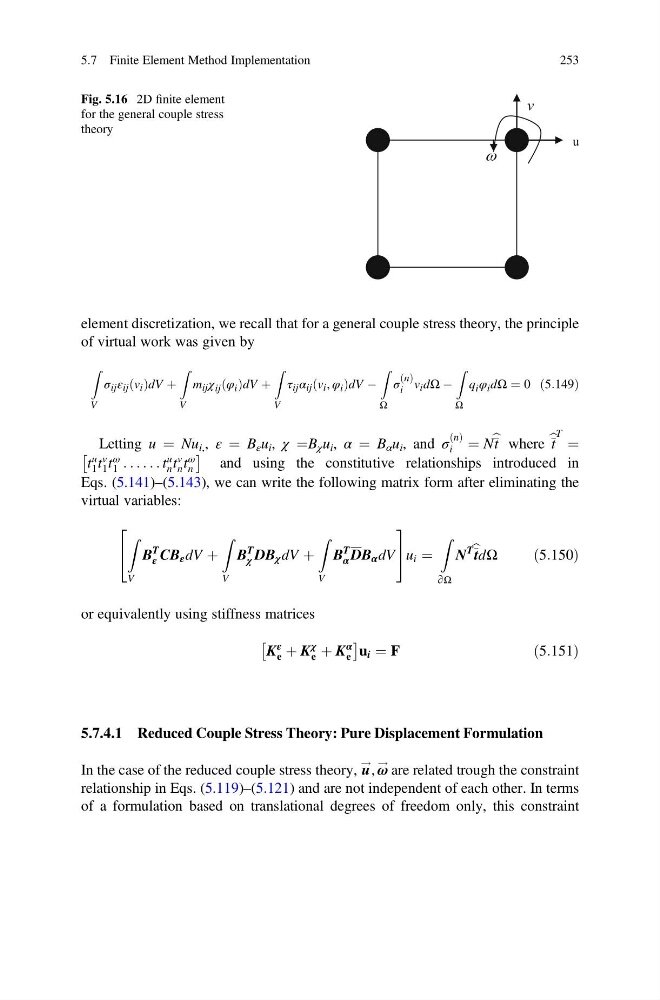
Fig. 5.16 2D finite element
for the general couple stress
theory
5.7 Finite Element Method Implementation
253
of virtual work was given by
Z
V
σ ij ε ij v i
ð ÞdV þ
Z
V
m ij χ ij φ i
ð ÞdV þ
Z
V
τ ij α ij v i , φ i
ð
ÞdV À
Z
Ω
σ
n
ð Þ
i v i dΩ À
Z
Ω
q i φ i dΩ ¼ 0 ð5:149Þ
Letting u ¼ Nu i, , ε ¼ B ε u i , χ ¼B χ u i , α ¼ B α u i , and σ
n
ð Þ
i ¼ N b t where b t
T ¼
t
u
1 t
v
1 t
ω
1 . . . . . . t
u
n t
v
n t
ω
n
Â
Ã
and using the constitutive relationships introduced in
Eqs. (5.141)–(5.143), we can write the following matrix form after eliminating the
virtual variables:
Z
V
B
T
ε CB ε dV þ
Z
V
B
T
χ DB χ dV þ
Z
V
B
T
α DB α dV
2
4
3
5 u i ¼
Z
∂Ω
N
Tb
tdΩ
ð5:150Þ
or equivalently using stiffness matrices
K
ε
e þ K
χ
e þ K
α
e
Â
Ã
u i ¼ F
ð5:151Þ
5.7.4.1 Reduced Couple Stress Theory: Pure Displacement Formulation
In the case of the reduced couple stress theory, u
!
, ω
! are related trough the constraint
relationship in Eqs. (5.119)–(5.121) and are not independent of each other. In terms
of a formulation based on translational degrees of freedom only, this constraint
u
v
ω
Fig. 5.16 2D finite element
for the general couple stress
theory
5.7 Finite Element Method Implementation
253