

is consistent with the general couple stress theory, and the resulting variational
problem is thus unconstrained.
5.7.2 Reduced Couple Stress Theory: Variational
Formulation
The principle of virtual displacements for a reduced couple stress theory can be
given by
Z
V
σ ij ε ij v i
ð ÞdV þ
Z
V
m ij χ ij v i
ð ÞdV À
Z
Ω
σ
n
ð Þ
i v i dΩ À
Z
Ω
q i φ i v i
ð ÞdΩ ¼ 0
ð5:147Þ
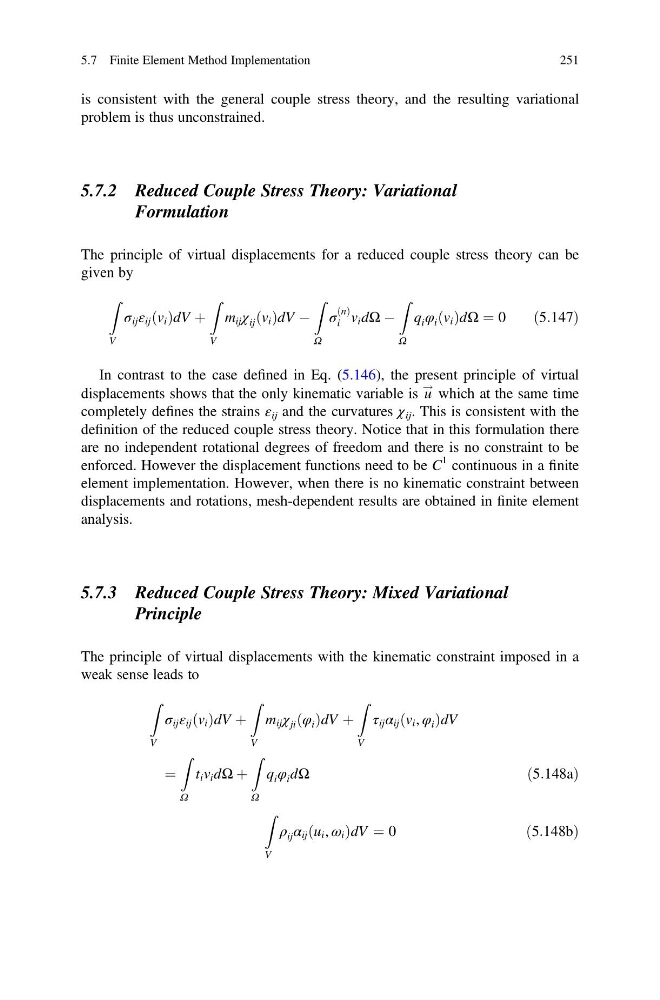
In contrast to the case defined in Eq. (5.146), the present principle of virtual
displacements shows that the only kinematic variable is u
! which at the same time
completely defines the strains ε ij and the curvatures χ ij . This is consistent with the
definition of the reduced couple stress theory. Notice that in this formulation there
are no independent rotational degrees of freedom and there is no constraint to be
enforced. However the displacement functions need to be C
1 continuous in a finite
element implementation. However, when there is no kinematic constraint between
displacements and rotations, mesh-dependent results are obtained in finite element
analysis.
5.7.3 Reduced Couple Stress Theory: Mixed Variational
Principle
The principle of virtual displacements with the kinematic constraint imposed in a
weak sense leads to
Z
V
σ ij ε ij v i
ð ÞdV þ
Z
V
m ij χ ji φ i
ð ÞdV þ
Z
V
τ ij α ij v i , φ i
ð
ÞdV
¼
Z
Ω
t i v i dΩ þ
Z
Ω
q i φ i dΩ
ð5:148aÞ
Z
V
ρ ij α ij u i , ω i
ð
ÞdV ¼ 0
ð5:148bÞ
5.7 Finite Element Method Implementation
251
problem is thus unconstrained.
5.7.2 Reduced Couple Stress Theory: Variational
Formulation
The principle of virtual displacements for a reduced couple stress theory can be
given by
Z
V
σ ij ε ij v i
ð ÞdV þ
Z
V
m ij χ ij v i
ð ÞdV À
Z
Ω
σ
n
ð Þ
i v i dΩ À
Z
Ω
q i φ i v i
ð ÞdΩ ¼ 0
ð5:147Þ
In contrast to the case defined in Eq. (5.146), the present principle of virtual
displacements shows that the only kinematic variable is u
! which at the same time
completely defines the strains ε ij and the curvatures χ ij . This is consistent with the
definition of the reduced couple stress theory. Notice that in this formulation there
are no independent rotational degrees of freedom and there is no constraint to be
enforced. However the displacement functions need to be C
1 continuous in a finite
element implementation. However, when there is no kinematic constraint between
displacements and rotations, mesh-dependent results are obtained in finite element
analysis.
5.7.3 Reduced Couple Stress Theory: Mixed Variational
Principle
The principle of virtual displacements with the kinematic constraint imposed in a
weak sense leads to
Z
V
σ ij ε ij v i
ð ÞdV þ
Z
V
m ij χ ji φ i
ð ÞdV þ
Z
V
τ ij α ij v i , φ i
ð
ÞdV
¼
Z
Ω
t i v i dΩ þ
Z
Ω
q i φ i dΩ
ð5:148aÞ
Z
V
ρ ij α ij u i , ω i
ð
ÞdV ¼ 0
ð5:148bÞ
5.7 Finite Element Method Implementation
251