

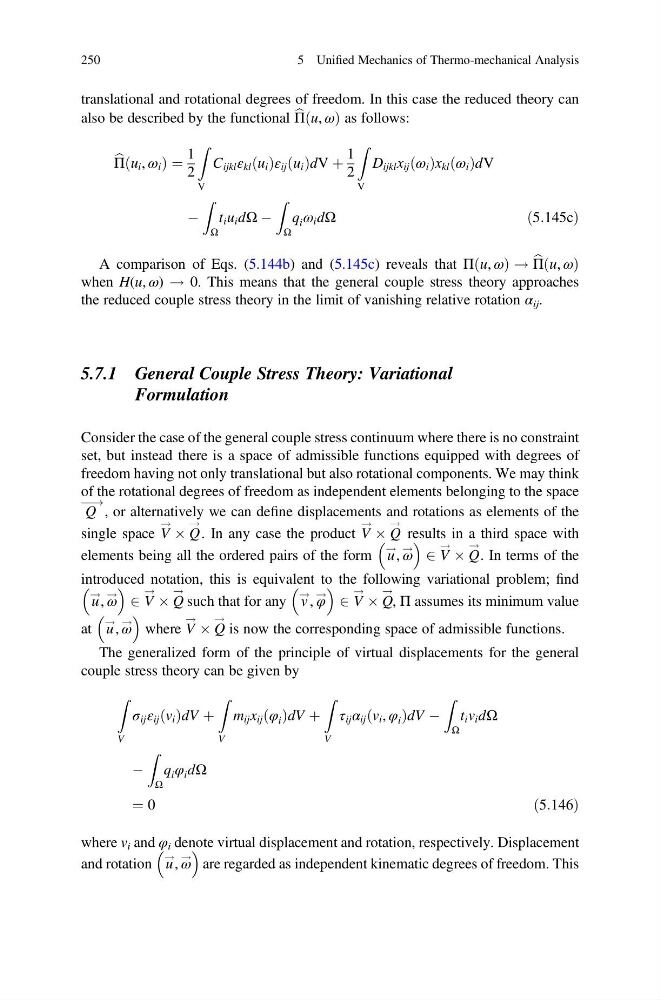
translational and rotational degrees of freedom. In this case the reduced theory can
also be described by the functional b
Π u, ω
ð
Þ as follows:
b
Π u i , ω i
ð
Þ¼
1
2
Z
V
C ijkl ε kl u i
ð Þε ij u i
ð ÞdV þ
1
2
Z
V
D ijkl x ij ω i
ð Þx kl ω i
ð ÞdV
À
Z
Ω
t i u i dΩ À
Z
Ω
q i ω i dΩ
ð5:145cÞ
A comparison of Eqs. (5.144b) and (5.145c) reveals that Π u, ω
ð
Þ ! b
Π u, ω
ð
Þ
when H(u, ω) ! 0. This means that the general couple stress theory approaches
the reduced couple stress theory in the limit of vanishing relative rotation α ij .
5.7.1 General Couple Stress Theory: Variational
Formulation
Consider the case of the general couple stress continuum where there is no constraint
set, but instead there is a space of admissible functions equipped with degrees of
freedom having not only translational but also rotational components. We may think
of the rotational degrees of freedom as independent elements belonging to the space
Q
! , or alternatively we can define displacements and rotations as elements of the
single space V
! Â Q
!
. In any case the product V
! Â Q
!
results in a third space with
elements being all the ordered pairs of the form u
!
, ω
!
2 V
! Â Q
!
. In terms of the
introduced notation, this is equivalent to the following variational problem; find
u
!
, ω
!
2 V
! Â Q
!
such that for any v
!
, φ
!
2 V
! Â Q
!
, Π assumes its minimum value
at u
! , ω
!
where V
! Â Q
!
is now the corresponding space of admissible functions.
The generalized form of the principle of virtual displacements for the general
couple stress theory can be given by
Z
V
σ ij ε ij v i
ð ÞdV þ
Z
V
m ij x ij φ i
ð ÞdV þ
Z
V
τ ij α ij v i , φ i
ð
ÞdV À
Z
Ω
t i v i dΩ
À
Z
Ω
q i φ i dΩ
¼ 0
ð5:146Þ
where v i and φ i denote virtual displacement and rotation, respectively. Displacement
and rotation u
! , ω
!
are regarded as independent kinematic degrees of freedom. This
250
5 Unified Mechanics of Thermo-mechanical Analysis
also be described by the functional b
Π u, ω
ð
Þ as follows:
b
Π u i , ω i
ð
Þ¼
1
2
Z
V
C ijkl ε kl u i
ð Þε ij u i
ð ÞdV þ
1
2
Z
V
D ijkl x ij ω i
ð Þx kl ω i
ð ÞdV
À
Z
Ω
t i u i dΩ À
Z
Ω
q i ω i dΩ
ð5:145cÞ
A comparison of Eqs. (5.144b) and (5.145c) reveals that Π u, ω
ð
Þ ! b
Π u, ω
ð
Þ
when H(u, ω) ! 0. This means that the general couple stress theory approaches
the reduced couple stress theory in the limit of vanishing relative rotation α ij .
5.7.1 General Couple Stress Theory: Variational
Formulation
Consider the case of the general couple stress continuum where there is no constraint
set, but instead there is a space of admissible functions equipped with degrees of
freedom having not only translational but also rotational components. We may think
of the rotational degrees of freedom as independent elements belonging to the space
Q
! , or alternatively we can define displacements and rotations as elements of the
single space V
! Â Q
!
. In any case the product V
! Â Q
!
results in a third space with
elements being all the ordered pairs of the form u
!
, ω
!
2 V
! Â Q
!
. In terms of the
introduced notation, this is equivalent to the following variational problem; find
u
!
, ω
!
2 V
! Â Q
!
such that for any v
!
, φ
!
2 V
! Â Q
!
, Π assumes its minimum value
at u
! , ω
!
where V
! Â Q
!
is now the corresponding space of admissible functions.
The generalized form of the principle of virtual displacements for the general
couple stress theory can be given by
Z
V
σ ij ε ij v i
ð ÞdV þ
Z
V
m ij x ij φ i
ð ÞdV þ
Z
V
τ ij α ij v i , φ i
ð
ÞdV À
Z
Ω
t i v i dΩ
À
Z
Ω
q i φ i dΩ
¼ 0
ð5:146Þ
where v i and φ i denote virtual displacement and rotation, respectively. Displacement
and rotation u
! , ω
!
are regarded as independent kinematic degrees of freedom. This
250
5 Unified Mechanics of Thermo-mechanical Analysis