

this approach relaxes the strong C
1 shape function continuity requirements and
allows the use of C
0 elements thus keeping the convergence features of the finite
element method. Here the kinematic constraint is enforced via a penalty function/
reduced integration scheme that allows treatment of the reduced theory based on
ideas motivated by the general theory. The current description progressively arrives
at this formulation after exploring different possibilities within the context of the
variational calculus. Throughout all the discussion, the objective should be clear that
the final goal is to implement the reduced couple stress theory framework in the form
of a user element subroutine within the finite element code ABAQUS which imposes
additional restrictions.
5.6.2 Cosserat Couple Stress Theory
The motivation behind Cosserat’s couple stress theory, also referred to as Cosserat
continuum, Fig. 5.12, Gomez (2006) stems from the following arguments. In
classical continuum mechanics, it is assumed that a material point occupies no
space (has zero volume) and then the finite size of material microstructure is ignored.
This is equivalent to the definition of representative volume element. In order to
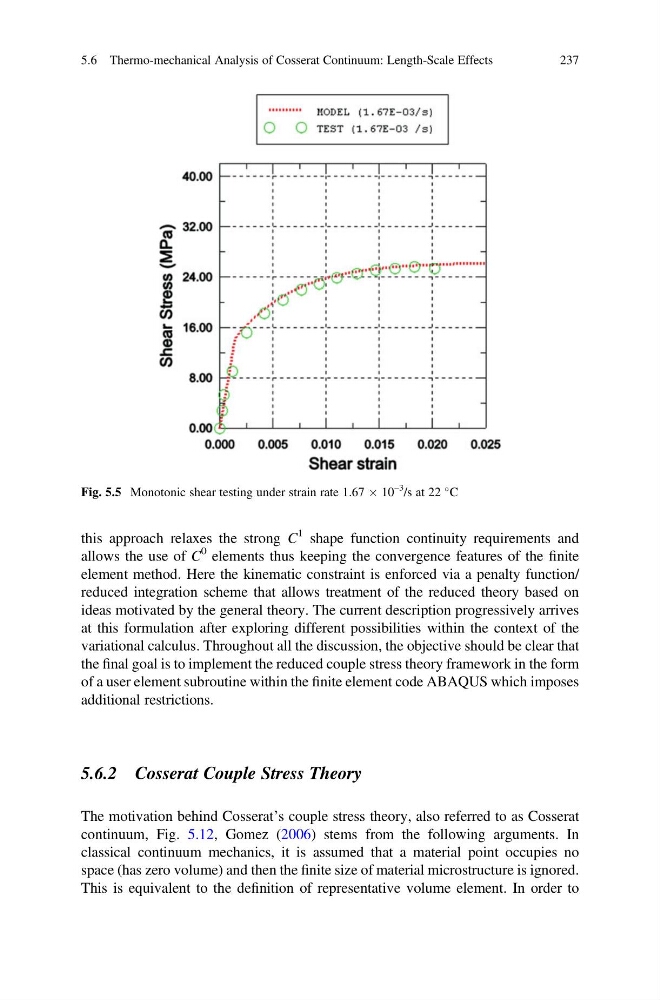
Fig. 5.5 Monotonic shear testing under strain rate 1.67 Â 10
–3
/s at 22
C
5.6 Thermo-mechanical Analysis of Cosserat Continuum: Length-Scale Effects
237
1 shape function continuity requirements and
allows the use of C
0 elements thus keeping the convergence features of the finite
element method. Here the kinematic constraint is enforced via a penalty function/
reduced integration scheme that allows treatment of the reduced theory based on
ideas motivated by the general theory. The current description progressively arrives
at this formulation after exploring different possibilities within the context of the
variational calculus. Throughout all the discussion, the objective should be clear that
the final goal is to implement the reduced couple stress theory framework in the form
of a user element subroutine within the finite element code ABAQUS which imposes
additional restrictions.
5.6.2 Cosserat Couple Stress Theory
The motivation behind Cosserat’s couple stress theory, also referred to as Cosserat
continuum, Fig. 5.12, Gomez (2006) stems from the following arguments. In
classical continuum mechanics, it is assumed that a material point occupies no
space (has zero volume) and then the finite size of material microstructure is ignored.
This is equivalent to the definition of representative volume element. In order to
Fig. 5.5 Monotonic shear testing under strain rate 1.67 Â 10
–3
/s at 22
C
5.6 Thermo-mechanical Analysis of Cosserat Continuum: Length-Scale Effects
237