

include the effects of the finite size of material’s microstructure while retaining a
mathematical continuum, classical continuum mechanics have been extended or
generalized. In Cosserat continuum, each material particle is enriched with higherorder kinematic degrees of freedom. In particular, the specification of position
requires also the definition of a rotation. In the more general Cosserat theory, this
new kinematic quantity, the micro rotation, is independent of the classical continuum
mechanics theory rotation vector θ k =
1
2 e ijk u j,k where e ijk is the alternating pseudotensor and a coma represents a derivative with respect to rectangular Cartesian
coordinates. This type of theory has been termed as “indeterminate couple stress
theory” by Eringen (1968) and “generalized couple stress theory” by Fleck and
Hutchinson (1997). The following discussion elaborates further upon this theory.
There are different interpretations of a Cosserat continuum. In the Cosserat and
Cosserat (1909), couple stress theory, a differential material element, is subjected to
not only normal and shear stresses but also couple stress components as shown in
Fig. 5.12. For linear elastic behavior, the usual stress components are functions of the
strains, and the couple stresses are functions of the strain gradients. Two distinct
theories are identified in the work of the Cosserat and Cosserat (1909). First, there is
a reduced couple stress theory with the kinematic degrees of freedom being the
displacement u i and an associated material rotation θ i tied to the displacements by
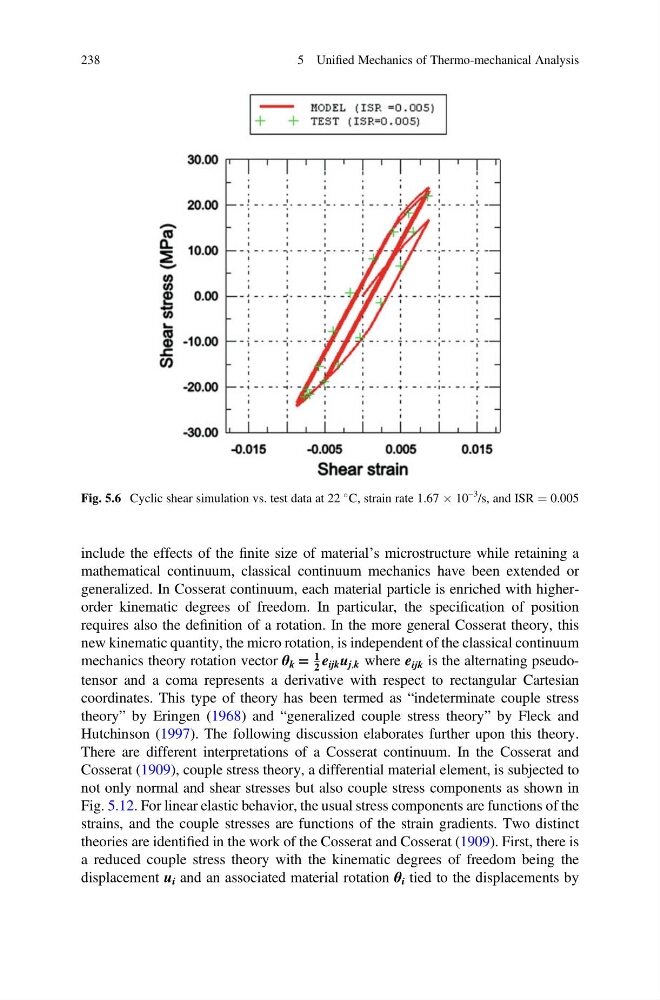
Fig. 5.6 Cyclic shear simulation vs. test data at 22
C, strain rate 1.67 Â 10
–3
/s, and ISR ¼ 0.005
238
5 Unified Mechanics of Thermo-mechanical Analysis
mathematical continuum, classical continuum mechanics have been extended or
generalized. In Cosserat continuum, each material particle is enriched with higherorder kinematic degrees of freedom. In particular, the specification of position
requires also the definition of a rotation. In the more general Cosserat theory, this
new kinematic quantity, the micro rotation, is independent of the classical continuum
mechanics theory rotation vector θ k =
1
2 e ijk u j,k where e ijk is the alternating pseudotensor and a coma represents a derivative with respect to rectangular Cartesian
coordinates. This type of theory has been termed as “indeterminate couple stress
theory” by Eringen (1968) and “generalized couple stress theory” by Fleck and
Hutchinson (1997). The following discussion elaborates further upon this theory.
There are different interpretations of a Cosserat continuum. In the Cosserat and
Cosserat (1909), couple stress theory, a differential material element, is subjected to
not only normal and shear stresses but also couple stress components as shown in
Fig. 5.12. For linear elastic behavior, the usual stress components are functions of the
strains, and the couple stresses are functions of the strain gradients. Two distinct
theories are identified in the work of the Cosserat and Cosserat (1909). First, there is
a reduced couple stress theory with the kinematic degrees of freedom being the
displacement u i and an associated material rotation θ i tied to the displacements by
Fig. 5.6 Cyclic shear simulation vs. test data at 22
C, strain rate 1.67 Â 10
–3
/s, and ISR ¼ 0.005
238
5 Unified Mechanics of Thermo-mechanical Analysis