

Entropy change caused by the heat transfer between the system and its surroundings has no influence on the degradation of the material, if the temperature field in
the body is uniform as a result of this exchange. If this heat exchange leads to a
temperature field that is nonuniform, then heat coming from outside can lead to
irreversible entropy generation in the material as thermomigration and other scattering mechanisms. Only the internal entropy generation, namely, the entropy created
in the system, should be used as a basis for the systematic description of the
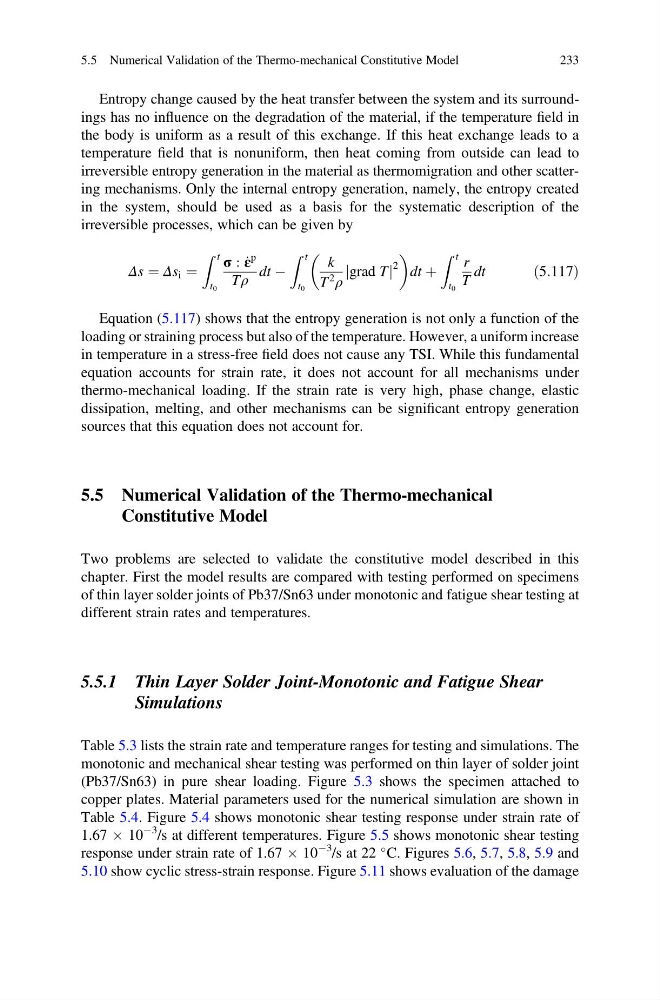
irreversible processes, which can be given by
Δs ¼ Δs i ¼
Z t
t 0
σ : _
ε
p
Tρ
dt À
Z t
t 0
k
T
2
ρ
grad T
j
j
2
dt þ
Z t
t 0
r
T
dt
ð5:117Þ
Equation (5.117) shows that the entropy generation is not only a function of the
loading or straining process but also of the temperature. However, a uniform increase
in temperature in a stress-free field does not cause any TSI. While this fundamental
equation accounts for strain rate, it does not account for all mechanisms under
thermo-mechanical loading. If the strain rate is very high, phase change, elastic
dissipation, melting, and other mechanisms can be significant entropy generation
sources that this equation does not account for.
5.5 Numerical Validation of the Thermo-mechanical
Constitutive Model
Two problems are selected to validate the constitutive model described in this
chapter. First the model results are compared with testing performed on specimens
of thin layer solder joints of Pb37/Sn63 under monotonic and fatigue shear testing at
different strain rates and temperatures.
5.5.1 Thin Layer Solder Joint-Monotonic and Fatigue Shear
Simulations
Table 5.3 lists the strain rate and temperature ranges for testing and simulations. The
monotonic and mechanical shear testing was performed on thin layer of solder joint
(Pb37/Sn63) in pure shear loading. Figure 5.3 shows the specimen attached to
copper plates. Material parameters used for the numerical simulation are shown in
Table 5.4. Figure 5.4 shows monotonic shear testing response under strain rate of
1.67 Â 10
À3 /s at different temperatures. Figure 5.5 shows monotonic shear testing
response under strain rate of 1.67 Â 10
À3
/s at 22
C. Figures 5.6, 5.7, 5.8, 5.9 and
5.10 show cyclic stress-strain response. Figure 5.11 shows evaluation of the damage
5.5 Numerical Validation of the Thermo-mechanical Constitutive Model
233
the body is uniform as a result of this exchange. If this heat exchange leads to a
temperature field that is nonuniform, then heat coming from outside can lead to
irreversible entropy generation in the material as thermomigration and other scattering mechanisms. Only the internal entropy generation, namely, the entropy created
in the system, should be used as a basis for the systematic description of the
irreversible processes, which can be given by
Δs ¼ Δs i ¼
Z t
t 0
σ : _
ε
p
Tρ
dt À
Z t
t 0
k
T
2
ρ
grad T
j
j
2
dt þ
Z t
t 0
r
T
dt
ð5:117Þ
Equation (5.117) shows that the entropy generation is not only a function of the
loading or straining process but also of the temperature. However, a uniform increase
in temperature in a stress-free field does not cause any TSI. While this fundamental
equation accounts for strain rate, it does not account for all mechanisms under
thermo-mechanical loading. If the strain rate is very high, phase change, elastic
dissipation, melting, and other mechanisms can be significant entropy generation
sources that this equation does not account for.
5.5 Numerical Validation of the Thermo-mechanical
Constitutive Model
Two problems are selected to validate the constitutive model described in this
chapter. First the model results are compared with testing performed on specimens
of thin layer solder joints of Pb37/Sn63 under monotonic and fatigue shear testing at
different strain rates and temperatures.
5.5.1 Thin Layer Solder Joint-Monotonic and Fatigue Shear
Simulations
Table 5.3 lists the strain rate and temperature ranges for testing and simulations. The
monotonic and mechanical shear testing was performed on thin layer of solder joint
(Pb37/Sn63) in pure shear loading. Figure 5.3 shows the specimen attached to
copper plates. Material parameters used for the numerical simulation are shown in
Table 5.4. Figure 5.4 shows monotonic shear testing response under strain rate of
1.67 Â 10
À3 /s at different temperatures. Figure 5.5 shows monotonic shear testing
response under strain rate of 1.67 Â 10
À3
/s at 22
C. Figures 5.6, 5.7, 5.8, 5.9 and
5.10 show cyclic stress-strain response. Figure 5.11 shows evaluation of the damage
5.5 Numerical Validation of the Thermo-mechanical Constitutive Model
233