

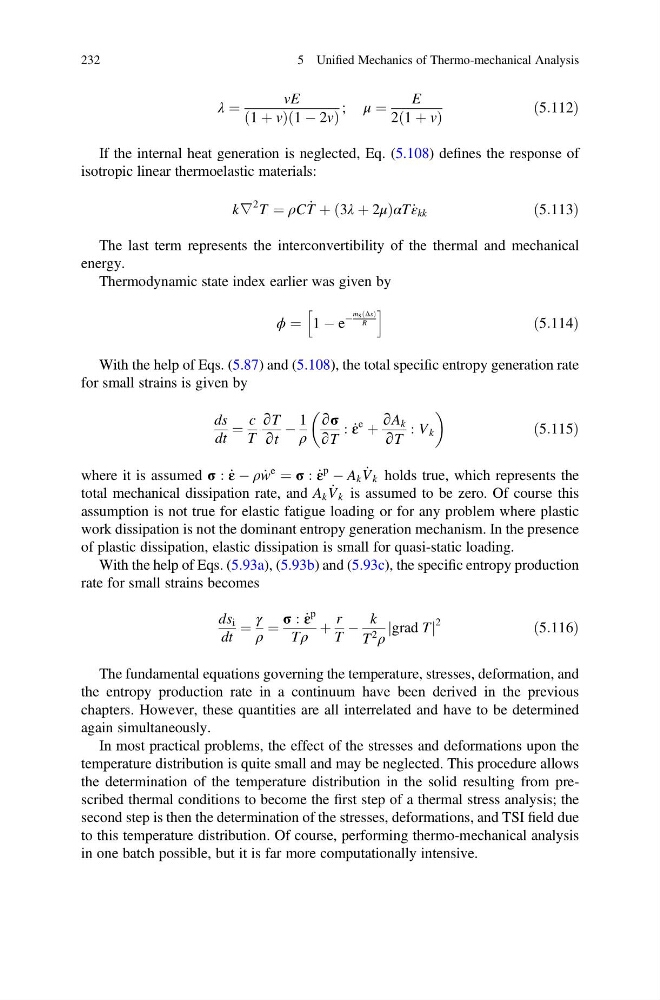
λ ¼
vE
1 þ v
ð
Þ 1 À 2v
ð
Þ
; μ ¼
E
2 1 þ v
ð
Þ
ð5:112Þ
If the internal heat generation is neglected, Eq. (5.108) defines the response of
isotropic linear thermoelastic materials:
k∇
2 T ¼ ρC _
T þ 3λ þ 2μ
ð
Þ αT _
ε kk
ð5:113Þ
The last term represents the interconvertibility of the thermal and mechanical
energy.
Thermodynamic state index earlier was given by
ϕ ¼ 1 À e
À
ms Δs
ð Þ
R
h
i
ð5:114Þ
With the help of Eqs. (5.87) and (5.108), the total specific entropy generation rate
for small strains is given by
ds
dt
¼
c
T
∂T
∂t
À
1
ρ
∂σ
∂T
: _
ε
e
þ
∂A k
∂T
: V k
ð5:115Þ
where it is assumed σ : _
ε À ρ _
w
e
¼ σ : _
ε
p
À A k _
V k holds true, which represents the
total mechanical dissipation rate, and A k _
V k is assumed to be zero. Of course this
assumption is not true for elastic fatigue loading or for any problem where plastic
work dissipation is not the dominant entropy generation mechanism. In the presence
of plastic dissipation, elastic dissipation is small for quasi-static loading.
With the help of Eqs. (5.93a), (5.93b) and (5.93c), the specific entropy production
rate for small strains becomes
ds i
dt
¼
γ
ρ
¼
σ : _
ε
p
Tρ
þ
r
T
À
k
T
2
ρ
grad T
j
j
2
ð5:116Þ
The fundamental equations governing the temperature, stresses, deformation, and
the entropy production rate in a continuum have been derived in the previous
chapters. However, these quantities are all interrelated and have to be determined
again simultaneously.
In most practical problems, the effect of the stresses and deformations upon the
temperature distribution is quite small and may be neglected. This procedure allows
the determination of the temperature distribution in the solid resulting from prescribed thermal conditions to become the first step of a thermal stress analysis; the
second step is then the determination of the stresses, deformations, and TSI field due
to this temperature distribution. Of course, performing thermo-mechanical analysis
in one batch possible, but it is far more computationally intensive.
232
5 Unified Mechanics of Thermo-mechanical Analysis
vE
1 þ v
ð
Þ 1 À 2v
ð
Þ
; μ ¼
E
2 1 þ v
ð
Þ
ð5:112Þ
If the internal heat generation is neglected, Eq. (5.108) defines the response of
isotropic linear thermoelastic materials:
k∇
2 T ¼ ρC _
T þ 3λ þ 2μ
ð
Þ αT _
ε kk
ð5:113Þ
The last term represents the interconvertibility of the thermal and mechanical
energy.
Thermodynamic state index earlier was given by
ϕ ¼ 1 À e
À
ms Δs
ð Þ
R
h
i
ð5:114Þ
With the help of Eqs. (5.87) and (5.108), the total specific entropy generation rate
for small strains is given by
ds
dt
¼
c
T
∂T
∂t
À
1
ρ
∂σ
∂T
: _
ε
e
þ
∂A k
∂T
: V k
ð5:115Þ
where it is assumed σ : _
ε À ρ _
w
e
¼ σ : _
ε
p
À A k _
V k holds true, which represents the
total mechanical dissipation rate, and A k _
V k is assumed to be zero. Of course this
assumption is not true for elastic fatigue loading or for any problem where plastic
work dissipation is not the dominant entropy generation mechanism. In the presence
of plastic dissipation, elastic dissipation is small for quasi-static loading.
With the help of Eqs. (5.93a), (5.93b) and (5.93c), the specific entropy production
rate for small strains becomes
ds i
dt
¼
γ
ρ
¼
σ : _
ε
p
Tρ
þ
r
T
À
k
T
2
ρ
grad T
j
j
2
ð5:116Þ
The fundamental equations governing the temperature, stresses, deformation, and
the entropy production rate in a continuum have been derived in the previous
chapters. However, these quantities are all interrelated and have to be determined
again simultaneously.
In most practical problems, the effect of the stresses and deformations upon the
temperature distribution is quite small and may be neglected. This procedure allows
the determination of the temperature distribution in the solid resulting from prescribed thermal conditions to become the first step of a thermal stress analysis; the
second step is then the determination of the stresses, deformations, and TSI field due
to this temperature distribution. Of course, performing thermo-mechanical analysis
in one batch possible, but it is far more computationally intensive.
232
5 Unified Mechanics of Thermo-mechanical Analysis