

parameter, [TSI] as a function of number of cycles. The computational simulations
are in good agreement with the experimental results. The differences are due to the
imperfect microstructure (such as voids) of the solder while the numerical model
assumes a perfect continuum. Moreover, entropy generation due to internal heat
generation was ignored for the sake of simplicity.
More examples of unified mechanics theory for thermo-mechanical problems are
provided in detail in the references listed at the end of the chapter.
5.6 Thermo-mechanical Analysis of Cosserat Continuum:
Length-Scale Effects
5.6.1 Introduction
Classical continuum mechanics formulation does not include a term for the size
effect. Strain gradient plasticity is needed when traditional continuum mechanics
formulation is unable to represent the material stress-strain behavior due to size
effects. Traditionally, continuum mechanics formulations are independent of size.
However, in some mechanics problems, this is not true, and material response is size
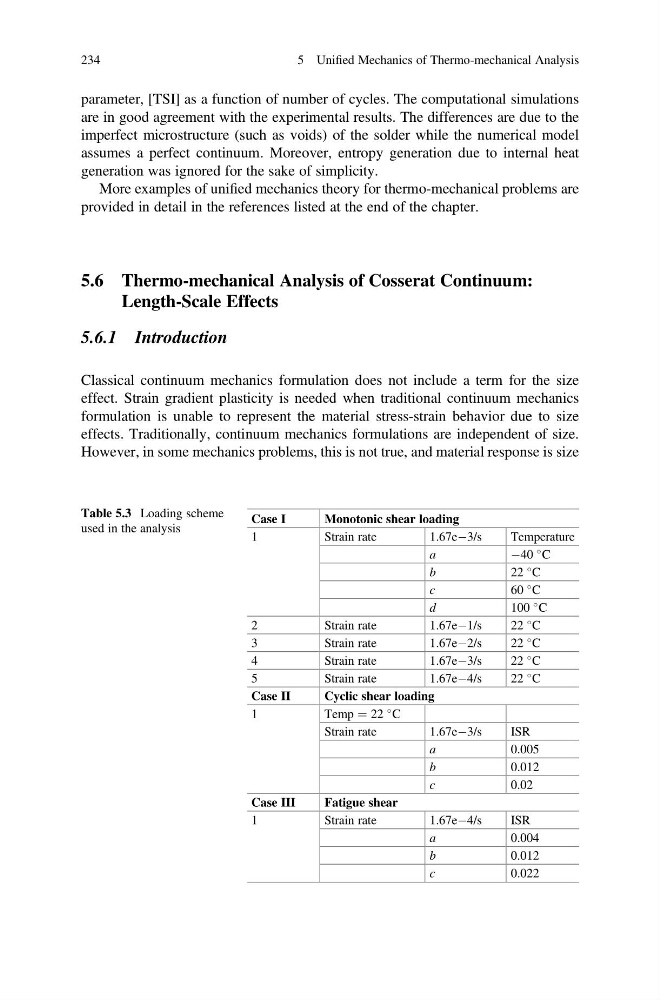
Table 5.3 Loading scheme
used in the analysis
Case I
Monotonic shear loading
1
Strain rate
1.67eÀ3/s
Temperature
a
À40
C
b
22
C
c
60
C
d
100
C
2
Strain rate
1.67eÀ1/s
22
C
3
Strain rate
1.67eÀ2/s
22
C
4
Strain rate
1.67eÀ3/s
22
C
5
Strain rate
1.67eÀ4/s
22
C
Case II
Cyclic shear loading
1
Temp ¼ 22
C
Strain rate
1.67eÀ3/s
ISR
a
0.005
b
0.012
c
0.02
Case III
Fatigue shear
1
Strain rate
1.67eÀ4/s
ISR
a
0.004
b
0.012
c
0.022
234
5 Unified Mechanics of Thermo-mechanical Analysis
are in good agreement with the experimental results. The differences are due to the
imperfect microstructure (such as voids) of the solder while the numerical model
assumes a perfect continuum. Moreover, entropy generation due to internal heat
generation was ignored for the sake of simplicity.
More examples of unified mechanics theory for thermo-mechanical problems are
provided in detail in the references listed at the end of the chapter.
5.6 Thermo-mechanical Analysis of Cosserat Continuum:
Length-Scale Effects
5.6.1 Introduction
Classical continuum mechanics formulation does not include a term for the size
effect. Strain gradient plasticity is needed when traditional continuum mechanics
formulation is unable to represent the material stress-strain behavior due to size
effects. Traditionally, continuum mechanics formulations are independent of size.
However, in some mechanics problems, this is not true, and material response is size
Table 5.3 Loading scheme
used in the analysis
Case I
Monotonic shear loading
1
Strain rate
1.67eÀ3/s
Temperature
a
À40
C
b
22
C
c
60
C
d
100
C
2
Strain rate
1.67eÀ1/s
22
C
3
Strain rate
1.67eÀ2/s
22
C
4
Strain rate
1.67eÀ3/s
22
C
5
Strain rate
1.67eÀ4/s
22
C
Case II
Cyclic shear loading
1
Temp ¼ 22
C
Strain rate
1.67eÀ3/s
ISR
a
0.005
b
0.012
c
0.02
Case III
Fatigue shear
1
Strain rate
1.67eÀ4/s
ISR
a
0.004
b
0.012
c
0.022
234
5 Unified Mechanics of Thermo-mechanical Analysis