

dS e
dt
¼ À
Z Ω
J S,tot Á dΩ
ð5:76Þ
dS i
dt
¼
Z V
γdV
ð5:77Þ
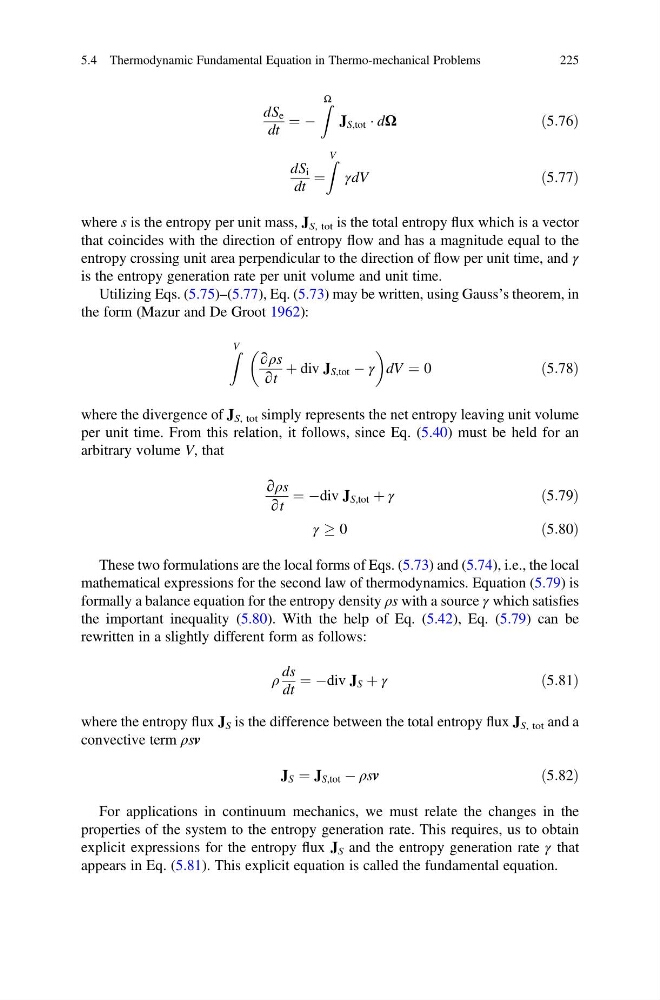
where s is the entropy per unit mass, J S, tot is the total entropy flux which is a vector
that coincides with the direction of entropy flow and has a magnitude equal to the
entropy crossing unit area perpendicular to the direction of flow per unit time, and γ
is the entropy generation rate per unit volume and unit time.
Utilizing Eqs. (5.75)–(5.77), Eq. (5.73) may be written, using Gauss’s theorem, in
the form (Mazur and De Groot 1962):
Z V
∂ρs
∂t
þ div J S,tot À γ
dV ¼ 0
ð5:78Þ
where the divergence of J S, tot simply represents the net entropy leaving unit volume
per unit time. From this relation, it follows, since Eq. (5.40) must be held for an
arbitrary volume V, that
∂ρs
∂t
¼ Àdiv J S,tot þ γ
ð5:79Þ
γ ! 0
ð5:80Þ
These two formulations are the local forms of Eqs. (5.73) and (5.74), i.e., the local
mathematical expressions for the second law of thermodynamics. Equation (5.79) is
formally a balance equation for the entropy density ρs with a source γ which satisfies
the important inequality (5.80). With the help of Eq. (5.42), Eq. (5.79) can be
rewritten in a slightly different form as follows:
ρ
ds
dt
¼ Àdiv J S þ γ
ð5:81Þ
where the entropy flux J S is the difference between the total entropy flux J S, tot and a
convective term ρsv
J S ¼ J S,tot À ρsv
ð5:82Þ
For applications in continuum mechanics, we must relate the changes in the
properties of the system to the entropy generation rate. This requires, us to obtain
explicit expressions for the entropy flux J S and the entropy generation rate γ that
appears in Eq. (5.81). This explicit equation is called the fundamental equation.
5.4 Thermodynamic Fundamental Equation in Thermo-mechanical Problems
225
dt
¼ À
Z Ω
J S,tot Á dΩ
ð5:76Þ
dS i
dt
¼
Z V
γdV
ð5:77Þ
where s is the entropy per unit mass, J S, tot is the total entropy flux which is a vector
that coincides with the direction of entropy flow and has a magnitude equal to the
entropy crossing unit area perpendicular to the direction of flow per unit time, and γ
is the entropy generation rate per unit volume and unit time.
Utilizing Eqs. (5.75)–(5.77), Eq. (5.73) may be written, using Gauss’s theorem, in
the form (Mazur and De Groot 1962):
Z V
∂ρs
∂t
þ div J S,tot À γ
dV ¼ 0
ð5:78Þ
where the divergence of J S, tot simply represents the net entropy leaving unit volume
per unit time. From this relation, it follows, since Eq. (5.40) must be held for an
arbitrary volume V, that
∂ρs
∂t
¼ Àdiv J S,tot þ γ
ð5:79Þ
γ ! 0
ð5:80Þ
These two formulations are the local forms of Eqs. (5.73) and (5.74), i.e., the local
mathematical expressions for the second law of thermodynamics. Equation (5.79) is
formally a balance equation for the entropy density ρs with a source γ which satisfies
the important inequality (5.80). With the help of Eq. (5.42), Eq. (5.79) can be
rewritten in a slightly different form as follows:
ρ
ds
dt
¼ Àdiv J S þ γ
ð5:81Þ
where the entropy flux J S is the difference between the total entropy flux J S, tot and a
convective term ρsv
J S ¼ J S,tot À ρsv
ð5:82Þ
For applications in continuum mechanics, we must relate the changes in the
properties of the system to the entropy generation rate. This requires, us to obtain
explicit expressions for the entropy flux J S and the entropy generation rate γ that
appears in Eq. (5.81). This explicit equation is called the fundamental equation.
5.4 Thermodynamic Fundamental Equation in Thermo-mechanical Problems
225