

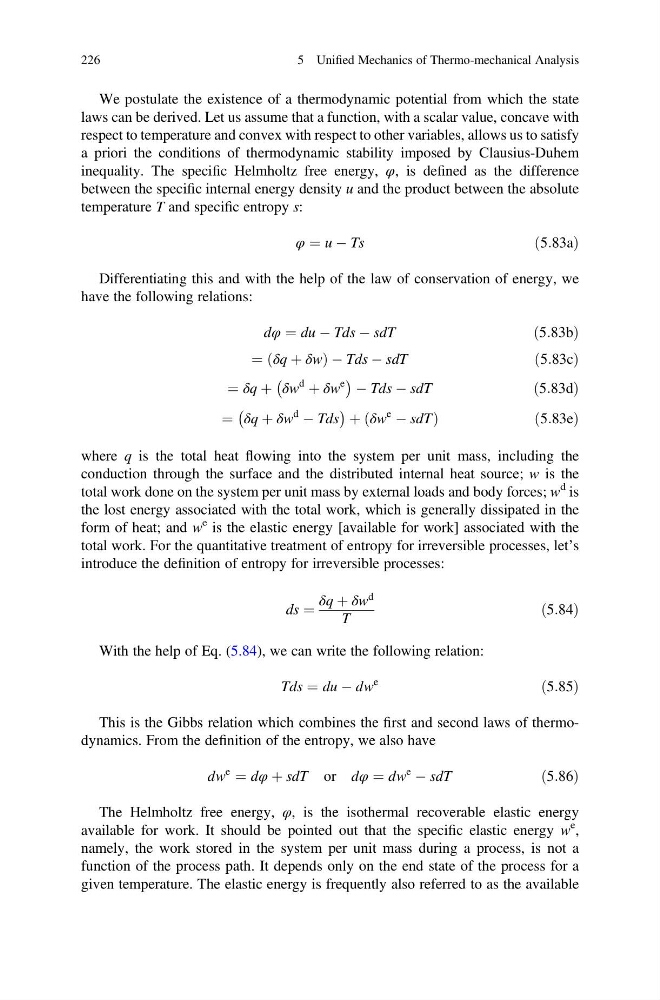
We postulate the existence of a thermodynamic potential from which the state
laws can be derived. Let us assume that a function, with a scalar value, concave with
respect to temperature and convex with respect to other variables, allows us to satisfy
a priori the conditions of thermodynamic stability imposed by Clausius-Duhem
inequality. The specific Helmholtz free energy, φ, is defined as the difference
between the specific internal energy density u and the product between the absolute
temperature T and specific entropy s:
φ ¼ u À Ts
ð5:83aÞ
Differentiating this and with the help of the law of conservation of energy, we
have the following relations:
dφ ¼ du À Tds À sdT
ð5:83bÞ
¼ δq þ δw
ð
ÞÀTds À sdT
ð5:83cÞ
¼ δq þ δw
d
þ δw
e
À
Á À Tds À sdT
ð5:83dÞ
¼ δq þ δw
d
À Tds
À
Á þ δw
e
À sdT
ð
Þ
ð 5:83eÞ
where q is the total heat flowing into the system per unit mass, including the
conduction through the surface and the distributed internal heat source; w is the
total work done on the system per unit mass by external loads and body forces; w
d is
the lost energy associated with the total work, which is generally dissipated in the
form of heat; and w
e is the elastic energy [available for work] associated with the
total work. For the quantitative treatment of entropy for irreversible processes, let’s
introduce the definition of entropy for irreversible processes:
ds ¼
δq þ δw
d
T
ð5:84Þ
With the help of Eq. (5.84), we can write the following relation:
Tds ¼ du À dw
e
ð5:85Þ
This is the Gibbs relation which combines the first and second laws of thermodynamics. From the definition of the entropy, we also have
dw
e
¼ dφ þ sdT or dφ ¼ dw
e
À sdT
ð5:86Þ
The Helmholtz free energy, φ, is the isothermal recoverable elastic energy
available for work. It should be pointed out that the specific elastic energy w
e ,
namely, the work stored in the system per unit mass during a process, is not a
function of the process path. It depends only on the end state of the process for a
given temperature. The elastic energy is frequently also referred to as the available
226
5 Unified Mechanics of Thermo-mechanical Analysis
laws can be derived. Let us assume that a function, with a scalar value, concave with
respect to temperature and convex with respect to other variables, allows us to satisfy
a priori the conditions of thermodynamic stability imposed by Clausius-Duhem
inequality. The specific Helmholtz free energy, φ, is defined as the difference
between the specific internal energy density u and the product between the absolute
temperature T and specific entropy s:
φ ¼ u À Ts
ð5:83aÞ
Differentiating this and with the help of the law of conservation of energy, we
have the following relations:
dφ ¼ du À Tds À sdT
ð5:83bÞ
¼ δq þ δw
ð
ÞÀTds À sdT
ð5:83cÞ
¼ δq þ δw
d
þ δw
e
À
Á À Tds À sdT
ð5:83dÞ
¼ δq þ δw
d
À Tds
À
Á þ δw
e
À sdT
ð
Þ
ð 5:83eÞ
where q is the total heat flowing into the system per unit mass, including the
conduction through the surface and the distributed internal heat source; w is the
total work done on the system per unit mass by external loads and body forces; w
d is
the lost energy associated with the total work, which is generally dissipated in the
form of heat; and w
e is the elastic energy [available for work] associated with the
total work. For the quantitative treatment of entropy for irreversible processes, let’s
introduce the definition of entropy for irreversible processes:
ds ¼
δq þ δw
d
T
ð5:84Þ
With the help of Eq. (5.84), we can write the following relation:
Tds ¼ du À dw
e
ð5:85Þ
This is the Gibbs relation which combines the first and second laws of thermodynamics. From the definition of the entropy, we also have
dw
e
¼ dφ þ sdT or dφ ¼ dw
e
À sdT
ð5:86Þ
The Helmholtz free energy, φ, is the isothermal recoverable elastic energy
available for work. It should be pointed out that the specific elastic energy w
e ,
namely, the work stored in the system per unit mass during a process, is not a
function of the process path. It depends only on the end state of the process for a
given temperature. The elastic energy is frequently also referred to as the available
226
5 Unified Mechanics of Thermo-mechanical Analysis