

process (or equilibrium) and positive for irreversible transformation of the system,
namely (Mazur and De Groot 1962)
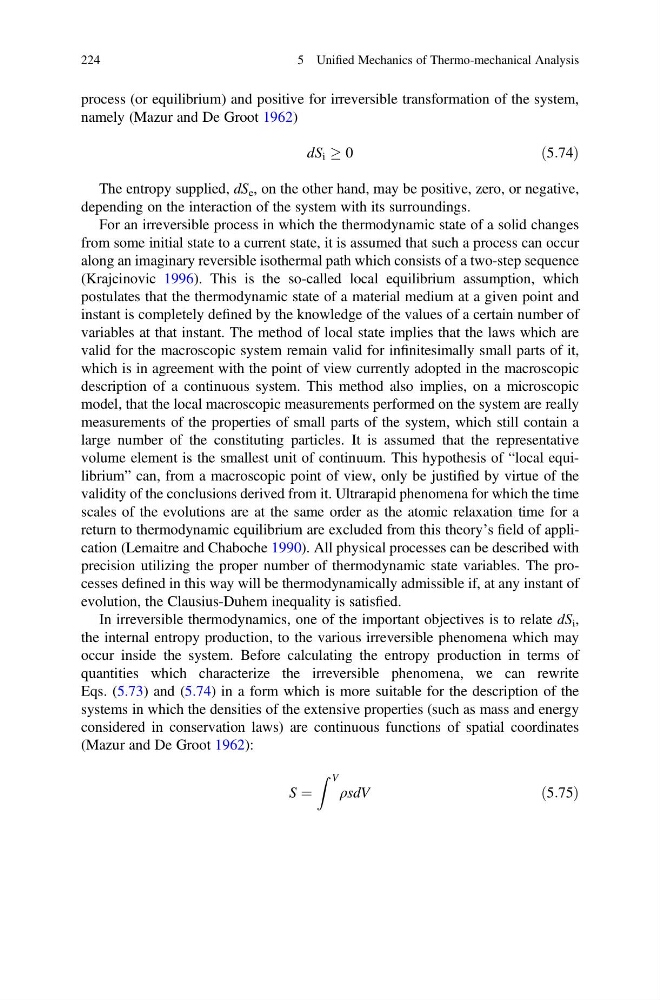
dS i ! 0
ð5:74Þ
The entropy supplied, dS e , on the other hand, may be positive, zero, or negative,
depending on the interaction of the system with its surroundings.
For an irreversible process in which the thermodynamic state of a solid changes
from some initial state to a current state, it is assumed that such a process can occur
along an imaginary reversible isothermal path which consists of a two-step sequence
(Krajcinovic 1996). This is the so-called local equilibrium assumption, which
postulates that the thermodynamic state of a material medium at a given point and
instant is completely defined by the knowledge of the values of a certain number of
variables at that instant. The method of local state implies that the laws which are
valid for the macroscopic system remain valid for infinitesimally small parts of it,
which is in agreement with the point of view currently adopted in the macroscopic
description of a continuous system. This method also implies, on a microscopic
model, that the local macroscopic measurements performed on the system are really
measurements of the properties of small parts of the system, which still contain a
large number of the constituting particles. It is assumed that the representative
volume element is the smallest unit of continuum. This hypothesis of “local equilibrium” can, from a macroscopic point of view, only be justified by virtue of the
validity of the conclusions derived from it. Ultrarapid phenomena for which the time
scales of the evolutions are at the same order as the atomic relaxation time for a
return to thermodynamic equilibrium are excluded from this theory’s field of application (Lemaitre and Chaboche 1990). All physical processes can be described with
precision utilizing the proper number of thermodynamic state variables. The processes defined in this way will be thermodynamically admissible if, at any instant of
evolution, the Clausius-Duhem inequality is satisfied.
In irreversible thermodynamics, one of the important objectives is to relate dS i ,
the internal entropy production, to the various irreversible phenomena which may
occur inside the system. Before calculating the entropy production in terms of
quantities which characterize the irreversible phenomena, we can rewrite
Eqs. (5.73) and (5.74) in a form which is more suitable for the description of the
systems in which the densities of the extensive properties (such as mass and energy
considered in conservation laws) are continuous functions of spatial coordinates
(Mazur and De Groot 1962):
S ¼
Z V
ρsdV
ð5:75Þ
224
5 Unified Mechanics of Thermo-mechanical Analysis
namely (Mazur and De Groot 1962)
dS i ! 0
ð5:74Þ
The entropy supplied, dS e , on the other hand, may be positive, zero, or negative,
depending on the interaction of the system with its surroundings.
For an irreversible process in which the thermodynamic state of a solid changes
from some initial state to a current state, it is assumed that such a process can occur
along an imaginary reversible isothermal path which consists of a two-step sequence
(Krajcinovic 1996). This is the so-called local equilibrium assumption, which
postulates that the thermodynamic state of a material medium at a given point and
instant is completely defined by the knowledge of the values of a certain number of
variables at that instant. The method of local state implies that the laws which are
valid for the macroscopic system remain valid for infinitesimally small parts of it,
which is in agreement with the point of view currently adopted in the macroscopic
description of a continuous system. This method also implies, on a microscopic
model, that the local macroscopic measurements performed on the system are really
measurements of the properties of small parts of the system, which still contain a
large number of the constituting particles. It is assumed that the representative
volume element is the smallest unit of continuum. This hypothesis of “local equilibrium” can, from a macroscopic point of view, only be justified by virtue of the
validity of the conclusions derived from it. Ultrarapid phenomena for which the time
scales of the evolutions are at the same order as the atomic relaxation time for a
return to thermodynamic equilibrium are excluded from this theory’s field of application (Lemaitre and Chaboche 1990). All physical processes can be described with
precision utilizing the proper number of thermodynamic state variables. The processes defined in this way will be thermodynamically admissible if, at any instant of
evolution, the Clausius-Duhem inequality is satisfied.
In irreversible thermodynamics, one of the important objectives is to relate dS i ,
the internal entropy production, to the various irreversible phenomena which may
occur inside the system. Before calculating the entropy production in terms of
quantities which characterize the irreversible phenomena, we can rewrite
Eqs. (5.73) and (5.74) in a form which is more suitable for the description of the
systems in which the densities of the extensive properties (such as mass and energy
considered in conservation laws) are continuous functions of spatial coordinates
(Mazur and De Groot 1962):
S ¼
Z V
ρsdV
ð5:75Þ
224
5 Unified Mechanics of Thermo-mechanical Analysis