

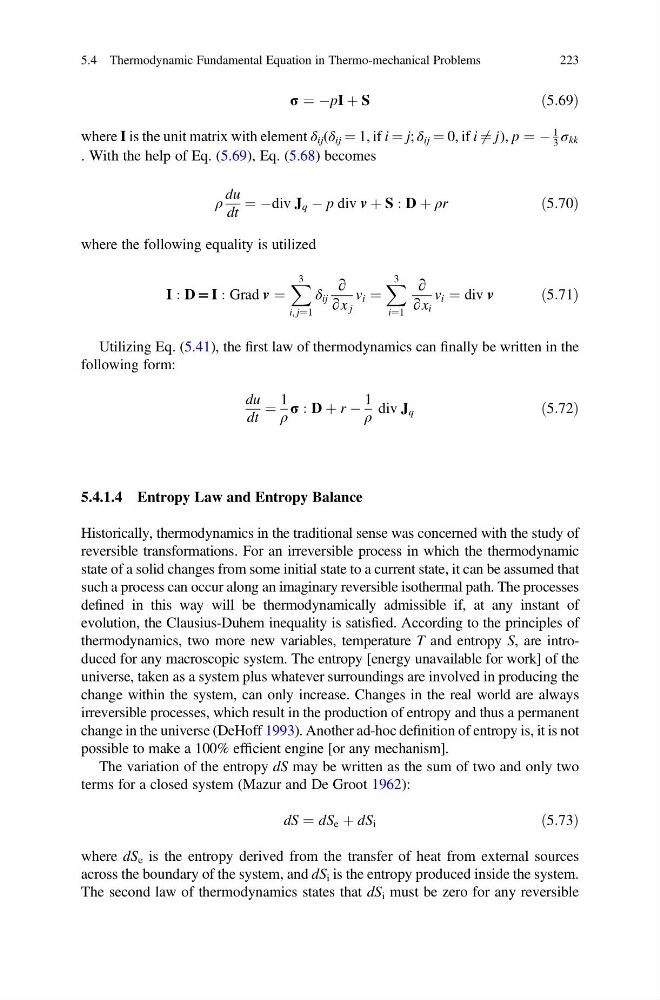
σ ¼ ÀpI þ S
ð5:69Þ
where I is the unit matrix with element δ ij (δ ij ¼ 1, if i ¼ j; δ ij ¼ 0, if i 6 ¼ j), p ¼ À
1
3 σ kk
. With the help of Eq. (5.69), Eq. (5.68) becomes
ρ
du
dt
¼ Àdiv J q À p div v þ S : D þ ρr
ð5:70Þ
where the following equality is utilized
I : D = I : Grad v ¼
X 3
i, j¼1
δ ij
∂
∂x j
v i ¼
X 3
i¼1
∂
∂x i
v i ¼ div v
ð5:71Þ
Utilizing Eq. (5.41), the first law of thermodynamics can finally be written in the
following form:
du
dt
¼
1
ρ
σ : D þ r À
1
ρ
div J q
ð5:72Þ
5.4.1.4 Entropy Law and Entropy Balance
Historically, thermodynamics in the traditional sense was concerned with the study of
reversible transformations. For an irreversible process in which the thermodynamic
state of a solid changes from some initial state to a current state, it can be assumed that
such a process can occur along an imaginary reversible isothermal path. The processes
defined in this way will be thermodynamically admissible if, at any instant of
evolution, the Clausius-Duhem inequality is satisfied. According to the principles of
thermodynamics, two more new variables, temperature T and entropy S, are introduced for any macroscopic system. The entropy [energy unavailable for work] of the
universe, taken as a system plus whatever surroundings are involved in producing the
change within the system, can only increase. Changes in the real world are always
irreversible processes, which result in the production of entropy and thus a permanent
change in the universe (DeHoff 1993). Another ad-hoc definition of entropy is, it is not
possible to make a 100% efficient engine [or any mechanism].
The variation of the entropy dS may be written as the sum of two and only two
terms for a closed system (Mazur and De Groot 1962):
dS ¼ dS e þ dS i
ð5:73Þ
where dS e is the entropy derived from the transfer of heat from external sources
across the boundary of the system, and dS i is the entropy produced inside the system.
The second law of thermodynamics states that dS i must be zero for any reversible
5.4 Thermodynamic Fundamental Equation in Thermo-mechanical Problems
223
ð5:69Þ
where I is the unit matrix with element δ ij (δ ij ¼ 1, if i ¼ j; δ ij ¼ 0, if i 6 ¼ j), p ¼ À
1
3 σ kk
. With the help of Eq. (5.69), Eq. (5.68) becomes
ρ
du
dt
¼ Àdiv J q À p div v þ S : D þ ρr
ð5:70Þ
where the following equality is utilized
I : D = I : Grad v ¼
X 3
i, j¼1
δ ij
∂
∂x j
v i ¼
X 3
i¼1
∂
∂x i
v i ¼ div v
ð5:71Þ
Utilizing Eq. (5.41), the first law of thermodynamics can finally be written in the
following form:
du
dt
¼
1
ρ
σ : D þ r À
1
ρ
div J q
ð5:72Þ
5.4.1.4 Entropy Law and Entropy Balance
Historically, thermodynamics in the traditional sense was concerned with the study of
reversible transformations. For an irreversible process in which the thermodynamic
state of a solid changes from some initial state to a current state, it can be assumed that
such a process can occur along an imaginary reversible isothermal path. The processes
defined in this way will be thermodynamically admissible if, at any instant of
evolution, the Clausius-Duhem inequality is satisfied. According to the principles of
thermodynamics, two more new variables, temperature T and entropy S, are introduced for any macroscopic system. The entropy [energy unavailable for work] of the
universe, taken as a system plus whatever surroundings are involved in producing the
change within the system, can only increase. Changes in the real world are always
irreversible processes, which result in the production of entropy and thus a permanent
change in the universe (DeHoff 1993). Another ad-hoc definition of entropy is, it is not
possible to make a 100% efficient engine [or any mechanism].
The variation of the entropy dS may be written as the sum of two and only two
terms for a closed system (Mazur and De Groot 1962):
dS ¼ dS e þ dS i
ð5:73Þ
where dS e is the entropy derived from the transfer of heat from external sources
across the boundary of the system, and dS i is the entropy produced inside the system.
The second law of thermodynamics states that dS i must be zero for any reversible
5.4 Thermodynamic Fundamental Equation in Thermo-mechanical Problems
223