

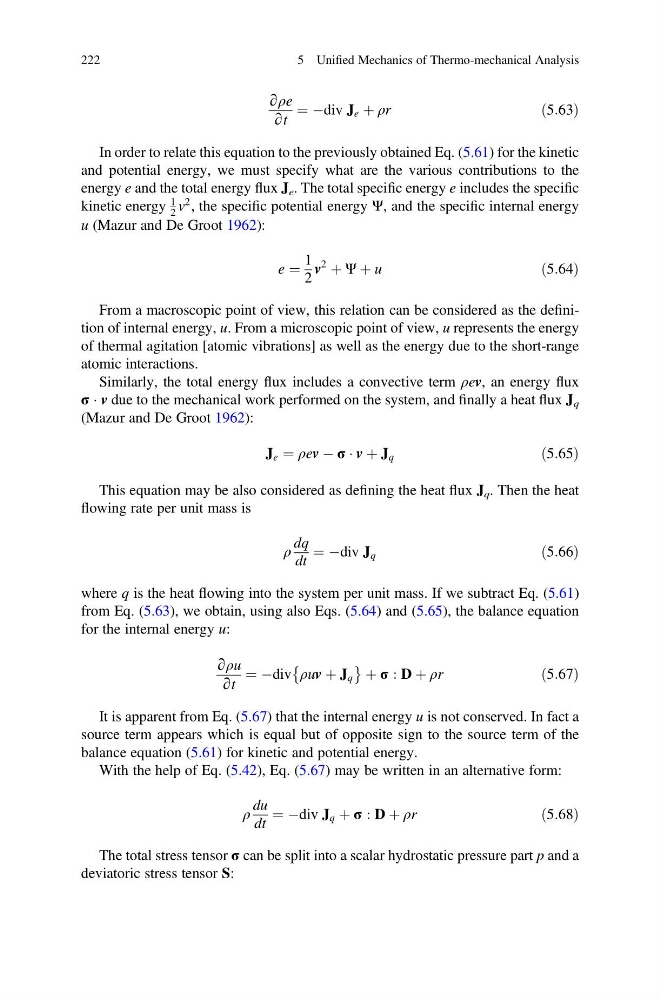
∂ρe
∂t
¼ Àdiv J e þ ρr
ð5:63Þ
In order to relate this equation to the previously obtained Eq. (5.61) for the kinetic
and potential energy, we must specify what are the various contributions to the
energy e and the total energy flux J e . The total specific energy e includes the specific
kinetic energy
1
2 v
2 , the specific potential energy Ψ, and the specific internal energy
u (Mazur and De Groot 1962):
e ¼
1
2
v
2
þ Ψ þ u
ð5:64Þ
From a macroscopic point of view, this relation can be considered as the definition of internal energy, u. From a microscopic point of view, u represents the energy
of thermal agitation [atomic vibrations] as well as the energy due to the short-range
atomic interactions.
Similarly, the total energy flux includes a convective term ρev, an energy flux
σ Á v due to the mechanical work performed on the system, and finally a heat flux J q
(Mazur and De Groot 1962):
J e ¼ ρev À σ Á v þ J q
ð5:65Þ
This equation may be also considered as defining the heat flux J q . Then the heat
flowing rate per unit mass is
ρ
dq
dt
¼ Àdiv J q
ð5:66Þ
where q is the heat flowing into the system per unit mass. If we subtract Eq. (5.61)
from Eq. (5.63), we obtain, using also Eqs. (5.64) and (5.65), the balance equation
for the internal energy u:
∂ρu
∂t
¼ Àdiv ρuv þ J q
È
É þ σ : D þ ρr
ð5:67Þ
It is apparent from Eq. (5.67) that the internal energy u is not conserved. In fact a
source term appears which is equal but of opposite sign to the source term of the
balance equation (5.61) for kinetic and potential energy.
With the help of Eq. (5.42), Eq. (5.67) may be written in an alternative form:
ρ
du
dt
¼ Àdiv J q þ σ : D þ ρr
ð5:68Þ
The total stress tensor σ can be split into a scalar hydrostatic pressure part p and a
deviatoric stress tensor S:
222
5 Unified Mechanics of Thermo-mechanical Analysis
∂t
¼ Àdiv J e þ ρr
ð5:63Þ
In order to relate this equation to the previously obtained Eq. (5.61) for the kinetic
and potential energy, we must specify what are the various contributions to the
energy e and the total energy flux J e . The total specific energy e includes the specific
kinetic energy
1
2 v
2 , the specific potential energy Ψ, and the specific internal energy
u (Mazur and De Groot 1962):
e ¼
1
2
v
2
þ Ψ þ u
ð5:64Þ
From a macroscopic point of view, this relation can be considered as the definition of internal energy, u. From a microscopic point of view, u represents the energy
of thermal agitation [atomic vibrations] as well as the energy due to the short-range
atomic interactions.
Similarly, the total energy flux includes a convective term ρev, an energy flux
σ Á v due to the mechanical work performed on the system, and finally a heat flux J q
(Mazur and De Groot 1962):
J e ¼ ρev À σ Á v þ J q
ð5:65Þ
This equation may be also considered as defining the heat flux J q . Then the heat
flowing rate per unit mass is
ρ
dq
dt
¼ Àdiv J q
ð5:66Þ
where q is the heat flowing into the system per unit mass. If we subtract Eq. (5.61)
from Eq. (5.63), we obtain, using also Eqs. (5.64) and (5.65), the balance equation
for the internal energy u:
∂ρu
∂t
¼ Àdiv ρuv þ J q
È
É þ σ : D þ ρr
ð5:67Þ
It is apparent from Eq. (5.67) that the internal energy u is not conserved. In fact a
source term appears which is equal but of opposite sign to the source term of the
balance equation (5.61) for kinetic and potential energy.
With the help of Eq. (5.42), Eq. (5.67) may be written in an alternative form:
ρ
du
dt
¼ Àdiv J q þ σ : D þ ρr
ð5:68Þ
The total stress tensor σ can be split into a scalar hydrostatic pressure part p and a
deviatoric stress tensor S:
222
5 Unified Mechanics of Thermo-mechanical Analysis