

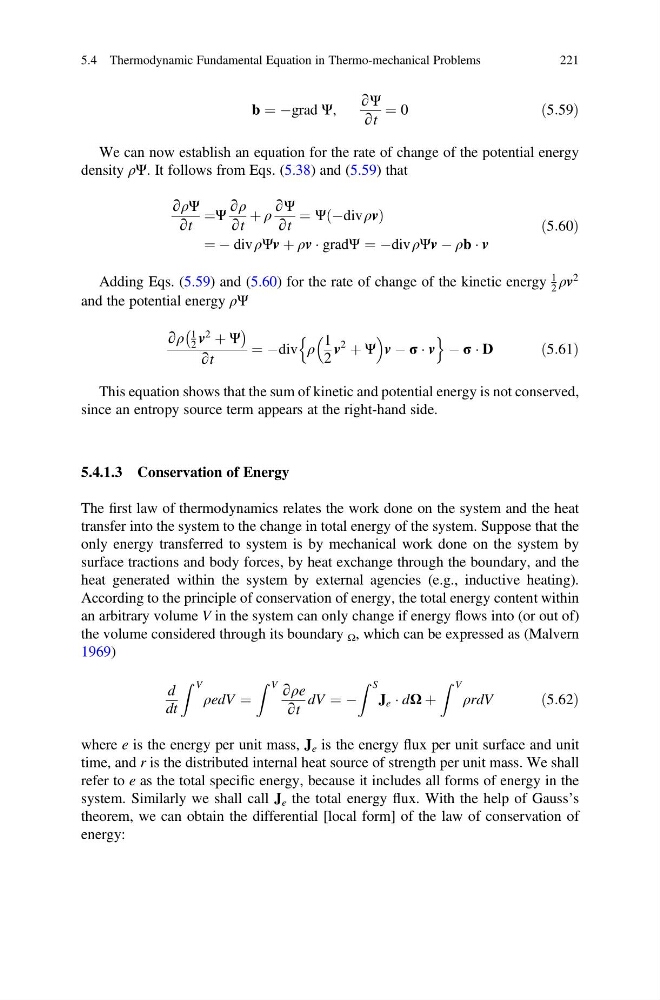
b ¼ Àgrad Ψ,
∂Ψ
∂t
¼ 0
ð5:59Þ
We can now establish an equation for the rate of change of the potential energy
density ρΨ. It follows from Eqs. (5.38) and (5.59) that
∂ρΨ
∂t
¼Ψ
∂ρ
∂t
þ ρ
∂Ψ
∂t
¼ Ψ Àdiv ρv
ð
Þ
¼ À div ρΨv þ ρv Á gradΨ ¼ Àdiv ρΨv À ρb Á v
ð5:60Þ
Adding Eqs. (5.59) and (5.60) for the rate of change of the kinetic energy
1
2 ρv
2
and the potential energy ρΨ
∂ρ
1
2 v
2
þ Ψ
À
Á
∂t
¼ Àdiv ρ
1
2
v
2
þ Ψ
v À σ Á v
n
o
À σ Á D
ð5:61Þ
This equation shows that the sum of kinetic and potential energy is not conserved,
since an entropy source term appears at the right-hand side.
5.4.1.3 Conservation of Energy
The first law of thermodynamics relates the work done on the system and the heat
transfer into the system to the change in total energy of the system. Suppose that the
only energy transferred to system is by mechanical work done on the system by
surface tractions and body forces, by heat exchange through the boundary, and the
heat generated within the system by external agencies (e.g., inductive heating).
According to the principle of conservation of energy, the total energy content within
an arbitrary volume V in the system can only change if energy flows into (or out of)
the volume considered through its boundary Ω , which can be expressed as (Malvern
1969)
d
dt
Z V
ρedV ¼
Z V ∂ρe
∂t
dV ¼ À
Z S
J e Á dΩ þ
Z V
ρrdV
ð5:62Þ
where e is the energy per unit mass, J e is the energy flux per unit surface and unit
time, and r is the distributed internal heat source of strength per unit mass. We shall
refer to e as the total specific energy, because it includes all forms of energy in the
system. Similarly we shall call J e the total energy flux. With the help of Gauss’s
theorem, we can obtain the differential [local form] of the law of conservation of
energy:
5.4 Thermodynamic Fundamental Equation in Thermo-mechanical Problems
221
∂Ψ
∂t
¼ 0
ð5:59Þ
We can now establish an equation for the rate of change of the potential energy
density ρΨ. It follows from Eqs. (5.38) and (5.59) that
∂ρΨ
∂t
¼Ψ
∂ρ
∂t
þ ρ
∂Ψ
∂t
¼ Ψ Àdiv ρv
ð
Þ
¼ À div ρΨv þ ρv Á gradΨ ¼ Àdiv ρΨv À ρb Á v
ð5:60Þ
Adding Eqs. (5.59) and (5.60) for the rate of change of the kinetic energy
1
2 ρv
2
and the potential energy ρΨ
∂ρ
1
2 v
2
þ Ψ
À
Á
∂t
¼ Àdiv ρ
1
2
v
2
þ Ψ
v À σ Á v
n
o
À σ Á D
ð5:61Þ
This equation shows that the sum of kinetic and potential energy is not conserved,
since an entropy source term appears at the right-hand side.
5.4.1.3 Conservation of Energy
The first law of thermodynamics relates the work done on the system and the heat
transfer into the system to the change in total energy of the system. Suppose that the
only energy transferred to system is by mechanical work done on the system by
surface tractions and body forces, by heat exchange through the boundary, and the
heat generated within the system by external agencies (e.g., inductive heating).
According to the principle of conservation of energy, the total energy content within
an arbitrary volume V in the system can only change if energy flows into (or out of)
the volume considered through its boundary Ω , which can be expressed as (Malvern
1969)
d
dt
Z V
ρedV ¼
Z V ∂ρe
∂t
dV ¼ À
Z S
J e Á dΩ þ
Z V
ρrdV
ð5:62Þ
where e is the energy per unit mass, J e is the energy flux per unit surface and unit
time, and r is the distributed internal heat source of strength per unit mass. We shall
refer to e as the total specific energy, because it includes all forms of energy in the
system. Similarly we shall call J e the total energy flux. With the help of Gauss’s
theorem, we can obtain the differential [local form] of the law of conservation of
energy:
5.4 Thermodynamic Fundamental Equation in Thermo-mechanical Problems
221